
Rugby union betting odds 2026: how the price is built, what it costs, and where the season's matches sit
 Available in US
A rugby union pitch on a fresh Saturday morning has fifteen players a side, two forty-minute halves, and a clock that never stops for stoppages. The ball is heavier and the scoring steeper than its rugby league cousin, which is why the betting markets built around it look a little different from the football ones most punters know. The Rugby World Cup rolls around every four years, the Six Nations every winter, the southern-hemisphere leagues every summer, and the Premiership, Top 14 and United Rugby Championship run through the cooler months on this side of the equator. World Rugby has governed the sport since 1886, and the whole international fixture list still runs through that body even when a host union runs the tournament.

The odds a bookmaker quotes on those matches are not pulled from a clean ledger. They are built around a margin — the slice of every pound wagered that the book keeps, whatever the result — and the size of that slice decides how much a winning bet is really worth. The page that follows is about that margin, the markets it sits inside, and the GB-licensed operators that price the 2026 season. A reader who understands the margin reads the price the way an analyst reads a balance sheet. A reader who does not keeps paying for it.
Data current as of 27 October 2026; licence status and operator terms verified against the Gambling Commission’s public register and each operator’s own published terms.
Where rugby union is actually being played this season
The international calendar is the spine of rugby union betting. Southern-hemisphere sides play through July and into the Rugby Championship, the Six Nations runs from February to March, and the autumn internationals fill November. Between those windows sit the domestic leagues: the English Premiership, France’s Top 14, the United Rugby Championship that spans Ireland, Italy, Scotland, South Africa and Wales, and Super Rugby across the Pacific. Each of those competitions carries its own betting programme, with markets the bookmaker tailors to the rhythm of the sport.
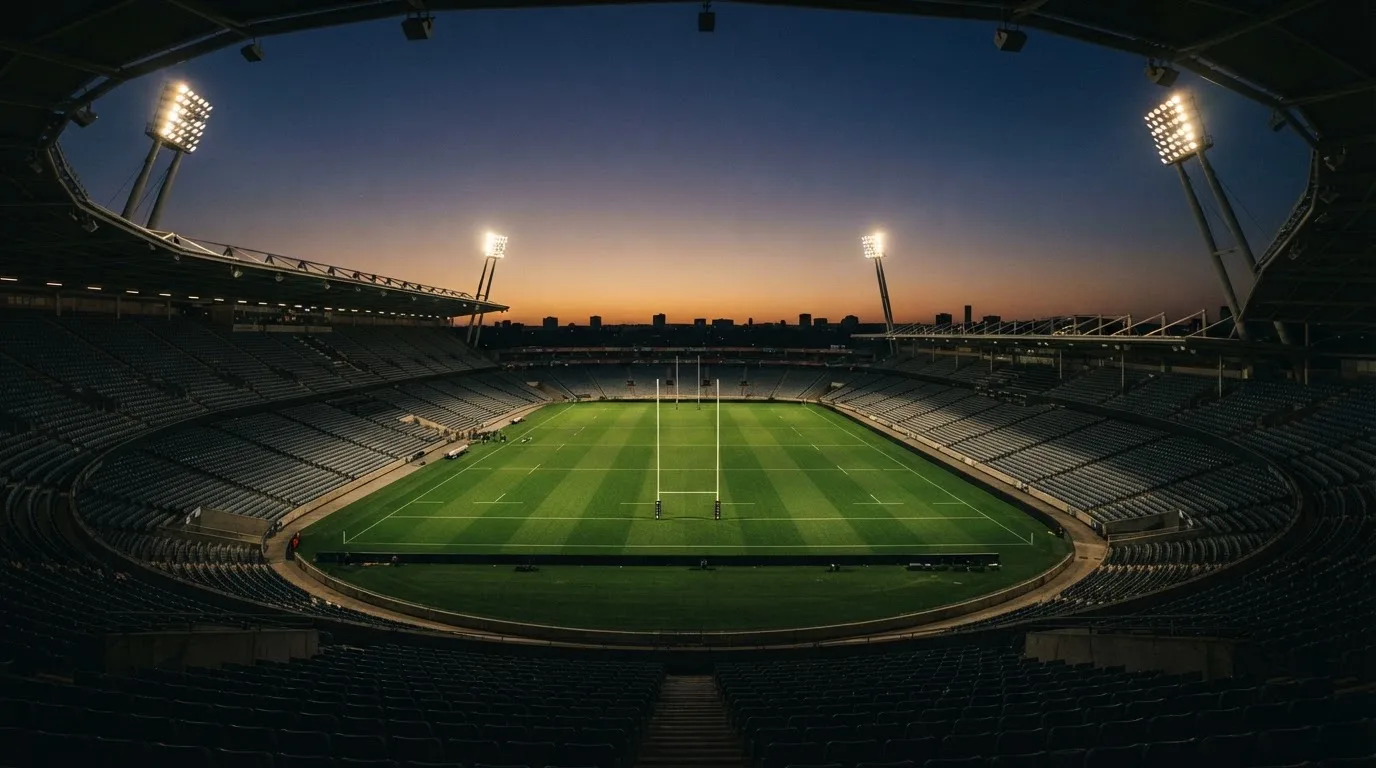
The Rugby World Cup sits above all of it. New Zealand won the inaugural tournament in 1987, and South Africa are the defending champions after beating New Zealand in the 2023 final. The 2027 Rugby World Cup is hosted by Australia from 1 October to 13 November 2027, with 24 teams in six pools of four and 52 matches in the schedule. Outright markets, group winners, top try-scorer, player of the tournament, and head-to-head prices all open long before the first whistle. Outright bets settle on the team that lifts the trophy; group-winner bets settle when the pool is decided; top try-scorer bets settle on the player with the most tries in the tournament. Outright markets are sensitive to squad announcements and injuries, and prices move sharply when a front-line forward is ruled out three months before the opening fixture.
Domestic rugby is shorter and tighter. The Premiership runs from September to June, with the play-offs and a final at Twickenham. The Top 14 has relegation play-offs, the URC a full round-robin across five countries, and Super Rugby a conference format across the Pacific. Each league carries the standard match markets: match result, handicap, total points, first try-scorer, and the in-play equivalents once the whistle goes.
How the game is scored
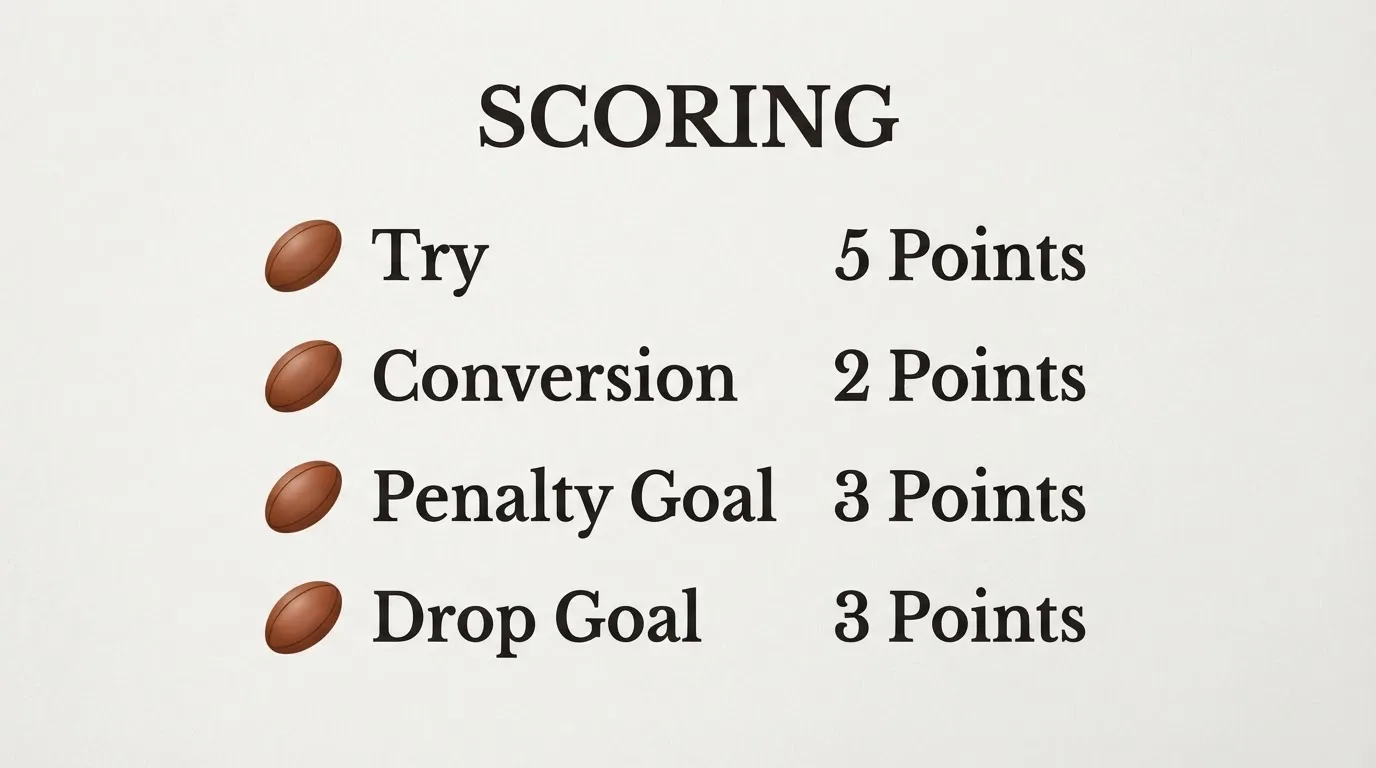
A try is worth 5 points, the conversion that follows is 2, a penalty kick is 3, and a drop goal in open play is 3. That arithmetic shapes the betting menu. A handicap of -7.5 on a strong favourite assumes the favourite wins by eight or more, which in rugby terms can mean a converted try and a penalty. Total points markets sit around the mid-40s in international rugby and the low-40s in tight domestic fixtures. A drop goal from anywhere on the pitch is the equaliser of last resort, and the books price the “anytime score” markets accordingly.
The game clock runs through stoppages, so a match that ticks past 80 minutes is the rule rather than the exception. That has consequences for live betting. A book that settles a half-time market at exactly 40 minutes will look strict next to one that settles on the referee’s whistle, and the in-play price moves faster the closer the game gets to its natural end. A punter who bets in-play on rugby union is reading a clock that is more honest than the one the stadium shows.
The ten bookmakers pricing rugby union this season
The set below is built from brands that hold a Gambling Commission remote licence for Great Britain and that publish a rugby union programme in time for the 2026 season. The order here is the order of the operator set, not a ranking; a book that is right for outright value is wrong for a casual weekend punter, and a book that runs a deep in-play product is not the place to look for a small-stake acca. Each review closes on what the brand is actually for, because the question every reader arrives with is the same one a single list cannot answer.
| Brand | Gambling Commission remote licence | What the operator’s own terms state on the key’s subject |
|---|---|---|
| Tote | 054779-R-331321-008 (TDCO Limited) | Pool-based product on UK and Irish racing; fixed-odds sportsbook under the same licence. |
| Hollywoodbets | 053028-R-330019-013 (Hollywoodbets International UK Limited) | Welcome offer pays a losing accumulator stake back as a free bet of up to £30. |
| Sporting Index | 027343-R-308898-011 (Sporting Index Limited) | Customers can switch between fixed odds and spread betting on the same account. |
| QuinnBet | 061011-R-335683-004 (QuinnBet (Gibraltar) Limited) | Best Odds Guaranteed on UK and Irish racing, daily from 10:00. |
| Betboro | 044181-R-324363-007 (Webmedia Development N.V.) | 100% matched free bet of up to £25 on the first qualifying wager. |
| BetGoodwin | 002927-R-327985-008 (Goodwin Racing Limited) | Welcome offer splits into three small free bets across single, acca and Sub-Cover products. |
| Fitzwilliam Sports | 048760-R-335434-009 (SBKI Limited) | Dublin-based, capped-membership book; responsible-gambling links prominent on the home page. |
| Betfair | 039439-R-319330-013 (PPB Counterparty Services Limited) | Exchange and sportsbook on one account; live streaming of racing and football in the app. |
| Bet Ahoy | 100094-R-341742-003 (Bet Ahoy Ltd) | Welcome offer pays £10 in free bets, split across a single and an acca. |
| Kalooki Sportsbook | 057730-R-333396-005 (Kalooki Sportsbook Limited) | GAMSTOP member, identity verification before first deposit. |
Tote
Tote sits at the meeting point of pool betting and the traditional sportsbook, and the licence on the Commission’s register is held by TDCO Limited. The brand’s roots in British racing mean a customer looking for rugby union is on the fixed-odds sportsbook product rather than the pool, and the menu is honest rather than deep: match result, handicap, total points, and a handful of player markets on the bigger internationals. The wagering experience is straightforward, the price is competitive on the headline markets, and the in-play product is functional without being the reason a punter comes to the brand. For a Saturday-afternoon bettor on a domestic league, Tote is a clean second book rather than a primary account.
Hollywoodbets
Hollywoodbets’ UK site carries the kind of welcome that is structured to fit a small-stake punter. New players who deposit £10 or more by card get their stake back as a free bet of up to £30 on their first qualifying losing accumulator, with the acca needing three or more legs at combined odds of 4/1 or higher, settled within seven days, and one free bet per customer. That shape — a refund on a losing acca, paid as a free bet whose stake is not returned with a win — is the standard small-stake offer across the UK market. The licence is held by Hollywoodbets International UK Limited, and the rest of the sportsbook is what a South African bookmaker looks like in Britain: a strong South African racing product, a competent Premiership and Six Nations menu, and a lean in-play window. Hollywoodbets is a fit for a small-stake punter who values a free-bet safety net over complex in-play tools.
Sporting Index
Sporting Index is a book where the same account carries fixed odds and spread betting, and the licence on the register is held by Sporting Index Limited. The sportsbook is competent on rugby union but the defining product is the spread book: a market priced in points, with the punter selling high or buying low and the result settled on the actual score. In-play betting, a Bet Builder for football, automatic cash-out, and Multi-Markets sit on the same account, and the brand sits inside the wider spread-betting inheritance that means the FCA is involved where the product is financial. For a punter who already understands the spread book and wants the rugby union version, Sporting Index is the natural home; for a punter who has never traded a spread, the learning curve is steep, and the loss on a spread can exceed the original deposit.
QuinnBet
QuinnBet’s headline offer is its Best Odds Guaranteed concession on UK and Irish racing. The published terms state it runs from 10:00am daily on singles, multiples and system bets, with a maximum benefit of £150 per customer per race. That cap matters: on a long-priced outsider the BOG uplift is uncapped in principle, but a customer who has already taken a price above the cap does not see the extra. The licence is held by QuinnBet (Gibraltar) Limited, and the sportsbook product is broad across football, racing and the team sports. On rugby union the menu is full: match result, handicap, total points, and a deeper player-product on the bigger internationals. QuinnBet suits a racing-led account that wants a BOG that pays on system bets as well as singles, with rugby union as a Saturday-afternoon side bet.
Betboro
Betboro’s sports welcome offer is a 100% matched free bet of up to £25 on the first qualifying wager, requiring a debit-card deposit of at least £10 and a first bet of £5 to £25 with at least three selections each at 3/5 (1.60) or higher. The minimum price of 1.60 on every leg is the constraint that matters: it rules out the heavy favourites that anchor small-stake accas and pushes the punter toward at least one selection that carries real price. The licence is held by Webmedia Development N.V., the sportsbook carries a strong football and racing menu, and the rugby union offering is competent without being deep. Betboro works well for a first-time customer who prefers a simple matched free bet on smaller accas over complex market variety.
BetGoodwin
BetGoodwin’s welcome offer is “Bet £10 & Get £15 in Free Bets”, made up of a £5 sports bet, a £5 acca, and a £5 Sub-Cover bet. Splitting the free bet into three smaller tokens rather than a single £15 one means each token carries a smaller maximum return and a narrower set of markets. The licence is held by Goodwin Racing Limited, and the brand sits inside the racing-led family of UK independents: a strong racing product, a competent Premiership and Six Nations menu, and a relatively light in-play product. The Sub-Cover product is a same-game multi on football and is unlikely to feature in a rugby union bettor’s account. BetGoodwin suits a racing-focused punter who uses the sportsbook for small singles, though the three-token welcome requires a clear plan to be useful.
Fitzwilliam Sports
Fitzwilliam Sports describes itself as a Dublin bookmaker with capped membership, and the welcome is a “High Stakes Welcome” subject to compliance criteria. The licence on the register is held by SBKI Limited, and the home page carries instant deposits, fast withdrawals, timeouts and deposit limits, with prominent links to GambleAware, GamStop and Gamblers Anonymous. The capped-membership model means the book is looking for higher-stake punters who want a personal relationship with a trading desk, not for a casual account that signs up and forgets. For a rugby union bettor whose weekend stake is £20 a match, Fitzwilliam is the wrong fit; for a bettor whose weekend stake is £500 a side, it may be the right one, and the home page’s responsible-gambling framing is the kind that comes from a book that knows its customer base.
Betfair
Betfair runs an exchange and a sportsbook under the same brand, with the licence on the Commission’s register held by PPB Counterparty Services Limited. The exchange is a betting intermediary — a separate licence category on the Commission’s register — and it lets a punter back a selection at one price or lay it at another, with the bookmaker taking a commission on net winnings rather than building a margin into the price. The sportsbook product carries in-play betting, Bet Builder, free live streaming of events such as UK and Irish racing and football in the app, and a 90-minute payout market on football. On rugby union the exchange tends to carry deeper liquidity than the sportsbook in the run-up to kick-off on internationals, and the in-play product is functional. Betfair stands out for the punter looking to combine exchange-based laying with sportsbook depth.
Bet Ahoy
Bet Ahoy’s welcome offer is “Bet £10 & Get £10 in Free Bets”, made up of a £5 sports bet and a £5 acca. The split is straightforward: a small free bet on a single and a small free bet on an accumulator, with the same minimum odds and settlement window that the rest of the market runs on. The licence is held by Bet Ahoy Ltd, and the brand sits in the newer-wave of UK-licensed independents: a competent sportsbook, a reasonable racing product, a thinner in-play product, and a clean mobile app. The £10 free bet is a modest welcome and the value lands on the punter who has a clear plan for both pieces. Bet Ahoy offers a straightforward experience for small-stake singles, though the in-play menu is lighter than what the major operators provide.
Kalooki Sportsbook
Kalooki Sportsbook is operated by Kalooki Sports Book Ltd (company number 12938274), licensed by the Gambling Commission under account number 57730, and is a GAMSTOP member. The published information on the home page covers identity verification before the first deposit, a standard sportsbook menu, and a responsible-gambling framework that includes the usual self-exclusion and limit options. The brand is one of the smaller independents on the register, and the rugby union programme is a competent but not deep offering. Kalooki is the right fit for a punter who has used smaller UK books before, wants a clean interface and a standard UK sportsbook product, and is happy to forgo the deeper markets the bigger names carry.
How odds work, and what the margin takes
A bookmaker’s odds are not the true probability of each outcome turned into a price. They are the true probability with a margin added — the overround — so that whatever the result, the book pays out less than it takes in. The size of that margin is the only honest number on a betting site, and the only one a serious punter learns to read.
For a simple two-way market, imagine decimal odds of 1.90 on either side. The implied probability of each outcome is 1 ÷ 1.90, which is just over 52.6%. Add the two together and the total is 105.3%. That 5.3% above 100% is the margin: the slice of every pound wagered on this market that the book keeps on average across the long run. A market at 1.85 / 1.85 would show a margin of about 8.1%, and a tight market at 1.95 / 1.95 would show a margin of about 2.6%. The bigger the margin, the worse the price for the punter, however generous the headline looks.
That same arithmetic on a three-way market — a rugby union match result with a draw on the right price — gives a margin that runs higher. A 1.40 / 22.0 / 3.40 line on a heavy favourite, a draw, and an outsider is already at a margin above 7%, because three outcomes means the book has to price the draw honestly and the favourite the book is willing to leave exposed. The bigger the price on the draw, the more margin the book can build into the favourite and the outsider. Rugby union’s three-way match result is therefore a tougher market to beat than its two-way handicap equivalent, and the punter who backs the favourite in the match-result market pays for the privilege of not having to think about the handicap line.
The margin varies by market. Outright tournament prices run at higher margins than match markets, because the book has more time for a position to go wrong and prices accordingly. Player markets — first try-scorer, anytime try-scorer — run at the highest margins, because the book has to price 30+ selections on a single match. The lesson is structural: a punter who bets match result, handicap and total points is paying a lower margin than a punter who bets player props, and the difference compounds over a season.
For a one-off illustration, take a two-way market at decimal odds 1.90 / 1.90, presented as fractional 9/10 on either side. The implied probability on each side is 1 ÷ 1.90, around 52.6%, so the bookmaker’s total implied probability is 105.3% and the margin sits at roughly 5.3%. A punter backing either side at those prices is, on average across a long run, paying about 5.3 pence of every pound wagered to the bookmaker, and pocketing 94.7 pence of every pound as the gross return on the winners. The exact margin moves with the price, the market and the event: the same 1.90 / 1.90 on a Six Nations match might sit at 5.3% on a Monday and 4.8% on a Friday as the book trims its position, and a 1.85 / 1.85 line on a domestic fixture could carry 8% because the book has priced for the smaller liquidity. Treat the 5.3% as a worked example rather than a number that travels.
The legal frame around a GB-licensed bookmaker
The Gambling Commission licenses the entire commercial market in Great Britain under the Gambling Act 2005, which covers England, Scotland and Wales. Northern Ireland is outside the Act and runs its own older law, so a GB licence is exactly that and nothing more. Since the Gambling (Licensing and Advertising) Act 2014, an operator whose remote facilities are used in Great Britain needs a Commission licence wherever it is based, and a Curaçao, Maltese or Gibraltar licence is not a substitute. A book that serves British customers without one is operating illegally, and the customer is the one who finds out after the fact.
A book that does hold the licence accepts the Licence Conditions and Codes of Practice as the cost of doing business. The customer-facing rules that matter most: minimum age 18, name and date of birth verified before a first deposit (since 7 May 2019), credit cards banned for gambling in Great Britain since 14 April 2020 (the ban covers e-wallet top-ups funded by a credit card), and GAMSTOP coverage mandatory for online operators since 31 March 2020. The financial vulnerability check that came in from 30 August 2024 is a public-record check — bankruptcy, county court judgments — not an income check, and it triggers at deposits minus withdrawals above £150 in a rolling 30 days. Above that level the operator can ask where the money is coming from, and the answer is part of the licence condition. The 10x wagering cap on bonuses and the ban on mixed-product promotions have applied since 19 January 2026.
A GB licence is not a guarantee. The player pays no tax on winnings in Great Britain, but the operator pays General Betting Duty at 15% of gross profit (rising to 25% on remote betting from 1 April 2027, with pool and on-course rates staying at 15%). The Commission’s levy is a separate charge, and the operator is responsible for the marketing its affiliates run. The Commission has DNS-blocking powers in train — never write that ISP blocking is in operation as a fact, because it changes month to month — and the enforcement net is disruption, not block-listing. None of that means a GB-licensed book is risk-free; it means a GB-licensed book is regulated, and a book that is not licensed is not.
To check a licence, the public register on the Commission’s site lets a punter search by business name, trading name, domain or account number. The list above carries the licence number and the licence holder for each operator. A brand that does not appear on the register is not licensed for Great Britain, whatever its terms page says, and a brand that appears under a different trading name from the one on the punter’s account is worth a closer look before the first deposit.
Offshore and the cost of skipping the licence
A book that takes British customers without a GB licence is not a faster, sharper version of a GB-licensed book. It is a book that has decided the cost of the licence is more than the cost of enforcement, and the punter is the one who absorbs the difference. No GAMSTOP coverage, no approved dispute-resolution service, no Commission complaints route, no British consumer protection if funds are withheld. The 10x bonus cap does not apply, the financial vulnerability check does not apply, and the source-of-funds questions do not apply. The price can look sharper, the offer can look bigger, and the book is under no obligation to pay out. Honest framing: a licensed book comes with checks, limits, GAMSTOP and a bonus cap; an unlicensed book comes with none of those and a real risk of being unable to get money out. Neither is “the safe choice” by default.
Responsible gambling in Great Britain
The framework around safer gambling in Britain is statutory, not voluntary, and it sits inside the licence conditions. GAMSTOP is the national multi-operator online self-exclusion scheme, and a GB-licensed online operator is required to be a member. Self-exclusion periods run six months, one year, five years, or five years with auto-renewal, and after the minimum period the exclusion stays in place for a further seven years unless the customer asks GAMSTOP to remove it. GAMSTOP covers online sites and apps; the betting-shop self-exclusion scheme is separate.
Deposit limits are a licence condition under the Remote Technical Standards. The first phase of changes has applied since 31 October 2025 and a second phase has been postponed to 30 September 2026; whether the second phase is in force on a given day is not something a punter can take for granted, and the page that follows describes the framework as it is, not as it might be. There is no state-set deposit or loss ceiling. Limits are the customer’s choice, and a punter who wants a weekly ceiling of £50 sets it in the responsible-gambling section of any GB-licensed book.
Help is independent of the operator. GamCare runs the National Gambling Helpline; GambleAware funds treatment and research; the NHS runs gambling clinics; Gamblers Anonymous runs peer-support meetings. A punter who feels the betting has stopped being a choice can use any of those routes, and the help is confidential and free.
Bonuses and free bets in rugby union
The standard welcome offer on a GB-licensed book is a free bet paid on a losing first wager, or a matched free bet on the first deposit. The shape of the offer matters more than the headline number, because the headline is what the book pays and the small print is what the punter does.
A free bet whose stake is not paid back with a win is the most common shape. A £10 free bet at decimal odds of 3.00 pays £20 back — the £10 stake is gone, the £20 is the profit — and the punter who does not understand that mechanic is surprised by a smaller return than the same odds on a cash stake would have produced. The value of a free bet of that shape on a market at a margin of 5% is roughly the free-bet amount times (odds − 1) divided by the odds, with a small haircut for the market margin. The book markets the headline as “£30 in free bets” because the headline is what sells the account.
The wagering cap on bonuses, in force since 19 January 2026, is 10x. A £10 bonus at 50x wagering needed £500 of qualifying bets before withdrawal; under the cap, a £10 bonus can never ask for more than £100 of qualifying bets. The cap applies to bonuses with a wagering condition, and the question of whether it applies to a free bet with no wagering condition has not been settled. Mixed-product promotions — “bet on rugby to get free spins” — are banned outright.
The welcome offers on the ten operators above are listed in the table. Reading them in the same place: a matched free bet with a minimum price on every leg is a different offer from a stake-back free bet on a losing acca, and a split into three small free bets is a different offer again. A punter who reads the offer against the kind of bet they actually place is the punter who keeps the value.
Live betting and cash out on rugby union
In-play betting on rugby union is offered by every GB-licensed book on this list, and the quality of the experience depends on the size of the in-play team and the speed of the price feed. A rugby union match settles slowly compared with a football match: scoring comes in clusters, the clock runs through stoppages, and a price that moves on every scrum is a price that punishes the punter. The books that price rugby union in-play well are the books that take the sport seriously; the books that price it badly are the books that will quote you a price that has not been refreshed in 30 seconds.
Cash out is a feature that lets a punter close a bet before the result, at a price the book quotes in the moment. The price the book quotes is built around the original price, the current state of the game and a margin that is wider than the pre-match margin, because the book is taking on the risk of a position it would rather not hold. A punter who uses cash out as a tool rather than a habit is the punter who gets value; a punter who uses cash out on every bet is the punter who gives the book its margin twice.
The 90-minute payout market on Betfair’s sportsbook is a football-specific product, and the live streaming of UK and Irish racing that Betfair offers in the app is a product that does not extend to rugby union. Sporting Index’s automatic cash-out is a feature on the fixed-odds book, and the spread book runs its own in-play pricing on the points line.
Tips, predictions and what a strategy can actually do
The rugby union betting market is not a market where a tipster service gives a punter an edge. It is a market where the margin, the timing and the line are the edges, and the punter who gets those right is the punter who beats the book. A tipster who promises a strike rate of 60% on a sport at 1.80 odds is promising a margin the book does not give; the maths does not work, and the punter who buys the subscription pays for the promise.
A bankroll is the size of the punter’s war chest, set against a unit stake that is small enough to survive a losing run. A 1% bankroll is conservative; a 5% bankroll is aggressive; a 10% bankroll is the kind of stake that empties the account in a bad week. A punter who bets 5% of the bank on a single match and loses three in a row is down 14% of the bank and needs a 17% recovery to get back. The size of the unit decides how long the punter survives a bad run, and the survival is the strategy.
A staking plan is a way of varying the unit, and a punter who bets a fixed unit on every selection pays a known cost in margin. A punter who bets more on perceived “certainties” pays the highest margin of all, because the book has built the margin into the favourite and the punter is paying the full price. A punter who bets the same unit on every selection, regardless of confidence, is the punter who keeps the most of the margin the book would otherwise take.
Predictions and forecasts are not what a betting page offers. The page explains how a bet, a market and an offer work, and what they cost the punter who uses them. The punter who arrives looking for a “sure” bet is the punter who pays the book’s margin, because the book has priced the certainty into the favourite and the certainty is the margin.
Bet types on a rugby union match
A match result market is the three-way line on home win, draw and away win. The draw in rugby union is rarer than in football but the price on the draw is longer when it does happen, because a drawn match is a tied match after 80 minutes and a draw is a different outcome from a defeat. The handicap market is the two-way line on a margin of victory, with the favourite giving points and the outsider receiving them. A handicap of -7.5 on a strong favourite assumes the favourite wins by eight or more; the punter who backs the handicap on a match that ends 24-20 has won, because the favourite’s margin is 4 points and the handicap of -7.5 has been covered. The total points market is the line on the combined score, set around the mid-40s in international rugby and the low-40s in domestic rugby, and the punter who backs the over or the under is taking a position on the run of scoring rather than the result.
Player markets — first try-scorer, anytime try-scorer, first scoring play — run at higher margins and smaller strike rates. A book that prices first try-scorer on a Six Nations match is pricing 30 selections on a single event, and the margin on the market is the cost of carrying all of them. A punter who backs first try-scorer on every match is paying a higher margin than a punter who backs the match result on every match, and the difference compounds.
A bet builder — also called a same-game multi — lets a punter combine markets from one match into a single bet. The price the book offers is built from the individual markets with a margin added on top, because the book is taking on the risk of a correlated outcome and pricing for the worst case. A bet builder on the favourite to win, the favourite to score over 20 points, and the favourite’s fly-half to score first has a price that is lower than the same markets priced individually, and the difference is the book’s margin on the combined product.
Each-way betting is a two-bet structure: one bet on the win, one bet on the place, with the place terms set by the book on each event. An each-way bet on a rugby union outright pays the win portion at the full price and the place portion at a fraction (typically a third or a fifth) of the full price, with the stake doubled because the punter has placed two bets. A punter who backs an outsider each-way in a Six Nations outright is paying twice the stake for a place return that runs at a fraction of the win price, and the value depends on the bookmaker’s place terms.
A worked example: what a £10 win at 3.00 pays
Decimal odds of 3.00 on a selection mean a winning £10 stake returns £30 — the £10 stake plus £20 of profit. A punter who backs the favourite in a handicap market at 1.90 in decimal is paying a margin of about 5.3% on the market, and the £10 stake returns £19 if the handicap lands. A punter who backs the favourite in a same-game multi that combines the match result with a player market is paying a margin of about 8%, and the £10 stake returns a higher headline price because the margin is built into the product.
The relationship is fixed: the higher the price, the more the book has to win from the margin to pay the headline, and the punter’s expected return on the headline is the headline less the margin. A 3.00 decimal is not a “good price” because the number is high; it is a price whose value depends on the true probability of the outcome and the margin the book has added. A punter who reads the price against the margin is the punter who knows what the bet is worth.
When the price sits beside the margin
A headline price of 5/1 on a rugby union handicap looks attractive next to the 1/3 on the favourite, and the difference is the margin. The favourite at 1/3 (1.33 in decimal) carries an implied probability of 75%, the outsider at 5/1 (6.00) carries an implied probability of 16.7%, and the total implied probability on a two-way market is 91.7%, leaving a margin of 8.3%. The favourite at 1/10 (1.10) and the outsider at 7/1 (8.00) carry implied probabilities of 90.9% and 12.5%, and the total implied probability is 103.4%, leaving an overround of 3.4%, which is a margin of 3.3%. The bigger the favourite, the smaller the margin on the favourite’s price; the bigger the outsider, the bigger the margin on the outsider’s price. A punter who backs the outsider is paying a higher margin than a punter who backs the favourite, and the higher margin is the cost of carrying the bigger price.
The pattern repeats across markets. Outright tournament prices at 25/1 on a defending champion carry a margin of about 12% because the book has priced 20 teams into the book and the longshots are the ones paying for the favourites’ shorter prices. Player markets at 20/1 on a first try-scorer carry a margin of about 15% because the book has priced 30 players into the market and the longshots are paying for the favourites’ shorter prices. A punter who backs the longshot is paying the margin that funds the favourite’s shorter price, and the cost is invisible in the headline.
The rule of thumb is this: a market with a small number of outcomes carries a small margin, a market with a large number of outcomes carries a large margin, and a market where the outcomes are unevenly priced carries a margin that falls on the longshot. A punter who reads the margin alongside the price is the punter who knows the real cost of the bet, and the real cost is rarely the headline.
Frequently asked questions
How does rugby union betting work in Great Britain?
A GB-licensed bookmaker offers a market on a rugby union match — match result, handicap, total points, player props — at a price that includes a built-in margin, and the punter stakes money on the outcome. The book settles the bet when the match ends, pays the stake plus the winnings on a win, and keeps the stake on a loss, and the margin on the market is the slice of every pound wagered that the book keeps across the long run.
How does a punter actually place a bet on rugby union?
Open an account with a GB-licensed bookmaker, verify name, address and date of birth, deposit by debit card or bank transfer (credit cards are banned for gambling in Great Britain), find the match in the sportsbook, select the market, enter the stake, and confirm the bet on the slip. The bet is recorded on the account and settles when the match ends, with the payout credited to the balance.
How can it be checked that a bookmaker holds a Gambling Commission licence?
The Commission’s public register can be searched by business name, trading name, domain or licence number, and the entry shows the licence categories the book holds and the licence holder. The licence number and licence holder for each book on this page is in the table above, and any book not on the register is not licensed for Great Britain.
How is the return on a bet worked out from the stake and the odds?
In decimal odds, multiply the stake by the odds to get the total return — the stake plus the profit. A £10 stake at 3.00 returns £30, of which £20 is profit and £10 is the original stake. In fractional odds, multiply the stake by the fraction and add the stake to get the return; a £10 stake at 5/1 returns £60 — £50 of profit plus the £10 stake.
What is the bookmaker’s margin and how can it be seen in the odds?
The margin is the slice of every pound wagered that the book keeps, and it sits inside the odds the book quotes. Convert each set of odds to its implied probability (1 divided by the decimal odds, or the stake plus the profit divided by the stake for fractional odds), add them together, and the total above 100% is the margin. A two-way market at 1.90 / 1.90 has an overround of about 5.3%, which is a margin of 5.0%, and a three-way match-result market runs higher.
How do fractional odds such as 5/1 convert to decimal odds such as 6.00?
Add 1 to the fractional odds expressed as a decimal — 5/1 becomes 6.00, 11/4 becomes 3.75, evens (1/1) becomes 2.00. The formula is decimal = (a ÷ b) + 1, where a/b is the fractional odds. A £10 stake at 5/1 returns £60, the same as a £10 stake at 6.00.
Rugby, cricket & Gaelic – Boxing betting
Content created by the «Boxing betting» team
