
Badminton Betting Odds 2026 — Markets, Margins and Where the Price Sits
 Available in US
Badminton is one of the smaller sports on a UK bookmaker’s site. Cricket draws bigger handle, horse racing draws tradition, football simply draws everything. What the smaller sports lack in volume they tend to make up for in margin — fewer prices, less liquidity, fatter over-rounds on the markets that do get priced. Badminton sits in that second group. A bettor who loads up a betting app at the weekend will find BWF events and All England Open fixtures on the page, but the depth of market underneath each match is a fraction of what the same firm’s Premier League offering looks like. That asymmetry is the whole reason a guide to badminton betting odds needs to exist at all: a price is a price in any sport, but the shape of the price list tells you how much the bookmaker thinks the match will be looked at, and the answer on a badminton game is “not very”.

This page walks through what a badminton price actually contains, how the market builds those prices from the fundamentals of the sport, which bookmakers serve the UK as licensed operators, what their welcome offers cost in turnover terms, and where the live and in-play product sits. The angle is consequence — what follows from a given price for a given reader at a given stake. A £10 bet on a match-winner at 1.91 pays back £19.10 if it lands, leaves a £9.10 profit, and was built on top of a market margin that the same firm applies to every other two-way line on the same event.
Data current as of 27 October 2026 and checked against the Gambling Commission’s public register of operating licences.
The shape of the badminton market and what gets priced
The Badminton World Federation (BWF) runs international badminton. Founded in 1934 as the International Badminton Federation, it governs five disciplines — men’s singles, women’s singles, men’s doubles, women’s doubles and mixed doubles — across events that move through the calendar year. Badminton has been an Olympic sport since 1992, with mixed doubles joining the programme four years later. The headline team events are the Thomas Cup (men’s, every two years), the Uber Cup (women’s, every two years) and the Sudirman Cup (mixed team, begun in 1989, also biennial). The All England Open Championships date to 1900; the BWF World Championships to 1977.

For a UK bettor this structure matters because the bookmaker’s schedule maps directly onto it. The operators priced below carry BWF tour events and Olympic-level badminton, with the largest firms extending into lower-tier BWF International Challenge and International Series fixtures through the year. Match-winner (the player or pair to win the match), game-winner (the player or pair to win a particular game inside the match) and handicap lines are the bread and butter. Total points, set betting and outright tournament winner markets appear when the bookmaker chooses to invest in the sport. For most operators badminton is a “small but listed” sport rather than a headline product.
The technical structure of the game explains the shape of the betting market. A game is played to 21 points with rally-point scoring, and a match is the best of three games. At 20–20 play continues until one side leads by two; at 29–29 the next point wins. Match dynamics follow that scoring: long service runs, breaks of serve, momentum shifts that don’t always reflect the run of play. From a price-setting point of view that scoring system produces tightly bunched game outcomes — neither side has a clear “endgame” the way a set of tennis does — which is one reason the handicap market on badminton is shallower than it is on tennis.
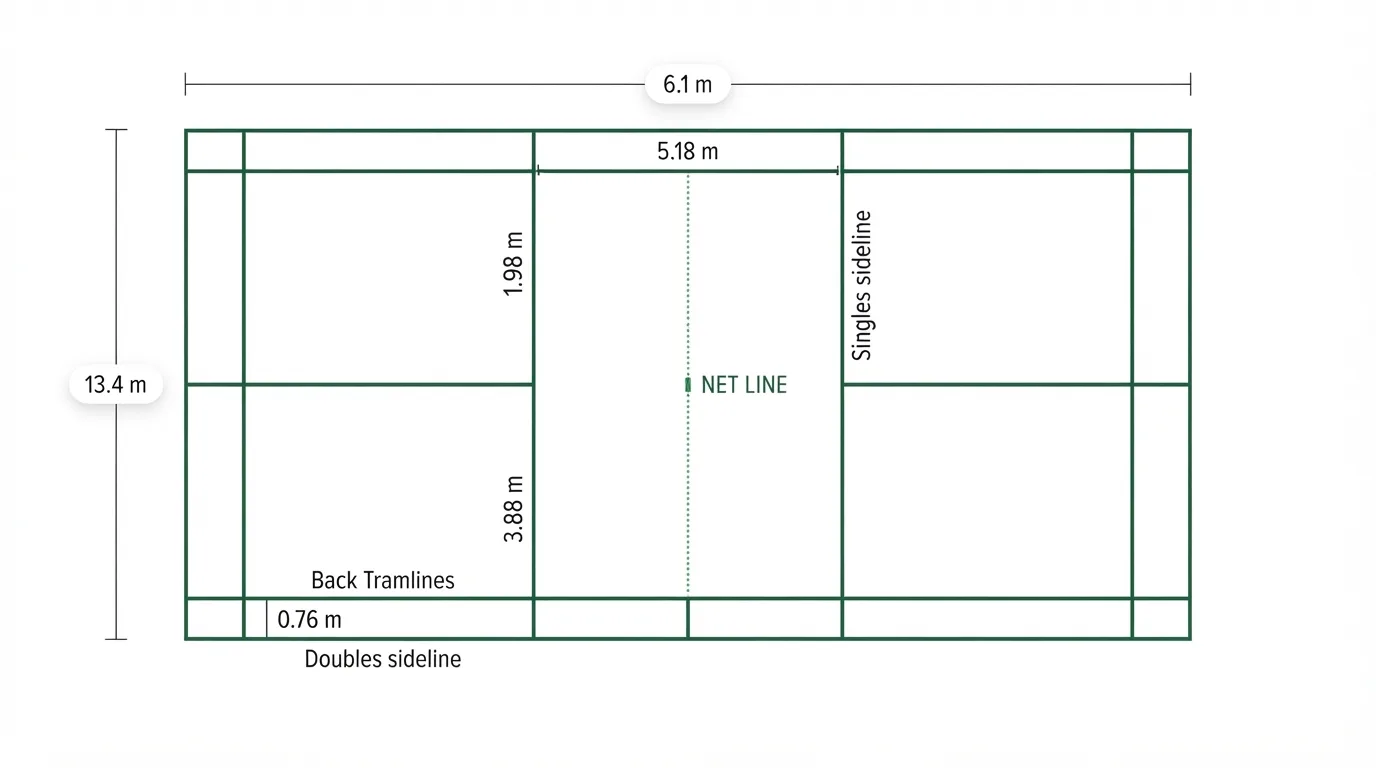
A badminton court is 13.4 m long, 6.1 m wide for doubles and 5.18 m wide for singles, with the net 1.55 m high at the edges and 1.524 m at the centre. Doubles play uses the wider surface; singles is the narrower configuration. The same court dimensions sit underneath every BWF event a UK bookmaker prices, so the fundamentals of the sport — the geometry of the court, the rally scoring, the best-of-three match format — are stable across the calendar.
What the field looks like: ten UK-licensed bookmakers that price badminton
The ten operators on this page all hold a remote operating licence from the Gambling Commission for Great Britain as of the data snapshot, verified against the Commission’s public register. They are presented as a comparison of who carries badminton, who offers the relevant welcome package and where the terms bite. The licensing position is the floor: not one of the ten is named here because it is the only licensed brand. Other licensed operators serve the UK market; these are the ones this guide covers.
| Brand | Gambling Commission licence | What the operator’s terms state on badminton and the welcome offer |
|---|---|---|
| Ladbrokes | 054743 (LC International Limited) | Ladbrokes Sports Betting app, made by Entain Operations Limited, rated 4.66 from 101,255 ratings on the GB App Store; badminton priced inside a full multi-sport football, racing and in-play offer |
| Bet Ahoy | 100094 (Bet Ahoy Ltd) | Welcome offer is a £5 sports bet plus a £5 acca when a new customer stakes £10 |
| Fitzwilliam Sports | 048760 (SBKI Limited) | Dublin-based bookmaker with capped membership; welcome is a “High Stakes Welcome” subject to compliance criteria, with instant deposits and fast withdrawals supported |
| London Bet | 066162 (Thistle Bet Limited) | App covers football, tennis, horse racing, greyhounds, darts, golf, cricket, NFL, NBA, MLB and snooker, plus Pragmatic Play casino slots and live in-play |
| Unibet | 045322 (Platinum Gaming Limited, Gibraltar) | Operated since 1999; sports welcome is £40 in free bets from a £20 qualifying bet at minimum odds of 2.0 (1/1), free bets expiring within 7 days |
| Smarkets | 039173 (Smarkets (Malta) Limited) | Betting exchange; open-bank transfers instant from £10 to £10,000, withdrawals processed within 6 hours up to £100,000, debit-card deposits instant from £10 to £15,000 |
| Fafabet | 057385 (Taichi Tech Limited) | Best Odds Guaranteed on UK and Irish horse racing win and each-way bets from 9am on race days, paying the bigger of the original price and the starting price |
| bet365 | 055148 (Hillside (UK Sports) ENC) | Official global betting partner of the UEFA Champions League; app described as the most-downloaded sports betting app in the UK; Bet Builder+, Super Boosts, Winnings Boosts on Bet Builders and selected singles, plus daily Bet Boosts, in-play betting and live streaming of events worldwide |
| Hollywoodbets | 053028 (Hollywoodbets International UK Limited) | Welcome offer: stake returned as a free bet of up to £30 on the first qualifying losing accumulator (stake £10+, 3+ legs, odds 4/1 or greater, settled within 7 days), one free bet per customer |
| Kalooki Sportsbook | 057730 (Kalooki Sportsbook Limited) | Operated by Kalooki Sportsbook Ltd (company number 12938272); GAMSTOP participant, with verification before the first deposit |
The framing matters. Ladbrokes and bet365 are household names from a UK perspective because the brands have run on the high street for decades and the apps carry everything from Premier League football to BWF tour badminton. The smaller names on this list — Kalooki, Fitzwilliam Sports, Bet Ahoy — price badminton less consistently, with some scheduling in only the headline events and dropping lower-tier BWF fixtures when liquidity is light. Pricing depth is not the same as licence status; a brand can hold a full remote general betting licence and still choose not to invest in the badminton price list on a given week.
For a bettor who wants badminton priced every week of the BWF tour, bet365 and Ladbrokes are the most reliable starting points, with Unibet and Smarkets sitting just behind. For a bettor chasing best-odds-guaranteed pricing on horse racing, Fafabet’s headline offer sits on the racing product rather than on badminton. Each operator’s page contains a fuller explanation of where each offer sits and who it fits.
The legal frame: a Gambling Commission licence as the floor, not the ceiling
In Great Britain the Gambling Act 2005 covers online betting. The Gambling Commission licences the whole commercial market, and since the Gambling (Licensing and Advertising) Act 2014 an operator whose remote facilities are used in Great Britain needs a Commission licence wherever it is based. A Curaçao, Maltese or Gibraltar licence is not a substitute — Platinum Gaming Limited, which runs Unibet’s UK site, is Gibraltar-registered, but it holds account 45322 on the Commission’s public register. The register is searchable by business name, trading name, domain or account number and is the whole test of whether a brand holds a valid licence.
There is no statutory list of permitted bets or markets in GB law. A bookmaker holds a licence for a category — remote general betting standard (real events), the licence category most sports-betting apps operate under; remote betting intermediary, the licence betting exchanges such as Smarkets run on; remote general betting limited; remote general betting standard (virtual events); and remote pool betting — and offers markets within that licence under the Commission’s Licence Conditions and Codes of Practice (LCCP). Badminton sits inside remote general betting standard (real events) under the same licensing envelope as football and tennis.
The minimum age is 18, and a licensed bookmaker has to verify name, address and date of birth before a customer can deposit or gamble. The credit-card ban has applied since 14 April 2020 across the GB licensed market, including credit-card-funded payments through an e-wallet; debit cards and bank-based payments sit outside that rule. There is no statutory cap on stakes — operators set their own maximum stakes and may restrict individual customers — and no state-set deposit or loss ceiling. Limits are the customer’s choice, set through the operator’s safer-gambling tools.
General Betting Duty is the operator’s tax, currently 15%. From 1 April 2027 a remote betting rate of 25% applies within that duty, while remote bets on UK horse racing, bets on self-self-service betting terminals in licensed premises, pool betting and in-person betting stay at 15%. Until that date, the remote rate stays at 15%. Players pay no tax on betting winnings in Great Britain. General information, not tax advice; a professional gambler should ask HMRC or a qualified adviser.
Offshore, a GB licence is compulsory at the point of consumption. Providing gambling facilities in Great Britain without the licence the Act requires is an offence under section 33 of the Gambling Act 2005 — aimed at the operator, with penalties up to 51 weeks’ imprisonment, a fine up to level 5, or both; six months in Scotland. No offence aimed at a customer who merely bets on an unlicensed site was found, so the framing is honest: licensed means checks, limits, GAMSTOP coverage, the bonus cap and the Commission’s complaints route; unlicensed means none of those protections and a real risk of funds not being paid out when a customer wins. Neither side of that line is “the safe choice” by default.
Player protection: what every licensed bookmaker has to provide
GAMSTOP is the national multi-operator online self-exclusion scheme and a mandatory licence condition for online operators in Great Britain. Self-exclusion runs for six months, one year, five years, or five years with auto-renewal; after the minimum period the exclusion stays in place for a further seven years unless the customer asks GAMSTOP to remove it. GAMSTOP covers online sites and apps; betting shops use a separate service.
The financial vulnerability check has applied since 30 August 2024 under LCCP condition 3.4.4. When a customer’s deposits minus withdrawals exceed £150 in a rolling 30 days — that rolling-30-day test has applied since 28 February 2025 — the operator runs a public-record check (bankruptcy, county court judgments and similar registers). The vulnerability check is not an income check and not a credit-reference check. Financial risk assessments — the “affordability checks” of the press coverage — are announced in a staged plan from a Commission article of 7 July 2026, with no start date.
Deposit limits sit alongside self-exclusion: a gross deposit limit on a fixed time frame is mandatory under the Remote Technical Standards, with the first changes applied since 31 October 2025 and a second phase postponed to 30 September 2026. Help is available through GamCare (the National Gambling Helpline), GambleAware, NHS gambling clinics and Gamblers Anonymous. Fitzwilliam Sports links directly to GambleAware, GAMSTOP and Gamblers Anonymous from its safer-gambling page; the rest of the licensed field carries the same links.
Identity verification before the first deposit is the practical consequence: every licence-holder named on this page will ask for a passport or driving licence and a proof of address before a customer can place a first bet. Free bets and bonuses count: the verification gate applies whether the first stake is real money or not.
Welcome offers and what they cost in turnover
A “welcome offer” is a marketing term for a one-off package given to a new customer in exchange for meeting a small set of conditions. The headline reads simply, but the conditions decide whether the offer is generous or a paper-thin gesture at best. Two patterns show up across the licensed UK field.
The first pattern is the matched free-bet: a deposit and a qualifying bet unlock free bets, the stake of which is not paid back with a win. Unibet’s sports welcome offers £40 in free bets from a £20 qualifying bet at minimum odds of 2.0 (1/1), with the free bets expiring within 7 days of issue. A £40 free bet on a 5.00 shot returns £160 in profit (stake not returned) — that’s a £40 stake times (5.00 − 1). The “free” framing is half-honest: the bet is free in the sense that the customer’s own money is not on the line, but the value of the bet depends on which price it lands on, and the bookmaker has stopped the stake being included with the winnings.
The second pattern is stake-back-as-free-bet: a first losing qualifying bet is refunded as a free bet, again with the stake usually not returned on a subsequent win. Hollywoodbets’ welcome offer returns the stake as a free bet of up to £30 on the first qualifying losing accumulator — stake £10 or more, 3+ legs, odds 4/1 or greater, settled within 7 days, one free bet per customer. A £30 free bet on a 6.00 price returns £150 in profit (stake not returned). Bet Ahoy’s welcome is “Bet £10 & Get £10 in Free Bets”, made up of a £5 sports bet plus a £5 acca. A £5 free bet on a 4.00 shot returns £15 in profit; a £5 acca line locks the bet into accumulator format.
On the regulatory side, wagering requirements on bonuses are capped at 10x for licensed GB operators in the rules in force since 19 January 2026 — a £10 bonus at 50x wagering would mean £500 of qualifying bets, well above the cap. Under the cap a £10 bonus carries at most £100 of qualifying bets. Mixed-product promotions — an offer that requires gambling on two or more product types such as betting, casino, bingo and lottery — are banned. Whether the cap applies to free bets with no wagering condition is not established; the writer’s framing stays at the cap and the description of the offer as it is written.
The other adjustment is structural. A free bet whose stake is not paid back is worth less than its face value on every price. The expected value of a £30 free bet on a 6.00 shot, with the stake not returned and assuming an average market margin around 5% applied to the free-bet stake, is £30 times (6.00 − 1) divided by 6.00 times the market payout share — a statistical estimate that says the offer is worth roughly £21 on the £30 face value before any account-level restrictions. The number is the average over many bets, not a guaranteed outcome for any single bettor.
Live betting and the badminton in-play product
In-play betting is the betting that takes place after a match starts, with prices that update through the match. Badminton is unusually well-suited to in-play pricing because rally-point scoring produces a continuous flow of points rather than discrete events — every rally resolves a price, every game ends, and the match-winner price responds in real time. game-winner markets, next-point markets and handicap lines all reset with each game. The control on in-play betting is the LCCP social responsibility code, not a statutory list of permitted markets, and licensed GB bookmakers offer it.
bet365’s offering includes in-play betting, live streaming of events worldwide and visual trackers such as Bet Track, Match Live and a Live Golf Tracker — the floor for what a top-end in-play product looks like on a smaller sport. London Bet’s app likewise mentions live in-play as a built-in feature across the sports it lists. Midnite cites in-play events on its site alongside an acca builder, popular accas and price boosts with maximum-stake limits. Smaller operators may offer in-play on badminton less consistently — match-winner markets update, but the depth of a game-winner or next-point market varies day by day.
Cash out is a separate feature that lets a customer close a bet before the match finishes, at a price the bookmaker sets. On a badminton match the cash-out price depends on the live state of the game and the original stake; whether the feature is available on a given event is a per-operator choice. The same applies to bet builders — bet365’s Bet Builder+ combines markets from one event into a single bet, available pre-match and in-play, with Winnings Boosts on Bet Builders and selected singles. On badminton the bet builder tends to combine match-winner with total games or with handicap lines; depth depends on the operator and the event.
The practical consequence for a bettor: in-play badminton pricing is best at the larger firms — bet365, Ladbrokes — because the market-making investment sits at the top of the licence list. For a bettor chasing a six-leg accumulator that places one leg on a Saturday-morning badminton BWF event, the same firms are where the cash-out product works most reliably.
Predictions, stats and what helps a bettor decide
“Badminton betting tips”, “badminton betting predictions” and “badminton betting tips today” all turn up in search volume from UK bettors before a BWF tour event. The honest framing is that no individual or service can know a badminton match outcome in advance, and a tipster service that charges for predictions is selling forecasts, not certainties. The shape of the betting picks market for badminton mirrors the sport itself: smaller volume, fewer specialist tipsters than for football or horse racing, and the same basic warning that stakes placed on someone else’s forecast are the bettor’s own money to lose.
Statistical angles exist. Player form over the last six months, head-to-head records at the same venue, surface and altitude adjustment for tournaments played at venue-specific conditions, and the bracket structure of an Olympic or BWF event are all factors a bettor can look at for themselves. BWF publishes match results and rankings on its own site; the same data feeds the bookmakers’ pricing models. A bettor who watches the form cycle on the men’s singles tour — Viktor Axelsen, Kunlavut Vitidsarn, Shi Yu Qi, Koki Watanabe, and the wider top-50 — will have a better sense of the bracket than one who reads a single tip line on a Saturday morning.
Bankroll management sits beside the angle. A flat stake of 1-2% of bank on each selection is the standard discipline for a small-market sport like badminton, where a single upset can blow a thin edge. The bet builder is exactly the product that punishes a bettor who loads the stake, because a six-leg line locks several smaller edges into one bet. The formula on the rule of one stake at a time is the simplest:
Stakes at 1-2% of bank on each selection, with a stop-loss at a fixed percentage of bank (5% is common) keep the bettor in the game through a BWF season that runs across most of the calendar year. Anything more aggressive on a small-market sport erodes the advantage of the deeper bookmakers. The arithmetic also makes the consequence plain: a £10 flat stake for a bettor with a £500 bank, kept up every week of the BWF tour, costs the bettor the market margin times total stake in expected terms. For a market priced at 5% margin, £10 × 35 weeks × 5% = £17.50 in expected bookmaker profit.
What a badminton bet looks like: bet types and odds explained
The single bet is the simplest form: a stake on one outcome, settled at the decimal odds, returning stake plus winnings if the bet wins. A £10 single at 2.50 returns £25 (£10 × 2.50) — £15 profit on a £10 stake. A losing single returns nothing.
The accumulator is several singles chained together: the stake from the first selection rolls into the second, the price compounds, and the bet pays only if every leg lands. A £10 four-fold at legs of 1.80, 1.95, 2.10 and 1.70 carries combined odds of 1.80 × 1.95 × 2.10 × 1.70 = 12.52. A winning accumulator at that combined price pays £125.20 (£10 × 12.52) and an unsuccessful leg at any point on the chain loses the whole stake. Hollywoodbets’ welcome offer pays the stake back as a free bet only on losing accumulators with 3+ legs at odds of 4/1 or greater — that rule sits squarely inside the accumulator format.
Each-way is a pair of bets: a win bet and a place bet at the same stake. Each-way has its clearest application in horse racing — a place pays if the horse finishes in the top positions at a fraction of the win odds — and the practice carries over into other sports where the bookmaker publishes place terms. The stake doubles: a £10 each-way bet is £10 on the win and £10 on the place, total stake £20.
The handicap bet evens out an uneven matchup. A -1.5 game handicap on a men’s singles favourite means the favourite has to win by two clear games for the bet to land — a 2-0 win in games, given that a game is played to 21 with a 2-point margin. The price carries the handicap. A +1.5 game handicap on the underdog pays if the underdog wins the match or loses by exactly one game.
Bet builder / same-game multi is a single bet that combines several markets from one event into a custom price. Bet Builder+ at bet365 covers pre-match and in-play: a bettor might build a line on Viktor Axelsen to win, total games over 2.5, and Axelsen to win the first game to 11 or more — the price is computed from the constituent market margins and the resulting price usually sits somewhere between 1.5x and 5x combined decimal odds, depending on how correlated the legs are.
Fractional odds convert to decimal by dividing the numerator by the denominator and adding one. 5/1 is 5 ÷ 1 + 1 = 6.00. 11/4 is 11 ÷ 4 + 1 = 2.75 + 1 = 3.75. Evens (1/1) is 1 ÷ 1 + 1 = 2.00. The reverse — decimal 6.00 back to fractional — is (6.00 − 1) as a fraction: 5/1, the simplest form. The conversion rule makes the two displays interchangeable: a £10 bet at 5/1 returns £60 (stake plus winnings), the same as £10 × 6.00 at decimal.
Odds-on is the British word for a price shorter than evens — fractional 4/6, decimal 1.67, for example. The shorter the price, the more likely the outcome in the bookmaker’s view and the smaller the return per unit stake. The longer the price, the less likely the bookmaker thinks the outcome and the larger the return — but also the longer the implied probability gap that has to close.
Best odds guaranteed (BOG) is the practice of paying the bigger of an early price and the starting price (SP), the price at the moment the event starts. The system has its home in UK and Irish horse racing, where the Fafabet welcome offer runs BOG on win and each-way bets from 9am on race days. BOG on badminton is uncommon — the practice does not naturally extend to sports without a traditional “off” time — and the betting exchange product at Smarkets works on a different model, where backers and layers set prices against each other.
What the bookmaker’s margin looks like in the odds is straightforward once the market is set up. The decimal payout share is computed from the prices of every outcome: for a two-way match-winner market at 1.90 / 1.90, payout share = 1 ÷ (1 ÷ 1.90 + 1 ÷ 1.90) = 1 ÷ (0.526 + 0.526) = 1 ÷ 1.053 = 0.950 — 95.0% of every unit bet on this market goes back to bettors in aggregate. The margin is 100% − 95.0% = 5.0%, the percentage the bookmaker keeps on this market. A £100 stake across both sides returns £95 in expected payouts, leaving £5 in expected bookmaker profit on every unit bet.
The same arithmetic at 1.85 / 1.85 produces payout share 1 ÷ (1 ÷ 1.85 + 1 ÷ 1.85) = 1 ÷ 1.081 = 0.925 — 92.5% payout share, 7.5% margin. The shorter the prices, the closer the market sits to 100% payout share, which is why favourites tend to look like generous prices until the underdog prices are added into the calculation. Margin is built into every market on every event across every operator; it is the cost of betting before the betting starts.
Ladbrokes — the deep multi-sport apps with badminton priced inside
Ladbrokes holds Gambling Commission account 054743, with LC International Limited as the licence holder and a register entry across remote general betting standard (real events) and remote betting intermediary. The Ladbrokes Sports Betting app, published by Entain Operations Limited, carries 4.66 stars from 101,255 ratings on the GB App Store. From a UK bettor’s perspective the brand is a household name, with a track record on the high street and a multi-sport app that prices football, horse racing, greyhounds and a tier-two list of other sports including BWF badminton.
Ladbrokes is one of the larger firms on this list for a bettor with a stake that needs the depth of a Premier League–level product to sit beside a Saturday morning badminton bet. The brand is also one of the few alongside bet365, Unibet and Smarkets where badminton pricing is consistent across the BWF tour calendar rather than concentrated on the largest events. Where Ladbrokes earns its place on this page: a bettor who wants badminton priced every week of the year, alongside racing and football, has a UK-licensed bookmaker available at the same brand.
Bet Ahoy — the light welcome with a £10 free-bet split
Bet Ahoy holds Gambling Commission account 100094 under Bet Ahoy Ltd, with a remote general betting standard (real events) licence. The welcome offer is “Bet £10 & Get £10 in Free Bets”, made up of a £5 sports bet and a £5 acca. The conditions are the standard split-stake free-bet format: a £10 qualifying bet unlocks the package. The price of the qualifying bet is a minimum odds threshold from the operator’s terms.
The split matters: a £5 free sports bet is a standard free bet (stake not returned on a win) at whatever price the bettor picks within the operator’s market selection. A £5 free acca is the same shape but locked into accumulator format — a single leg does not work for an acca free bet. The two pieces can carry different minimum-odds conditions, so reading the operator’s own terms before claiming is the practical answer.
This is the right offer for a bettor placing a first qualifying stake on a BWF event and looking for a small second-position bet on the same week. The bundle sits on the cheaper end of the welcome field; the brand does not list headline welcome terms beyond the £10 / £10 split.
Fitzwilliam Sports — Dublin membership, high-stakes welcome, capped tier
Fitzwilliam Sports is a Dublin-based bookmaker, run by SBKI Limited under Gambling Commission account 048760. The brand describes itself as operating with capped membership, a sign that account approvals are not automatic, and the welcome is a “High Stakes Welcome” subject to compliance criteria rather than a fixed offer listed on a marketing page.
The terms-of-service shape tells the reader where the brand fits. Instant deposits and fast withdrawals are supported, alongside timeouts and deposit limits; safer-gambling links route to GambleAware, GAMSTOP and Gamblers Anonymous. That package is a smaller operator running with the same safer-gambling controls as the rest of the GB licensed field — the brand’s competitive edge is not marketing breadth but a particular reader profile.
The bettor who lands here is the one who picks a brand by personal fit rather than by headline offer, who wants a Dublin-based bookmaker with capped membership, and who reads the compliance criteria on a high-stakes welcome before claiming. The high-stakes framing means the welcome terms reward larger deposits; the size of the deposit and the qualifying-bet requirements sit in the operator’s own marketing. Where Fitzwilliam Sports loses to the rest of the field: the badminton price list is shallower than a bet365 or Ladbrokes, and the capped membership restricts the audience.
London Bet — the multi-sport app with Pragmatic Play casino
London Bet, run by Thistle Bet Limited under Gambling Commission account 066162, runs a remote general betting standard (real events) licence alongside its casino product. The app carries sports betting across football, tennis, horse racing, greyhounds, darts, golf, cricket, NFL, NBA, MLB and snooker, with Pragmatic Play casino slots and live in-play as the integrated product.
For a bettor pricing badminton on a London Bet fixture, the product is the sports-betting arm of a multi-product app. In-play is built in; the app lists the standard small-sport events at times when the BWF tour runs. London Bet’s market depth on badminton sits in the middle of the field — the firms above it on the price list are larger and invest more in market-making, the firms below it are smaller still. Where the brand fits is the bettor who wants a sportsbook and casino under one app and uses the sports arm for badminton alongside the other sports on the same schedule.
Unibet — £40 in free bets, 7-day expiry, minimum odds 2.0
Unibet’s UK site is run by Platinum Gaming Limited, Gibraltar, under Gambling Commission account 045322. Unibet states it has operated since 1999, which puts the brand in the long-running tier alongside bet365 and Ladbrokes. The sports welcome offer is “Get £40 in Free Bets when you bet £20”: a deposit and sports bet of £20 or more at minimum odds of 2.0 (1/1), with free bets expiring within 7 days of issue, for new GB customers using a debit card or instant bank transfer.
The 7-day expiry is the binding condition. A £40 free bet unlocked on a Monday has to settle by the following Sunday. At a market margin in the region of 5% on a two-way line, the statistical value of a £40 free bet at average market price sits around £30 — a £40 free bet at decimal odds of 3.00 returns £80 profit, and applying a 5% margin haircut puts the average expected return at around £80 × 0.95 = £76 on a 3.00 line, with the stake not returned. That number is the average over many bets at that price, not a guaranteed outcome for any single bettor.
The 2.0 minimum odds on the qualifying bet is the standard rule. The structure of the welcome — £40 in free bets from a £20 qualifying stake — sits at the heavier end of the field. Unibet earns its place for the bettor who already plans to place a £20 qualifying bet and wants a free-bet bundle with the standard licence protections underneath.
Smarkets — the betting exchange with banking-time advantages
Smarkets runs as a betting exchange under Gambling Commission account 039173, with Smarkets (Malta) Limited as the licence holder. The exchange format is different from a sportsbook: backers bet for an outcome to happen, layers bet against it, and prices form between them rather than from a bookmaker’s margin. UK debit-card deposits are instant from £10 to £15,000; open bank transfer is instant from £10 to £10,000, and withdrawals are processed within 6 hours from £10 to £100,000.
The 6-hour withdrawal time is the standout. Most sportsbook brands sit on a 1-3 working day withdrawal cycle once verification is complete; a 6-hour cut is competitive with the e-wallet fast-lane of the rest of the field. For a bettor pricing badminton on the exchange side, the depth is shallower than at the larger sportsbooks — liquidity on a small sport is the long-standing constraint on betting exchanges. Where Smarkets wins: a bettor who wants an exchange price format, fast withdrawals, and the GB licence frame. Where it loses: depth on badminton as a smaller sport on the exchange.
The rules specific to betting exchanges — commission rates, lay betting liability, market suspension during in-play — are stated from the operator’s own terms, not the regulator. The constraint of a betting intermediary licence versus a remote general betting standard licence is real but invisible to most customers; what differs in practice is the price formation mechanism.
Fafabet — best odds guaranteed on horse racing, badminton on the multi-sport list
Fafabet, run by Taichi Tech Limited under Gambling Commission account 057385, prices badminton inside a multi-sport book. The headline offer is Best Odds Guaranteed (BOG) on UK and Irish horse racing win and each-way bets from 9am on race days: if the starting price is bigger than the price the bet was placed at, the bigger odds are paid. The rule has its home in racing and does not directly affect the badminton product; it tells the reader where Fafabet has invested its marketing budget.
A bettor who has a Fafabet account and wants to add badminton pricing to a Saturday morning of horse-racing bets will find the BWF events priced, with a bookmaker that prices sports like every other bookmaker. The badminton depth sits somewhere between a Ladbrokes and a Bet Ahoy on a given week. Fafabet’s place on this list is the racing-first multi-sport bookmaker with the GB licence frame.
bet365 — the in-play floor with Bet Builder+ and live streaming
bet365’s licence sits with Hillside (UK Sports) ENC under Gambling Commission account 055148, covering remote general betting standard (real events). The brand is the official global betting partner of the UEFA Champions League and the most-downloaded sports betting app on the GB App Store.
On badminton, bet365’s in-play product is the closest the licensed field gets to a top-tier market. In-play betting on every priced event, live streaming of events worldwide, and visual trackers (Bet Track, Match Live and a Live Golf Tracker) make it the firm where badminton pricing carries depth beyond the simple match-winner line. Bet Builder+ lets a bettor combine markets from one event into a single bet, available pre-match and in-play. Super Boosts, Winnings Boosts on Bet Builders and selected singles, plus daily Bet Boosts, are the standard promotional scaffolding the firm layers over the product.
For a bettor pricing badminton weekly, bet365 is the brand where the in-play product carries the most depth, where match-winner pricing sits alongside game-winner lines and handicap markets, and where live streaming of international badminton events is built into the app. Where the brand costs more than the smaller firms on this list: nothing direct on price, but the welcome scaffolding is the standard deposit-and-qualifying-bet shape rather than a headline giveaway. The depth of product is the value, not the bonus.
Hollywoodbets — stake-back-as-free-bet on a losing accumulator
Hollywoodbets runs under Hollywoodbets International UK Limited under Gambling Commission account 053028, with a remote general betting standard (real events) licence. The welcome offer is the stake-back pattern: new players who deposit £10 or more by card get their stake back as a free bet of up to £30 on their first qualifying losing accumulator — stake £10 or more, 3+ legs, odds 4/1 or greater, settled within 7 days; one free bet per customer.
The 4/1 minimum on the qualifying accumulator is the binding constraint. A £10 stake at combined odds 4.00 or greater has to lose for the offer to trigger — if the acca wins, the offer does not pay out as a free bet. The free bet itself is stake-not-returned on a subsequent win, so the value is again the statistical average across many bets. A £30 free bet on a 6.00 shot returns £150 in profit (stake not returned); the same £30 free bet at a 4.00 shot returns £90 in profit. The cap of £30 on the free bet means a stake above £30 still only returns £30 in free-bet terms, so staking more on the qualifying bet does not increase the headline payout.
For a bettor who plans a Saturday acca on badminton plus a couple of other sports and accepts the risk of a losing ticket, the offer fits the betting slip. For a bettor whose pattern is singles and short doubles, the offer is the wrong shape. Hollywoodbets earns its place for the multi-sport acca bettor with a card deposit and the willingness to take a 4/1-plus multi-leg line.
Kalooki Sportsbook — verification at the gate, GAMSTOP by design
Kalooki Sportsbook is operated by Kalooki Sportsbook Ltd (company number 12938272) under Gambling Commission account 05730. The brand is a GAMSTOP member, with verification before the first deposit. The licence type is remote general betting standard (real events), the standard sports-betting category. Midnite, by contrast, has its own licence cited on the site — account 101839 — and includes in-play events, an acca builder, popular accas and price boosts with maximum-stake limits.
For a bettor who values safer-gambling controls as the core feature, Kalooki carries the same baseline as the rest of the GB licensed field. The brand is one of the smaller sportsbooks on this list, with badminton pricing concentrated at the headline BWF events. The choice of a bettor pricing badminton for a month at a time is one of convenience: where the bettor has an account already and the brand carries the line, the bettor can place the bet.
What the welcome offers add up to at the bettor’s stake
Three calcs sit underneath the welcome packages across the licensed field, with each calculation a statistical estimate rather than a guaranteed outcome for any single bettor.
A £20 qualifying bet at minimum odds 2.0 to unlock £40 in free bets at Unibet means a £40 free bet bundle, with the stake not returned on a win and a 7-day expiry on the free bets. Expected value at a 5% market margin and an average free-bet price around 3.00 sits around £40 × (3.00 − 1) ÷ 3.00 × 0.95 = £40 × 0.667 × 0.95 = £25.34 in average profit — the average over many bets at that price, with a 7-day clock pressure that nudges the bettor toward higher-margin events.
A £10 qualifying bet for a £10 split free-bet at Bet Ahoy means a £5 sports free bet plus a £5 acca free bet. At a 5% market margin and an average free-bet price around 3.00, the expected value sits around £10 × 0.667 × 0.95 = £6.34 in average profit across the bundle — again, the statistical average, not a guaranteed outcome.
A £10 qualifying acca at odds 4/1 or greater for a stake-back free bet of up to £30 at Hollywoodbets means the offer only triggers when the accumulator loses. The free bet, when paid, carries the standard stake-not-returned value. At a 5% market margin on the bet used to deploy the free bet, the expected value sits around £30 × 0.667 × 0.95 = £19.02 in average profit — but only on the subset of qualifying weeks when the customer’s accumulator loses, which by construction is more than 50% of acca bets at any meaningful size.
These numbers are statistical estimates of the welcome package’s value. They are not guaranteed outcomes for any single customer, and any operator may impose additional restrictions not covered here — maximum-stake limits, restricted markets, anti-abuse rules. The bettor’s actual return depends on the prices they pick and the bets they actually place.
In-play product depth and where the live product works best
For a sport like badminton, in-play product depth varies sharply across the licensed GB field. bet365’s product — in-play betting across every priced event, live streaming, Bet Builder+ available pre-match and in-play, plus the various trackers — is the most developed. Ladbrokes sits close behind, with a multi-sport app that carries in-play across the same multi-sport list.
Smaller operators — Bet Ahoy, Kalooki, Fitzwilliam Sports, Fafabet — invest less in the live product for badminton. The match-winner line will update as the match plays out, but the depth underneath (game-winner, next-point, handicap) depends on the operator and the event. London Bet’s app mentions live in-play as built into the product across the sports it lists. Smarkets, as an exchange, handles in-play through layers setting prices, but liquidity on a small sport is the binding constraint; the depth is thinner on a Saturday-morning BWF event than on a Premier League football fixture.
The consequence for the bettor: a single Saturday-morning badminton selection sits best at bet365 or Ladbrokes. A multi-sport Saturday with a badminton leg at the same firm works best at the larger brands. The cash-out feature on a badminton bet is most reliably available at bet365, with the price depending on the live state of the match and the original stake; smaller firms offer cash out at their discretion.
A practical order for choosing where to bet on badminton
The cleanest decision tree starts with the licence: choose only from the GB licensed field. Every brand named on this page holds a current remote operating licence for Great Britain, verified against the Commission’s public register. The argument for staying inside that frame is the practical one — identity verification, the GAMSTOP route, the Commission’s complaints mechanism, the 10x bonus cap and the £150 financial-vulnerability check — all sit inside the GB licensed frame and not outside it.
The second decision is depth: a bettor pricing badminton weekly needs a firm that carries the BWF tour calendar beyond the headline events, with in-play product that updates through the match. bet365 and Ladbrokes are the most reliable starting points; Unibet and Smarkets sit just behind; the rest of the field carries the sport at lower consistency.
The third decision is the welcome offer. Each welcome is a marketing term with binding conditions; reading the operator’s own terms before claiming is the practical answer. Matched free-bets, stake-back-as-free-bet and split-stake free-bets each have their own shape, and the value depends on which welcome fits the bettor’s staking pattern.
The fourth decision is the betting pattern: singles, doubles, accumulators and live bets each suit a different operator. Singles and doubles fit a smaller field comfortably; accumulators fit Hollywoodbets’ welcome and the standard acca-format product; live bets fit bet365’s product most reliably. The same bookmaker is rarely the right choice for every betting pattern.
What a bettor can check before staking the first pound
The four checks are the gate of every decision. First, the Gambling Commission’s public register for the operator’s licence status, by business name or domain. Second, the operator’s own terms for the welcome package, the minimum odds on the qualifying bet, the expiry on free bets and the maximum-stake limits on boosted markets. Third, the betting rules for the chosen sport — what makes a bet void, what happens in walkovers and abandonments, and how a non-runner rule applies. Fourth, the safer-gambling tools available at the operator — deposit limits, timeouts, GAMSTOP self-exclusion.
These checks are not optional. The licence is a single line in the public register; the terms are a single click away on every operator’s site; the safer-gambling tools are a single menu in every account page. The decision to skip a check is the decision to bet without the information a reader can get for themselves.
The bettor’s own books are the second layer: a record of stakes, of prices, of markets, of how each operator’s welcome package settled. The flat-stake discipline — 1-2% of bank — keeps a small-market sport’s margin from eroding the bank faster than the bettor can replace it.
The outline of a badminton weekend at the licensed field
A bettor with a Fafabet account and a Hollywoodbets account, both verified, both inside the GAMSTOP frame: Saturday morning, BWF tour event at 10am UK time, match-winner pricing available at Fafabet, in-play available at the same firm with cash-out priced at the operator’s set rate; Sunday afternoon, a Hollywoodbets acca with a badminton leg plus two football legs at 4/1 combined odds or greater, and a £10 stake matched with the welcome package’s terms. The two accounts are independent, the licences separate, the safer-gambling tools available in each.
This is the shape badminton betting takes in Great Britain in 2026. The licensed field is at this width; the price on each market sits at the operator’s chosen margin; the welcome offers settle into the betting pattern over the weeks the bettor holds the accounts. The deeper choice — which operator carries the BWF tour beyond the All England Open and the Thomas Cup — sits in the field’s coverage, and the bettor who wants that depth carries their stake to the firms that invest in the sport.
Frequently Asked Questions
How do I bet on badminton?
Pick a UK-licensed bookmaker from the operators on this page, complete the verification gate (passport or driving licence plus proof of address), and choose from the markets the operator lists for the upcoming BWF event. Match-winner and game-winner are the two markets at every operator; outright tournament winner, handicap and total points appear at the larger firms.
How do I check that a bookmaker holds a Gambling Commission licence?
Open the Gambling Commission’s public register at the regulator’s site, search by business name or domain, and read the licence status, the licence type (remote general betting standard, betting intermediary, or another category), and the trading name against the licence. Every operator on this page is verified against the same register.
How is the return on a bet worked out from the stake and the odds?
Multiply the stake by the decimal odds. A £10 stake at 2.50 returns £25 (stake and profit). A £10 accumulator at combined odds 12.52 returns £125.20 if every leg wins; the same accumulator with any losing leg returns zero. Decimal odds carry stake-inclusive returns; fractional odds such as 5/1 carry stake plus winnings, so a £10 bet at 5/1 returns £60.
What is the bookmaker’s margin and how do I see it in the odds?
The margin is the percentage of every unit bet that the bookmaker keeps on average across the market. For a two-way market at 1.90 / 1.90, the payout share computes to about 95.0%, leaving 5.0% as the margin. A market at 1.85 / 1.90 computes to about 94.0% payout share and 6.0% margin. The margin sits inside every price, and the arithmetic varies market by market.
How do fractional odds like 5/1 convert to decimal odds like 6.00?
Divide the numerator by the denominator and add one. 5/1 becomes 5 ÷ 1 + 1 = 6.00. 11/4 becomes 11 ÷ 4 + 1 = 3.75. Evens (1/1) becomes 1 ÷ 1 + 1 = 2.00. The reverse — decimal 6.00 back to fractional — is (6.00 − 1) as a fraction, giving 5/1 in simplest form. Both displays are interchangeable on the same bet.
What safer-gambling tools does a licensed bookmaker have to offer?
GAMSTOP self-exclusion for periods of six months, one year, five years or five years with auto-renewal is a mandatory licence condition for online operators in Great Britain, alongside deposit limits set by the customer through the operator’s safer-gambling tools and timeouts. Help is available through GamCare (National Gambling Helpline), GambleAware, NHS gambling clinics and Gamblers Anonymous.
Tennis, darts & cue sports – Boxing betting
Content created by the «Boxing betting» team
