
How to Build Curling Betting Tips That Survive the Margin
 Available in US
Curling betting tips are mostly marketing dressed up as insight. The working answer is duller and better: a punter who can read form, weigh the hammer, compare odds across bookmakers and track the margin already runs ahead of one who can’t. This page is the working answer — how to build those checks, what a value bet really is, why the bookmaker’s margin sits inside every price, and how UK readers verify that a bookmaker is actually licensed by the Gambling Commission. No picks are given and none are promised; the topic is the thinking that makes a pick defensible at all.

*As of 27 October 2026, licence claims below were checked against the Gambling Commission’s public register.*
Curling Betting in Plain Terms
Curling is a sport of inches on long ice, and a curling match offers the punter a compact set of decisions once the format is understood. A four-player team throws eight stones per end, two per player, and ten ends is the standard length at international level. Whoever’s stone sits closest to the button — the painted target at the centre of the house — scores one point for every stone they have lying closer than the opponent’s nearest stone, and only stones already inside the house count. Tied games go to extra ends until somebody wins; the hammer, the last stone of an end, goes to the team that did not score in the previous end, and stays put when an end is blanked.
The betting consequence is that curling is a low-event sport on a frame level — a championship match produces maybe 200 stones over two hours and ten ends — but high on tactical granularity. The hammer is everything in tight games: a team protecting a one-point lead with the last stone can be bluffed into lying two, and a team trying to steal usually cannot win outright without taking a big risk. A bettor who follows curling knows that bookmakers do not always price the hammer with care, especially on undercard mixed-doubles ties and qualifying-round games, and that gap is where the value questions live.
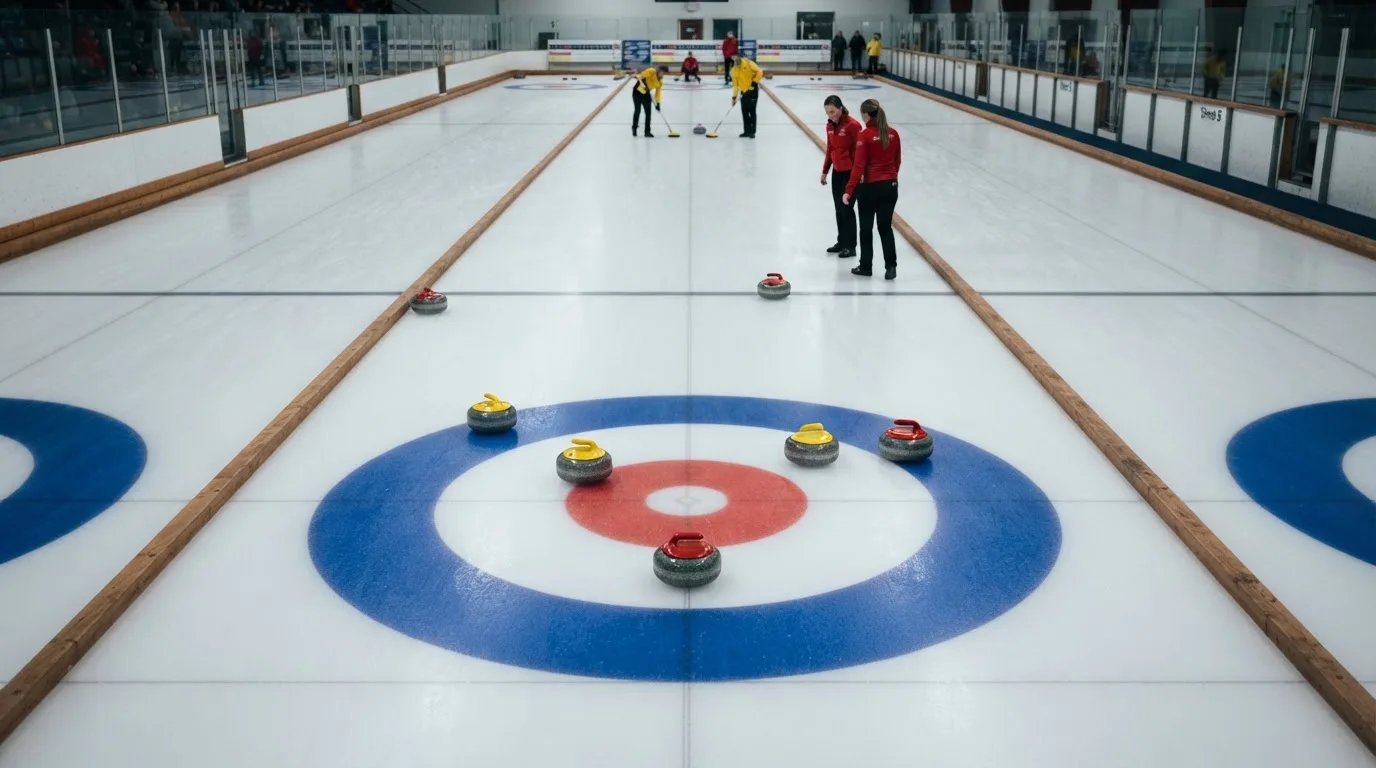
Curling became an Olympic medal sport at the 1998 Winter Games and mixed doubles joined the programme in 2018. That wider visibility has, in places, narrowed the margin on the headline events; the opening odds on a men’s gold-medal match at a Winter Olympics are now the most heavily-scrutinised prices on the calendar, alongside the Grand Slam of Curling finals. Lower-tier competition is the opposite story: world-qualifier ties, Continental Cup legs and many European championships still trade at prices that read as if the bookmaker skimmed one team’s Wikipedia page on Tuesday and ran with it. That spread — tight Olympic headlines, soft undercards — is the shape of the market a punter should know before reading a single line of form.
What Makes Curling an Odd Sport to Bet On
Bookmaker margins are not uniform across a sport. On major football leagues the overround lives in the 2-4% band on a 1X2 market; on curling outright and tournament winner markets at the same operators, the overround often settles higher because a market-making team has fewer data points to update. There is also a thematic difference: curling has fewer mainstream bookmakers with full pre-match cards than football, horse racing or tennis, and the operators who do carry it will sometimes run one set of lines for the whole weekend rather than pricing each end of each draw. That does not mean curling is “easy” — it means the price the punter sees is less efficient than the price they would see on a Premier League coupon, and less efficient markets are where discipline matters more, not less.

It is also a sport where momentum is thin. There is no clock pressure beyond ends, no shots-per-possession count and no clock to bleed, so a team down three halfway through a match is genuinely out of normal ways back; a two-point lead with the hammer at the start of the tenth end is essentially the match. A punter reading live in-play prices from a bookmaker’s algorithms will see them move sharply when the hammer changes hands — those moves are mechanical and do not always track the field. Reading them is the craft.
Curling Odds, the Margin and What the Numbers Actually Pay
Decimal odds are the practical currency of the page; every number in this section is decimal unless the page says otherwise. A single at 2.50 pays £25 back on a £10 stake (£10 × 2.50), of which £15 is profit; a wagering multiple of x with a bookmaker’s edge t costs the punter x × t on a turnover basis before any selection skill is added. None of this is exotic — the hard part is to remember that any price is two things at once: the bookmaker’s estimate of probability and their margin taken out of it.
The margin is the share of every pound staked the bookmaker keeps on average across the outcomes of a market. A curling two-way market priced at 1.90 / 1.90, for example, returns roughly 95.00 pence on the pound to the punter, with the bookmaker retaining 5.00 pence as margin. When the market prices shift to 1.85 / 1.95, the implied probabilities change and the margin adjusts to 4.67%. This fluctuation demonstrates why comparing prices across bookmakers is often an exercise in comparing margins rather than opinions. In practice, a curling two-way market typically carries a 4% to 6% margin; outright tournament winner markets are usually wider, often ranging from 8% to 12% across the industry.
A combination bet — say a four-fold acca at decimal prices 1.60, 1.70, 1.80 and 2.00 — multiplies its legs into 1.60 × 1.70 × 1.80 × 2.00 = 9.792. A £10 stake returns £97.92 (£87.92 profit). The combined price looks generous, but the joint margin is the sum of the per-leg margins, and a 5% per-leg market at four legs compounds into roughly a 19% margin on the combination. That is the real reason accas are beloved by bookmakers and disliked by serious punters: a £10 stake on a 9.79 four-fold is, on average, expected to return about £79 of the £98 it would pay on a fair price.
What a Value Bet Actually Is
A tip is a hunch. A value bet is a price that exceeds the bettor’s own estimate of the true probability once the book’s margin is taken out. The mechanic is straightforward: divide 1 by the decimal price to get the book’s implied probability, subtract its share of the margin, and ask whether that adjusted figure is below the bettor’s estimate. So at 3.00 the book is implying 33.3%; if the punter’s own number is 38%, the difference is positive and the bet has value; if the punter’s number is 30%, the price is short and the bet should be refused. The form of the bet is irrelevant — single, double, each-way — value is a property of one number against another, not of one market type against another.
This is also why no tip is ever certain and why the page makes no predictions. A bookmaker’s quoted probability includes their margin; a tipster’s quoted probability includes their error margin, which is usually unspoken and often larger than the tipster thinks. A bet is a probability trade, and the only question is whether the punter can sustain a positive spread across many of them with a unit-size stake. Over a few weekends the variance dominates; over a season the spread — positive or negative — is what remains.
The discipline that makes it work is harder than the maths. A unit stake — typically 1-2% of bank — limits what a bad week does. A record of every bet settled, with the price and the bookmaker’s implied probability, is the only way the punter ever sees their own spread; guesses are not data. Bankroll rules separate tipsters who lose from punters who lose, and the difference is not skill but record-keeping.
Curling Betting Sites, UK Licensed
A bookmaker serving customers in Great Britain needs a Gambling Commission licence, wherever the company behind it sits. Since the Gambling (Licensing and Advertising) Act 2014 the test is where the bet is placed, not where the company is incorporated; a Curaçao or Malta registration is not a substitute, even if a brand lists one as a badge. The Commission’s public register is the whole test of whether a brand holds a licence — anyone can search it by business name, trading name or domain.
That point cuts two ways at once. A licence proves regulation; it does not prove quality, generosity of odds, depth of curling markets or how fast withdrawals clear. A licence is the floor for a UK punter, not the ceiling. The list below is the licensed register of bookmakers reviewed elsewhere on this site; ordering reflects role in the comparison, not a judgement of who is “best”.
Kalooki Sportsbook
Kalooki Sportsbook runs under Gambling Commission account 57730 (licence 057730-R-333396-005), held by Kalooki Sports Book Ltd, and is a participating operator in GAMSTOP. Its offer profile is narrower than the high-street houses — fewer sports, a more focused card — which is also its pitch: fewer markets, sharper attention to those it runs. For a curling bettor the appeal is depth on the undercard rather than the breadth of a full-multi operator.
For the regular £10 punter who follows the World Curling Tour and wants a price on Thursday-night Canadian Tire-tankard ties, Kalooki has more reason to exist than for someone who only bets the Olympics and the World Championships. That is the verdict, narrow as it sounds: a curling specialist’s option rather than a generalist’s first choice.
Octobet
Octobet’s licence is Gambling Commission account 62545 (licence 062545-R-337248-005), held by Octopus Game Limited. Its welcome package is described by the brand as 50% back as a free bet up to £50, alongside a small casino component — described as the brand states it rather than as a printed offer, because offers change month to month. The percentage-back-with-cap shape means a £100 stake returns £50 of free bet tokens, and the realised value of those tokens is the market margin on whatever the punter stakes them at, not their headline number.
The caution is the same one that applies to any percentage-back offer: the headline sounds larger than the realised value, and the punter’s edge is the gap between the two. As a multi-sports bookmaker for an everyday curling bettor with a flat-stake discipline, Octobet sits in the middle of the field — solid licence, modest offer, neither the deepest curling card nor the thinnest.
William Hill
William Hill is a long-standing UK high-street name now operating online under WHG (International) Limited, with Gambling Commission licence 039225-R-319373-015 (account 39225). It runs Best Odds Guaranteed on UK and Irish horse racing from 8 AM on the day of the race — both single and multiple bets, with ante-post, tote and pari-mutuel bets out of scope — which matters for racing punters more than curling ones. The curling card at a major operator of William Hill’s scale covers the headline events well; the undercard depth varies by season and is the place where the operator-to-operator comparison actually moves.
For a punter who already has a William Hill account and wants to add curling selections to it, it is an obvious option. For someone opening fresh, it sits alongside other big-multi houses whose curling-card comparison is more informative than any welcome headline. Verdict: a default large-multi house, strongest for the racing-curling punter, no special claim on curling.
Bet Ahoy
Bet Ahoy’s licence is Gambling Commission account 100094 (licence 100094-R-341742-003), held by Bet Ahoy Ltd. Its welcome is described as “Bet £10 & Get £10 in Free Bets” — split by the brand into a £5 sports-bet portion and a £5 acca portion — with the usual qualifying-bet and time-window conditions. New-account offers of this shape settle into the market norm only when the stake-returned rules and qualifying minimums are read carefully, because a £5 sports bet credit on a 5/1 winner is £25 of profit while the same selection on a £5 cash stake would have been £30.
For a curling bettor specifically, Bet Ahoy is one of several smaller UK-licensed brands whose depth on the sport depends entirely on the time of year. During the World Curling Championships and Grand Slam legs the card expands; outside those windows it shrinks. The shape of the offer makes it a usable secondary account rather than a primary one.
Betfred
Betfred is published by Done Brothers (Cash Betting) Ltd and licensed under Gambling Commission account 39544 (licence 039544-R-319290-010). The Betfred Sports, Casino & Games app covers 21 sports and several thousand casino-style games, which is the breadth of a generalist; curling is in the lineup but is not the headline product. For a punter who already bets with Betfred on horse racing and football, adding curling selections to the same account is the cleanest route; for someone choosing a bookmaker purely on curling depth, the case is weaker.
Verdict: a generalist multi-sports house where curling is one of twenty-one sports, not a specialist pick on the ice. The licence and the brand familiarity are the points in its favour; the undercard depth is the limit.
Matchbook
Matchbook runs as a betting exchange — customers bet against each other, with the operator taking a small commission on net winnings — under Gambling Commission licence 039504-R-319407-024 (account 39504), categories that include a remote betting intermediary licence as well as the standard real-events category. The exchange shape changes the punter’s calculus: prices on match winner and outright markets are typically sharper than a fixed-odds book because the overround is reduced to the commission rather than built into every price, but liquidity — the willingness of other customers to take the other side — varies by sport. Major curling ties around the Olympics and World Championships draw enough liquidity to be useful; lower-tier ties often do not.
The bettor who is comfortable laying as well as backing has, on a well-liquored event, the lowest-cost route in curling. The bettor who only ever backs will find the platform less friendly: same-game-multi coverage is supported, but accumulators across sports can be slower to fill. The verdict sits with how the punter actually trades.
Star Sports
Star Sports runs on Gambling Commission account 9177 (licence 009177-R-104555-019), held by Star Racing Limited. The brand’s own pitch, beyond the betting card, is direct trader access — the support line 08000 521 321 and [email protected] let punters open accounts, place bets and resolve queries by speaking to a person. That is a real feature in a market that has shifted almost entirely to app-based self-service, and it leans towards a customer who values phone-based betting.
For curling, Star Sports is a credible second account rather than a primary. Verdict: the licence, the phone service and the racing-curling crossover are the draw; the undercard depth across other sports is narrower than the largest multi houses.
BetUK
BetUK’s licence is Gambling Commission account 39198 (licence 039198-R-319450-029), held by LeoVegas Gaming PLC. Its welcome is described by the brand as four £10 free bets — two football accumulators of four or more selections and two multiples of two or more — issued to new customers who deposit £10 or more and place a sports bet within seven days of registering, valid for seven days with opt-in. The football-shaped free-bet allocation is a real limit for a curling-only punter: two of the four credits are usable only on football accumulators, and a curling-only bettor uses two. That is half the headline value of the offer, applied without a discount, and it is the kind of mismatch the small print catches before the punter does.
For a multi-sports punter who does run an accumulator on football alongside curling wagers, BetUK sits in the middle of the field. For a curling specialist, the football-shaped allocation tilts the offer off-target and makes this a third account rather than a first.
Tote
Tote runs on Gambling Commission account 54779 (licence 054779-R-331321-008), held by TDCO Limited, and is the legacy pool-betting brand. Pool betting prices differ from fixed-odds prices in both construction and take: a tote dividend depends on the pool after take rather than a margin set against each runner, and SP-style returns can flatter one set of winners while quietly paying worse on others. For curling specifically, pool-betting coverage is uneven and tied to brand partnerships on the big events.
For a punt, the verdict is that Tote is worth keeping as a price-comparison point rather than as a primary curling bookmaker — a useful sanity check when an event is priced across more than one source.
Midnite
Midnite’s licence is Gambling Commission account 101839 (licence 101839-R-342850-001), held by Midnite Limited. The brand’s app shows in-play events, an acca builder, popular accas and price boosts with maximum-stake limits surfaced within the app. Its welcome is described by the brand as £25 in free bets and 50 free spins on a £5 or more pre-match wager at evens or greater within 14 days of sign-up, valid for seven days — a stake-weighted offer rather than a percentage-back offer.
For curling, Midnite’s app-led pitch appeals to a punter who already works from a phone screen and who likes the bet-builder idea. The price-boost maximum-stake limits in the app are the most important caveat: a boosted price on a curling tie means little if the max stake is well below the bettor’s normal unit. Verdict: a credible generalist on curling, best for the mobile-first bettor who reads price boosts as a feature rather than a marketing line.
Reading the Table the Comparison Built
The table below summarizes the key details for the licensed bookmakers reviewed in this guide.
| Brand | Gambling Commission Licence | Licence Holder | Operator Terms |
|---|---|---|---|
| Kalooki Sportsbook | 057730-R-333396-005 | Kalooki Sports Book Ltd | Focused on undercard depth |
| Octobet | 062545-R-337248-005 | Octopus Game Limited | Flat-stake discipline focus |
| William Hill | 039225-R-319373-015 | WHG (International) Limited | Best Odds Guaranteed (racing) |
| Bet Ahoy | 100094-R-341742-003 | Bet Ahoy Ltd | Variable undercard depth |
| Betfred | 039544-R-319290-010 | Petfre (Gibraltar) Limited | Generalist multi-sport platform |
| Matchbook | 039504-R-319407-024 | Triplebet Limited | Betting exchange model |
| Star Sports | 009177-R-104555-019 | Star Racing Limited | Personal trader access |
| BetUK | 039198-R-319450-029 | LeoVegas Gaming PLC | Football-focused offers |
| Tote | 054779-R-331321-008 | TDCO Limited | Legacy pool betting |
| Midnite | 101839-R-342850-001 | Midnite Limited | Mobile-first app experience |
The table that accompanies the review of the licensed bookmakers above covers a small set of facts. Each row is one operator. The columns are the Gambling Commission’s licence number, the licence holder named on the register, and what the operator’s own terms state on the key under review — in the operator’s own words where available, blank where not. A blank cell says “the operator’s own terms did not state this in the materials research read”; it does not say the operator does not offer the feature, and the punter checks the operator’s own page where it matters.
The most important thing the table is not is a ranking. Two operators sitting three rows apart have not been judged one above the other by this page; they have been separated by what their own sites and terms say, and the spread between them is the spread between those statements, not the spread of the editorial judgement. The Gambling Commission’s licence number is the only column that is also a fact a register confirms independently, and the punter checks it on the register before depositing a penny.
A column of dashes is the sign that the feature is too uniform to be informative — every UK-licensed operator in the comparison is in GAMSTOP; saying so ten times is no information — or that research did not state a specific fact for most rows. The plan keeps such columns off the table rather than letting them read as a careful silence that the column was actually empty.
UK Legality and the Gambling Commission Licence
The framework is the Gambling Act 2005 for Great Britain — England, Scotland and Wales — under which the Gambling Commission, a non-departmental public body sponsored by the Department for Culture, Media and Sport, issues operating licences. Northern Ireland sits outside the Act; this page uses “Great Britain” rather than “United Kingdom” wherever the scope matters. The Gambling (Licensing and Advertising) Act 2014 made the test the point of consumption, so a Curaçao, Maltese or Gibraltar registration is not a substitute for the Commission licence an operator needs to take bets from GB customers. Five licence categories matter for curling: remote general betting standard (real events) is the headline one; remote general betting standard (virtual events), remote general betting limited, remote pool betting and remote betting intermediary round out the set the comparison touches. Financial spread betting is regulated by the Financial Conduct Authority, not the Commission.
Identity, age and the customer experience follow from the same regime. The minimum age is 18, and identity verification before the first deposit is a licence condition — name, address and date of birth are checked before a customer can stake, including with a free bet or bonus (the requirement has been in force since 7 May 2019). That is the practical reason a UK punter cannot open an account and deposit anonymously, and it is the same reason an unlicensed brand that runs without verification is not in the same regulatory regime: it is the licence that requires the checks, and the absence of verification is the absence of that part of the regime.
There is no statutory list of which bets or markets may be offered, no state-set maximum stake and no state-set deposit ceiling. An operator is licensed for a category and offers markets under its own rules and the Licence Conditions and Codes of Practice. In-play betting is offered by every operator in this comparison; spread betting that is not a financial product sits inside General Betting Duty, with the financial-spread product under the FCA. Bets on politics and TV contests are offered by GB bookmakers and no statutory prohibition was found.
The Commission announced, in stages, a series of player-protection rules that became a major theme of the last two years. GAMSTOP, the national multi-operator online self-exclusion scheme, has been a mandatory licence condition for online operators since 31 March 2020; periods are six months, one year, five years, or five years with auto-renewal, and the minimum period is followed by a further seven years unless the customer asks GAMSTOP to remove it. Betting shops use a separate scheme. From 30 August 2024 a financial vulnerability check (LCCP condition 3.4.4) applies to licensed remote betting when a customer’s deposits minus withdrawals exceed £150 in a rolling 30 days, since 28 February 2025: the check is a public-record check such as for county court judgments and is not an income or credit-reference check. Financial risk assessments — the affordability checks the press calls them — were announced in a staged Commission plan of 7 July 2026 with no start date, and the page writes them as “announced, staged, no start date” rather than as rules in force. Deposit limits under RTS 12 of the Commission rules: the first changes have applied since 31 October 2025, a second phase was postponed to 30 September 2026, and whether the second phase is live is not established. There is no state-set ceiling on a customer’s own losses; deposit limits are a customer-set choice operators must offer on a fixed time frame.
The advertising regime is parallel rather than identical. The Commission does not license marketing; the CAP Code (non-broadcast) and BCAP Code (broadcast) run through the ASA, with LCCP marketing conditions bolted alongside. CAP Code section 16 makes marketing socially responsible and bars strong appeal to under-18s, with a rule that no-one who is or seems to be under 25 may feature in gambling marketing or play a significant role — that rule concerns who appears in the advertisement, not who may place a bet. Since 19 January 2026 the bonus terms have been tightened at the Commission end: wagering requirements on bonuses are capped at 10x, so a £10 bonus at the cap needs £100 of qualifying bets, and mixed-product promotions — an offer that requires play across two or more product types, for example a bet on football to get free spins — are banned. The position on whether the cap applies to free bets with no wagering condition, or any cap on the money value of a bonus, is not established; the page does not assume either way. “Whistle-to-whistle” — no betting TV ads from five minutes before a live sports broadcast to five minutes after it, before the 9pm watershed — is an industry code rather than statute, and horse and greyhound racing are excluded. The Premier League clubs’ voluntary withdrawal of gambling sponsorship from the front of matchday shirts from the 2026/27 season is exactly that, voluntary, not statute.
Tax is the cleanest piece. The punter pays no tax on betting winnings in Great Britain — general information, not tax advice; a professional gambler asks HMRC or an adviser. General Betting Duty is the operator’s tax on gross profits, currently 15%, with the Government announcing a new remote betting rate of 25% from 1 April 2027 within the same regime; rates for UK horse-racing remote bets, on-premises self-service terminals, pool betting and in-person betting stay at 15%. Spread betting rates are separate (3% financial, 10% other). Until 1 April 2027 the remote rate stays at 15%; whether operators pass duty on through odds is not established, and the page does not state the player is charged.
Offshore Brands and the Loss of Protection
A brand without a Commission licence is not “illegal to use” — the offence created by section 33 of the Gambling Act 2005 is aimed at the operator providing unlicensed facilities in Great Britain (on summary conviction up to 51 weeks’ imprisonment, a fine up to level 5, or both; six months in Scotland), not at the customer who places a bet. What the customer loses are the protections that come with the licence: no GAMSTOP coverage, no Commission complaints route, no approved dispute-resolution body, no British consumer redress if funds are withheld, and no obligation on the operator to honour the 10x bonus cap, the £150 vulnerability check or any other Commission rule. That is the price; calling the site “the safe choice” because it does not require ID is the wrong way to look at it. Enforcement is the Commission’s work — cease-and-desist notices, search-engine referrals, work with registrars, hosts and payment providers — and the Commission has, or is about to receive, court-order DNS blocking powers. The page writes “enforcement by disruption” because that is what the Commission’s own materials describe.
Responsible Gambling, Realistically
Safer gambling language turns into wallpaper when it is repeated in the same wording on every page, so this section carries the points once and refers back to them when they resurface. The minimum age is 18. Identity is verified before the first deposit, and that is a feature rather than an inconvenience: a brand that does not verify is operating outside the regime whose checks are the reason the regime exists. GAMSTOP is the customer-side self-exclusion tool and applies across every online operator in the comparison; period minimums run from six months to five years plus auto-renewal, with a further seven-year minimum tail after the chosen period.
Help exists and is not advertising. GamCare runs the National Gambling Helpline; GambleAware funds treatment and education; the NHS runs gambling clinics in several regions; Gamblers Anonymous runs peer-support meetings. The bookmakers in the comparison link to at least one of these; Fitzwilliam Sports, for example, links from its homepage to GambleAware, GAMSTOP and Gamblers Anonymous. A punter who uses those links is taking a step a consumer-protection regime was built to make possible; a punter who cannot read the offer’s small print in front of them is the punter who is most at risk of clearing a bonus they did not intend to.
A financial vulnerability check is the trigger at £150 of deposits minus withdrawals over 30 days, and the operator may ask for more detail; this is the public-record check described above, not a credit-reference hit. Affordability checks of a different shape were announced in stages with no start date, and the page treats them as announced, not as in force. Deposit limits set on the customer’s own side, on a fixed time frame, are the customer-side cap that always exists; an operator must offer them, and the punter can set them in pounds, in any window. They are the single most effective line of defence the punter has control over.
Curling Tournaments Worth Watching
The headline curling calendar is two seasons. The Olympic Winter Games cycle brings men’s and women’s fours and mixed doubles once every four years; the next Winter Olympics is the event that drives the largest bookmaker margins and the heaviest betting volume. Beyond the Olympics, the World Curling Championships run annually and produce the bulk of the international-match card that UK punters see. The European Curling Championships sit a tier below, with continental representation shaping the early rounds; the World Junior Curling Championships and the World Mixed Doubles Curling Championship fill out the international calendar.
The other half of the calendar is the World Curling Tour and its Grand Slam of Curling — the top-flight professional tour. Slams are the regular-season shop window and offer the most in-play betting volume outside the Olympics; the tour’s other legs are where the undercard depth question is real. Liquidity on exchanges is concentrated on Olympic, World Championship and Grand Slam finals; lower-tier legs can be thin. The Continental Cup and a handful of national championships round out the year.
The seasonal pattern matters for pricing. Outright markets on a year-end championship tighten as the field narrows and the form is known; match-winner markets on the same games widen out as the deeper round games begin and bookmakers’ lines adjust to less-familiar teams. The two shapes do not run in the same direction at the same time, which is one reason the comparison extends further than a single game price.
How a Punter Should Read a Curling Match
Three checks turn an opinion into a wagers. First, the hammer. A team starting an end with the hammer is typically the favourite to score at least one in that end; a team down one with the hammer in the tenth end of a tied or near-tied game is the betting favourite to win; a team down one without the hammer in the tenth is the betting favourite to lose. Bookmakers’ prices track this much of the time, but not all of it — the gap is one of the cleaner value spots on the undercard.
Second, the team’s record by game state. Curling is a sport with great longitudinal data: teams that are consistent at drawing to the button, that blank ends efficiently and that steal with the hammer at the right moment have records that show it across seasons. Wikipedia, the World Curling Federation site and the specialist press (TSN’s curling coverage in Canada is the deepest) are the public sources; the punter looks for the per-end scoring patterns rather than the W-L line, because the W-L line hides how a team wins.
Third, the match-up itself. Some teams play a more aggressive style — high-tariff shots, more blanks, more steals at the price of occasional blow-ups — and others play conservatively. The match-up between styles tells the punter what kind of game to expect, and a “blanked end” pricing market is a thin one with most bookmakers but a real one at the bigger operators. None of these checks require insider information; all of them require keeping records. The record is the spread.
Frequently Asked Questions
How do you bet on curling?
Decide on a market — match winner, outright tournament winner, correct-score-end, or a same-game multi if the bookmaker offers it — pick a price and place a single at your unit stake. The mechanics are the same as any sport; curling-specific bets are limited to the events the bookmaker carries, which is mainly the World Championships, the Grand Slams, the Europeans and the Olympics in any given year.
Can you bet on curling in the UK?
Yes, at any bookmaker licensed by the Gambling Commission for remote general betting standard (real events). Coverage is widest on the headline events and thinnest on undercard ties outside the tour calendar; an exchange such as Matchbook carries the same events with sharper prices but at the cost of liquidity on the lower tiers.
What is a value bet and why is no tip ever certain?
A value bet is one whose decimal price exceeds the punter’s own probability estimate after the bookmaker’s margin is removed: divide the price into 1, subtract the margin and compare. Tips fail because a tipster’s probability estimate is unspoken and uncertain, and a margin already sits inside every book price. No tip can remove both layers; the best the punter can do is to clear them with discipline.
What is the bookmaker’s margin and how does it show in the odds?
The margin is the share of every pound staked the bookmaker keeps on average across the outcomes of a market. For a two-way market at decimal odds a and b the margin is 1 − (1 ÷ (1/a + 1/b)). On a 1.90 / 1.90 line the margin is 5.00%; at 1.85 / 1.95 it is 4.67%. It is the reason backing every outcome of a market is a guaranteed loss over a settled book.
How is the return on a bet worked out from the stake and the odds?
Return is stake multiplied by the decimal odds. A £10 stake at 3.50 returns £35; profit is return minus stake, so £25. For a combination bet, the prices of each leg multiply into one combined price and the same rule applies to the combined stake.
How can a UK punter check a bookmaker holds a Gambling Commission licence?
Search the Commission’s public register by business name, trading name or domain. Each licensee has an account number on the register, and the licence categories on the entry — remote general betting standard (real events), remote betting intermediary, and so on — tell the punter what the licence covers. A brand without an entry on the register is not licensed for Great Britain.
Tennis, darts & cue sports – Boxing betting
Content created by the «Boxing betting» team
