
Online Rugby League Betting in Great Britain: How the Markets Work and Which Licensed Bookmakers Cover Them
 Available in US
Data current as of 27 October 2026 and cross-checked against the Gambling Commission’s public register.
Rugby league is a thin betting market in commercial terms, which is one reason its prices carry wider margins than football or horse racing. The Super League season runs through the British summer, the NRL dominates the southern hemisphere winter, and the World Cup turns up every few years — a calendar that leaves the betting calendar lopsided. Licensed bookmakers in Great Britain (every operator covered below holds a Gambling Commission remote licence) treat rugby league as a real-events line on the same betting platform they use for football. Most punters who bet on the sport do so weekly, on Super League, and rarely stray into the international game because prices are sparse and turn over more slowly.

The page that follows walks through how the sport is actually structured (because scores and handicaps mean different things than in football), how GB bookmakers are licensed and what protection that licence gives, where the offers and the live markets sit, what a price is telling a punter when the margin is wider, and ten operators that take rugby league bets from British customers. The angle throughout is consequence: every rule and every figure is read for what it costs a punter placing a real stake. The page is a description and a judgment of those operators and their offers, not a recommendation to use any one of them.
Fixtures and Competitions: How the Betting Calendar Runs
Rugby league betting in Great Britain follows two domestic competitions — Super League and the Championship — plus the Australian and New Zealand NRL and an international window that surfaces when the World Cup or the Pacific Championships come round. From a punter’s seat the year is not uniform. Super League runs from February to a September Grand Final, with a mid-season split between the regular rounds, the Challenge Cup knockout, and a handful of international fixtures in June when England play. The NRL runs through the Australian winter, so a British punter’s evening cards sit on a 9–11pm kick-off rather than a Saturday-afternoon fixture. The World Cup sits outside this rhythm; the 2022 edition closed in November and the next men’s senior tournament is scheduled for 2026, hosted across Australia and Papua New Guinea.

The market depth reflects that. On a typical Saturday afternoon in May, a Super League fixture will price a moneyline, a small handicaps line, a handful of totals and a same-game-multi at one or two of the bigger firms. By comparison a midweek NRL fixture will reach the same lines at most firms. A Championship match can fall off the menu entirely at smaller operators, and a women’s Super League match will rarely be priced at all by anyone beyond the outright market. That unevenness matters: when a market is thin, the bookmaker’s margin is wider and the odds are worse, and that is true on this sport in particular. Pool liquidity stays with Super League and the NRL regular season; the rest is a low-volume book.
International fixtures behave differently. The men’s senior World Cup and the four-nations-style tournaments are scheduled so the whole calendar peaks in one window, and bookmakers cut prices close to the kick-off rather than days ahead. Outright markets on the World Cup sit open months in advance, and a betting strategy that worked in 2022 (England were favourites; the cup returned to Australia) cannot be expected to repeat in 2026 — the lineups change, the price formation changes, and the points of leverage sit on different fixtures. The consequence is practical: a punter who only knows Super League will price a Papua New Guinea–Fiji group match as if it were a Super League match, and the two are not the same market at all.
What carries from year to year is the rhythm: a Super League season book, an NRL season book, a Challenge Cup run, and either a World Cup or a regional tournament on top. A punter who plans by that rhythm — backing away in the off-season, returning when Super League’s first round is two days away — gets prices before they are squared up; a punter who wanders in for one match and out finds whatever the screen shows that day. The fixtures drive the calendar, and the calendar drives where the page on this site sits through the rest of the year.
Regional Variation: Super League, NRL, Championship and Beyond
Super League is the British market’s anchor and the one every GB-licensed firm carries moneyline prices on through the season. Twelve clubs play a 27-round regular season plus a five-week knockout. Matches are priced early and re-priced as team news lands, with the larger firms holding markets open until first team callouts. The NRL is the second-largest competitor by fixture count and the one whose prices move fastest — kick-offs in the British evening mean a punter betting in-play hits the same screens as Australian customers, and liquidity sits there.
The Championship sits underneath as a smaller league — twelve clubs, more regional coverage. Prices are sometimes published by the larger operators and may stay up the day before the match; a smaller operator might only carry outright markets or skip the league altogether. Match coverage at this tier is thinner and prices less tight. A punter should not expect Championship prices to mirror Super League prices; the margin built into the line is wider.
Below that sit League 1 (the third tier), the women’s Super League, student rugby league, and regional cups whose presence on a betting site is the operator’s call. Outright markets for Super League and the NRL are live through August each year; outright markets for the World Cup are live months ahead.
Fundamentals: Scoring and Structure That Shape the Markets
A rugby league team fields 13 players, plays two 40-minute halves (an 80-minute match in total) and, on attacking possession, gets a maximum of six tackles before the ball turns over. Positions and substitutions are governed by interchange rules (eight interchanges and one captain’s challenge per match), but those figures matter to the punter less than the scoring system. A try is worth 4 points, a conversion adds 2, a penalty goal is worth 2, and a drop goal 1 — except that a drop goal scored from beyond the 40-metre line is worth 2. That last clause is unusual enough to catch out a casual reader who skims the rules.
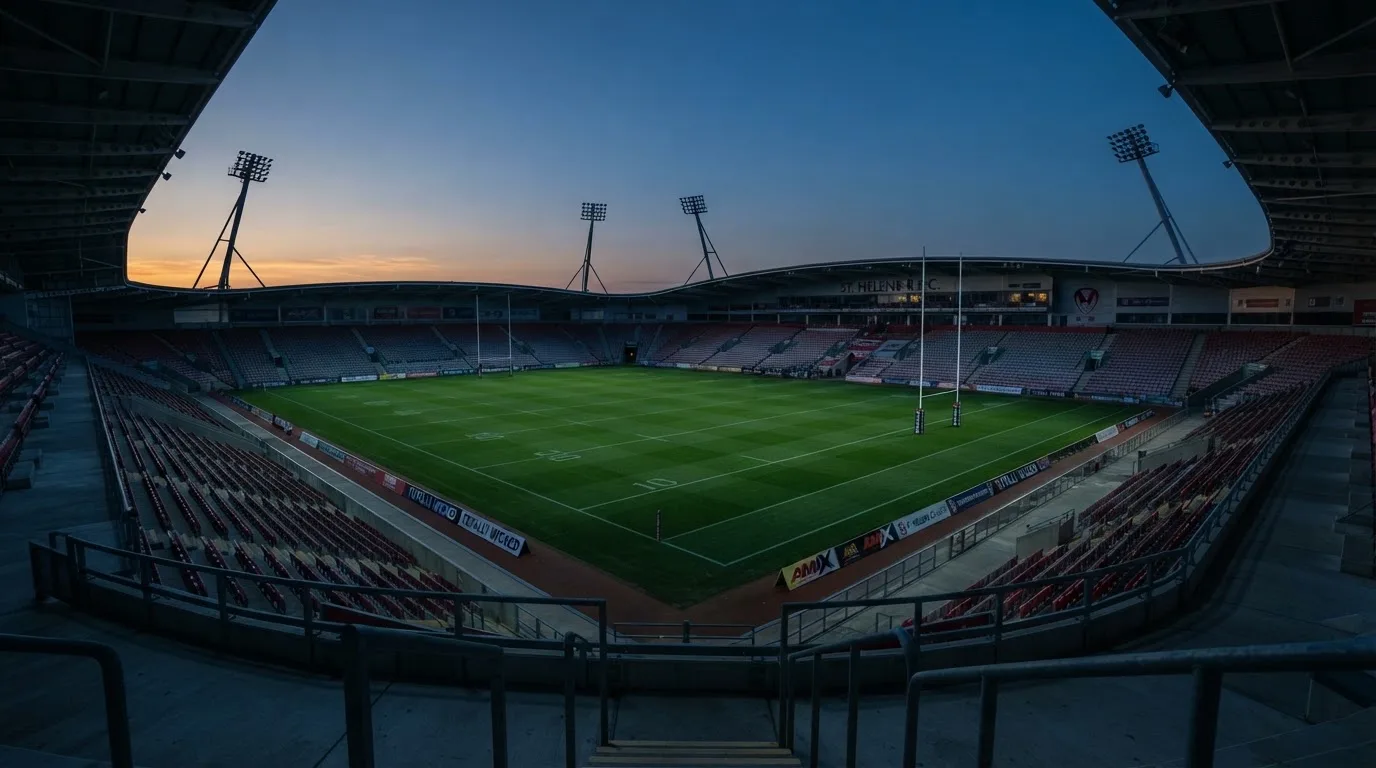
Handicap lines work off the points spread, not the tries-scored count, and bookmakers typically quote a small handicap (within a try’s worth of points) on Super League and a fuller one on the NRL where score gaps run larger. A line of +4.5 means the side starts the match four and a half points ahead for betting purposes; a line of −6.5 means the favourite gives the outsider six and a half. Because Super League matches often end with a try’s worth of points between the sides, the lines are tight. A whole-number handicap at a major firm is set so the favourite gives an exact figure, and an exact-margin result refunds all wagers on that line — all of them, the punter and the bookmaker alike, take their stakes back.
Totals are priced on total points scored, in segments (typically 30.5, 35.5, 40.5 and 45.5), and the size of the line moves with the form of the teams involved. Same-game multis combine these into one bet: any combination of moneyline, handicap and totals with one set of odds. The combined price is the product of the leg prices minus the bookmaker’s margin layered on top, so a four-leg same-game multi carries more margin than its single prices read.
Match betting on Super League and the NRL, and handicaps betting on both, settles on 80 minutes’ play under most operators’ rules. Most other markets on those fixtures — including tournament points, top tryscorer and any markets specified as “including extra time” — settle on the official result including extra time. Super League fixtures do not go to extra time in the regular season; some knockout rounds do, and the World Cup allows for extra time in the knockouts. A punter betting on Super League’s regular season therefore never has to think about extra time; a punter betting on a Challenge Cup final or a World Cup knockout does, and the market specifies which rules apply.
If a match is postponed, bets stand for 48 hours from the original kick-off; if the fixture is not played within that window, bets become void and stakes are returned. That rule is consistent across the larger GB operators. The Rule 4 deduction, the mechanism for paying out when a withdrawal happens after the betting closes, applies mainly to horse racing and not to rugby league, and a punter switching codes should not assume it transfers.
Match abandonment is rare in rugby league because most regular-season matches are weather-tight stadium fixtures, but it is documented: a lightning abandonment before half-time, a floodlight failure, a flood. The position is settled under the operator’s rules, with stakes refunded in most cases when the match is not completed. Punish nothing in the rules and trust the firm; check the rules before settlement day and the punter’s position is clearer.
Landscape: How Licensed GB Operators Compare on Rugby League
The table below lists ten operators that hold a Gambling Commission remote betting licence and accept British customers. Each row states the licence number, the entity the Commission records as the licence holder, and what that operator’s published terms and app entry say about rugby league. The “what the operator’s own terms state” column is qualitative — it tells the punter what to check on that operator’s site, not what to expect every Saturday.
| Brand | Gambling Commission licence | Licence holder | What the operator’s terms state on rugby league |
|---|---|---|---|
| Swifty Sports | Remote licence 058957-R-334734-006 (account 58957) | Swifty Global (UK) Ltd | Live streaming and in-play listed as features in the GB App Store entry; Best Odds Guaranteed named on horse racing on the same listing; rugby league pricing is published through the football-and-other-sports platform, in-play priceboards are open during matches |
| Ladbrokes | Remote licence 054743-R-330863-014 (account 54743) | LC International Limited | Long-standing high-street bookmaker with a published GB App Store app; rugby league markets sit inside the main football-style menu and the in-play console; Best Odds Guaranteed applies to horse racing, not rugby league, and the terms state that explicitly |
| Smarkets | Remote licence 039173-R-319366-011 (account 39173) | Smarkets (Malta) Limited | Operates as a betting exchange, not a traditional bookmaker; back and lay on rugby league are quoted on a commission-based model rather than a margin-based one; published payment-methods hub lists debit-card and open-bank deposits and a 6-hour withdrawal window for bank transfers |
| Midnite | Remote licence 101839-R-342850-001 (account 101839) | Midnite Limited | A relatively new GB-licensed bookmaker; in-play, acca builder, popular accas and price boosts with maximum-stake limits are all named in the app entry; rugby league moneyline and totals typically available; published welcome offer is a small-stake bonus with short-window wagering |
| Copybet | Remote licence 053774-R-330743-010 (account 53774) | Copybet UK Limited | GB bookmaker that markets itself on Best Odds Guaranteed for UK and Irish racing (all day, every day); pays first past the post on horse racing even if the runner is later disqualified; rugby league markets sit on the same platform, with no horse-racing-style BOG offer applied to them |
| Betfred | Remote licence 039544-R-319290-010 (account 39544) | Petfre (Gibraltar) Limited | A high-street chain that also runs an online sportsbook; covers the standard rugby league lineup (moneyline, handicaps, totals, match betting); pricing tends to be published early; named in the GB App Store entry with twenty-one sports and over 2,000 casino games on the app |
| Fafabet | Remote licence 057385-R-333191-006 (account 57385) | Taichi Tech Limited | GB App Store entry names Best Odds Guaranteed on UK and Irish horse racing win and each-way bets from 9am on race days; rugby league prices are listed through the general sports menu; position on BOG-style price commitments on rugby league is not separately stated |
| Fitzwilliam Sports | Remote licence 048760-R-335434-009 (account 48760) | SBKI Limited | A Dublin-based bookmaker with a capped-membership policy; the welcome is described as a “High Stakes Welcome” and subject to compliance criteria; instant deposits and fast withdrawals are advertised, with safer-gambling links to GambleAware, GamStop and Gamblers Anonymous |
| Bar One Racing | Remote licence 056516-R-332750-007 (account 56516) | Bar-One Racing Limited | An Irish independent bookmaker rebranded as BAR 1 Betting; shops across Ireland with horse-racing sponsorships in Dundalk, Fairyhouse, Navan, The Curragh, Curraheen Park and Cork; rugby league pricing is published but the brand’s centre of gravity is horse racing |
| BetTom | Remote licence 064959-R-339314-003 (account 64959) | Bet Tom Limited | A GB-licensed bookmaker with a sports welcome offer structured as 50% back as a free bet up to £50 plus 50% back up to £50 as free slot funds for casino play, with full terms applying; rugby league sits inside the general sports menu in the app |
Three points to draw from the table. First, a Gambling Commission remote licence does not differentiate these brands on rugby league quality — every one of them is licensed to the same regulatory floor, and the margin that separates them is thin to non-existent on any given match. Second, several of the names in this list (Fitzwilliam Sports, Bar One Racing) are Irish-rooted bookmakers whose centre of gravity is horse racing; rugby league markets exist but the firms’ pricing teams are not built around them. Third, the difference between a traditional bookmaker and a betting exchange (Smarkets) is a structural one: an exchange lets punters lay one another, and the published commission is the price of access, not the price of the bet itself. Rugby league liquidity on a betting exchange is thinner than on horse racing or football, so the spread of back-and-lay prices at off-peak hours can be wide.
Checking a licence is a five-second job and worth doing once before the punter’s first deposit. The Commission’s public register is searchable by business name, trading name, domain or account number; every operator covered here appears there, with the licence number and categories as listed. An operator holding a remote general betting standard (real events) licence may offer rugby league markets; an operator holding only a pool-betting licence may not. A punter who sees no licence where the firm name should appear, or a licence list that excludes rugby league events, should not deposit.
Legality and Regulation: What a GB Licence Buys a Punter
A bookmaker serving British customers needs a Gambling Commission remote licence since the Gambling (Licensing and Advertising) Act 2014 took effect. The Gambling Act 2005 sets the framework for England, Scotland and Wales (the Act covers Great Britain); Northern Ireland runs on earlier legislation and a separate regime. A Gibraltar or Malta licence is not a substitute where GB customers are concerned. The Commission’s public register lists every business that holds a current licence, with its account number, its remote categories and (where relevant) its licensed domains. That register is the only authoritative test of who is licensed; no other document or webpage carries the same weight.
The same scheme applies to customer-side checks. Every licensed remote bookmaker verifies name, address and date of birth before the first deposit, and has done since 7 May 2019 — the customer pays nothing for the check, but neither can the customer place a stake anonymously. The point is worth being specific about because a casual reader may hear “verification” and assume it is optional; it is not. A punter without the basic documents cannot open an account at all at any of the operators in this list. The consequence is a softer point of entry than the high street — no in-person ID — but the same load of paperwork on the back end.
Financial vulnerability checks sit on top of that. Under LCCP condition 3.4.4, in force since 30 August 2024 and rolled out to remote betting from 28 February 2025, an operator runs a public-record check (bankruptcy, county court judgments and similar) once a customer’s deposits net of withdrawals exceed £150 in a rolling 30-day window. That is not a credit check and not an income check; it surfaces information that is already in the public record. A punter will not be declined because of a low income, but may be asked further questions if a public record appears. Customer funds protection sits under a separate rule: large operators ring-fence customer balances in segregated accounts, and the specific protection offered varies by operator and is set out in the firm’s terms.
GAMSTOP is the national multi-operator self-exclusion scheme that every licensed remote operator has joined since 31 March 2020. A self-excluded customer can register once and block themselves across all participating operators for six months, one year, five years, or five years with auto-renewal. After the minimum period the exclusion stays in place for a further seven years unless the customer asks GAMSTOP to remove it. The punter-facing effect: a self-exclusion asked for at one operator does not need to be repeated at the next one, and an operator that lets a self-excluded customer bet is breaking its licence.
The bonus rule worth knowing is the cap on wagering requirements. Since 19 January 2026 any bonus promotion carries a wagering cap of 10x the bonus value: a £10 bonus cannot require more than £100 of qualifying bets to release its value. That rule is a structural change to how GB offers are written, not a small adjustment. A punter reading an offer published before that date should not assume the same terms carry across; an offer published after should sit at or below 10x. Mixed-product offers — promotions that demand gambling on betting and casino and bingo together for one bonus — are also banned in their entirety. The result is shorter, simpler offers at licensed firms.
The tax line is brief. Players pay no tax on betting winnings in Great Britain. General Betting Duty is the operator’s tax on gross profits (currently 15%, rising to a new remote rate of 25% within it from 1 April 2027 for remote bets other than on UK horse racing), and what share of duty the operator absorbs versus passes through in odds is not established by any regulator statement. A punter does not need to budget for tax.
Offshore is a separate case. A firm that takes GB customers without a Commission licence is acting unlawfully under section 33 of the Gambling Act 2005; the offence is the firm’s, not the punter’s. What the punter loses by using such a site is structural protection — no GAMSTOP coverage, no Commission complaints route, no approved dispute-resolution body, no British consumer redress, and no application of the bonus cap or the vulnerability-check rule. The Commission’s enforcement is disruption-led rather than blocking-led: cease-and-desist notices, search-engine referrals, registrar and payment-provider work, and (more recently) court-order DNS blocking powers. None of that undoes a customer being unable to withdraw. The honest framing is that licensed firms have the protection and the verification overhead, and unlicensed firms have neither.
The legal position turns on three lines. The first is whether the operator is licensed (search the register). The second is whether the customer’s account is verified (the basic registration checks). The third is whether the offer and the wagering condition fit the published cap and rule set. A punter who answers all three before the first deposit has done what licensing can do for them.
What the Licence Does Not Cover
Licence does not make the bookmaker accurate. The Commission licenses the firm; it does not audit its prices. A price the firm publishes may be generous or thin; the licence does not say. The market protection — the £150 vulnerability check, the GAMSTOP coverage, the bonus cap, the deposit limits the operator must offer — is real, but it sits on top of the operator’s pricing, not behind it. The punter’s skill is the punter’s own.
Licence does not guarantee settlement when the operator becomes insolvent. Customer funds protection rings customer balances in a separate account at large operators, but the level of protection varies — “segregated” is not the same as “insured”. A punter should look for the operator’s published customer-funds policy before staking significant sums.
Licence does not override anti-money-laundering questioning. At higher stake levels the operator is required to ask source-of-funds questions (a payslip, a bank statement, a tax document). The punter is the source and the punter provides the document. This is heavier than the registration check and may surprise a customer who has never been through it.
Responsible Gambling: Practical Steps a Punter Can Use
Responsible gambling at a licensed bookmaker is structural, not optional. The firm’s safer-gambling team has the duty to monitor play and intervene, and the customer’s tools sit underneath that as a layer of personal limits. This section sets them out in the order a punter is most likely to meet them, from the first deposit to a long-tenured account in trouble.
Deposit limits are the headline tool, and they are mandatory at the operator level — every licensed firm offers them and is required to ask new customers to set one before the first deposit. A deposit limit is a cap on gross deposits in a chosen window (a day, a week or a month) and once set, a punter cannot raise it without a cool-down: an increase is processed after a period of 24 hours, sometimes longer, so the customer has time to reconsider. A decrease takes effect immediately. RTS 12 introduced phased changes to how deposit limits work from 31 October 2025, with a second phase scheduled for 30 September 2026. The published position is that no statutory daily or monthly ceiling exists; the punter picks the ceiling and the firm enforces it.
Time-outs are the second tool and sit close by. A time-out is a self-imposed ban from the account lasting 24 hours, 48 hours, a week, or any period up to six weeks. It cannot be lifted early. It is a smaller step than self-exclusion and useful for a punt who wants a circuit-breaker without committing to a six-month block. The punter’s account is closed for the period; any open bets placed before the time-out stand to settlement.
Self-exclusion is the heaviest personal tool. A punter can exclude themselves from one operator or from all GB-licensed remote operators simultaneously through GAMSTOP. The minimum exclusion is six months; the maximum the customer can request is five years with auto-renewal, after which it stays in effect for a further seven years unless the punter asks GAMSTOP to lift it. Once in place, the punter is on the operator’s stop list and any attempt to reopen an account at the same firm is rejected. Multiple-operator exclusion through GAMSTOP is the structural answer for a punter who wants out of online betting entirely.
Reality checks sit underneath those tools and run automatically. A licensed firm must prompt the customer with a reality check during play — typically every 30 minutes — showing time on the site, money deposited, money won, and money lost. The message is informational rather than a stop; the punter reads it and continues or logs out. Several firms also publish profit-and-loss statements on request, drawn from the same time-accounting logic.
Help lines sit outside the firm’s site. GamCare runs the National Gambling Helpline (a free 24-hour service), and GambleAware funds treatment and counselling for problem gambling. Gamblers Anonymous runs peer-support meetings in most British cities. NHS gambling clinics exist in several regions; referral is through a GP. None of those services is the punter’s softer option; they are the front-line answer once a punter has decided the personal tools are not enough.
Two practical points on using those tools well. First, set the deposit limit at the registration stage even if the punter plans to raise it later — the cool-down applies to increases, not to the original setting, and starting at a sensible level establishes the floor. Second, treat time-out as a real intervention rather than a tactical gesture. A time-out set with the intent of breaking a session works; a time-out set because the punter felt they ought to set one does not. A line that is a real limit is a line that holds when the temptation hits.
What a Punter Should Not Do With the Tools
Do not use self-exclusion as a marketing tactic — set a six-month exclusion, lift it, set a one-year exclusion. The system assumes a self-excluded punter has decided to stop, and the operator treats that decision as settled. A punter who cycles in and out of exclusion is signalling the opposite of what self-exclusion means, and the operator’s safer-gambling team will read that as a flag.
Do not chase losses with a deposit-limit increase. The cool-down is the regulator’s structural way of forcing a pause before that step, and a punter who hits “increase deposit limit” during a session is the precise use case the regulator has in mind. The pause is the value.
Do not assume the firm will spot the problem first. The safer-gambling team works in the background, but the documentation they see is the documentation the punter produces. A punter who is honest with the firm in a single sentence — “I am spending more than I should” — gets a different response than a punter whose first contact is a complaint about a voided bet.
Bonuses and Free Bets: How GB Offers Are Priced Now
The offer landscape at GB bookmakers has tightened since the 10x wagering cap took effect on 19 January 2026 and mixed-product offers were banned on the same date. The headline-grabbing free bet of a few years ago — £30 free for a £10 stake with six or seven layers of turnover attached — is no longer the legal shape of the welcome. The structural direction is towards simpler mechanics: the bonus or the free bet carries a published value, a wagering cap that does not exceed 10x the bonus, and a short validity window (typically seven to fourteen days). Mixed-product offers, where the same promotion demands betting and casino and bingo to release, are out.
The offer types that a GB punter will see on a rugby league welcome are essentially three. First, the free bet bundle: place a qualifying bet, receive a set of free bets. The qualifying bet usually carries a minimum price (Evens, in decimal terms 2.0 or greater, is the industry norm), an expiry window (typically fourteen days from registration) and a stake-restriction during the early days of the account. The free bets that follow are paid as bet credits and usually exclude the stake from a winning return — stake £10 of free bets at 3.0 and the punter wins £20 (the £10 stake is not returned with the win). Second, the cash bonus: place a qualifying bet, receive a percentage of the stake as a cash bonus, with a wagering multiplier on the bonus that does not exceed 10x. Third, the odds boost or acca insurance: a one-off price boost on a selected fixture (often a heavily-watched football or racing event), or insurance on an accumulator that pays back the stake as a free bet if exactly one leg lets the punter down. Each carries fine print on minimum odds, validity, what counts as an eligible selection and how the refund is paid.
The free bet’s expected value is a calculation worth doing once. For a free bet whose stake is not returned with the win, the formula gives expected value as the free-bet amount multiplied by the price minus one, divided by the price, multiplied by the payout share of the market. For a £10 free bet at a price of 3.0 on a market with 95% payout share, that gives 10 × (3 − 1) ÷ 3 × 0.95 = £6.33 — an average return across many stakes, not a guaranteed one. A punter placing the same free bet at a price of 2.0 on a market with 95% payout share gets £10 × 1 ÷ 2 × 0.95 = £4.75. The free bet is worth more at higher prices, but only because a higher price pays more when it wins; the free bet itself does not change.
Promotional pricing is a parallel issue. The “boosted odds” or “Super Boost” pattern — a one-off price on a selection offered to all customers, with stake limits at the lower end — is now the standard give-away at larger operators. The punter reads it as a price more generous than the going rate and accepts a low maximum stake, typically £10 or £20. The economic value of a price boost is the difference between the boosted price and the going price, multiplied by the stake — small on a £20 stake, meaningful on a large accumulator with several boosted legs. The punter looking for value should price the boost against the same selection at the firm’s regular price, or against the same selection at an exchange. A boost that takes the price from 2.50 to 3.00 on a £20 stake is worth £4 by itself — meaningful across an accumulator with several such legs.
A punter looking at a rugby league-specific offer is more likely to meet a generic sportsbook welcome (small-stake bonus, short window, 10x cap) than a sport-specific offer. The reason is that rugby league fixtures are sparse enough that running a sport-specific promotion collapses when the next round is delayed by weather or international call-ups. Operators prefer to attach bonuses to fixtures whose kick-off is known and the market populated; rugby league rarely meets that test on its own. The consequence is that the welcome sits on the sportsbook rather than the rugby league lines, and the rugby league lines are priced in their own right.
The Trade-Off the Punter Is Reading
Every welcome promotion is a marketing spend dressed as a price. The promotion is paid for by the margin on the punt’s subsequent bets, and the clever punter reads the offer for the wagering condition and the validity window before deciding whether to take it. A high headline-value bonus with a tight validity is heavy turnover packed into a small calendar; a low headline-value bonus with a 30-day validity is gentler. The 10x cap means the maximum staking to release any welcome bonus at a GB firm now sits at ten times the bonus value; an offer previously requiring 30x turnover requires, by present law, three times less staking than before. That is real value to a punter choosing between offers.
One last caveat applies to all offers: the fine print is the offer. Market restrictions, eligible selections, payment-method exclusions (some offers exclude deposits made via Skrill or Neteller), minimum odds on the qualifying bet, country-of-residence limitations and a stake cap on the bonus release are all common. A punter who reads only the headline has read half the offer.
Live Betting and Cash Out
Live betting on rugby league is a real market at the larger operators, with prices updating ball-by-ball through the second half of Super League and NRL fixtures. The in-play product is part pricing-engine, part UI: a priceboard of moneyline, handicaps and totals that updates on scoring events (tries, conversions, penalties), with cash out offered on most lines the moment the operator can price them.
A cash out is the operator buying back the punter’s bet at a price the operator sets in real time. The mechanic is straightforward: a £10 bet at 3.0 has a return of £30 if it wins; the punter requests a cash out at half-time when the punter’s team is winning; the operator offers, say, £18. The punter closes the position and walks away with £18 instead of holding for the full return or nothing. The price is operator-set; the punter either accepts the figure offered or holds for settlement. Cash out is most useful when the price has moved in the punter’s favour but the outcome is no longer as certain as it looked when the bet was placed.
The margin on live markets is wider than the margin on pre-match markets, in general. The pricing engine has to publish a price through a moving event where the operator’s information set is ahead of the punter’s (slower data feeds and slower screenshot times work in the operator’s favour). A pre-match Super League handicap priced at 90% payout share might appear in-play at 88% or lower as the match progresses, and the difference comes out of the punter’s pocket. A punter who is comparing the price that was available pre-match with the price offered live is comparing two different products.
The same applies to cash out. The cash-out price incorporates the firm’s margin for closing the bet early; the punter is paying for the convenience of stepping out of the position. A £10 bet at 3.0 with an in-running fair price of £24 might cash out at £18; the £6 is the cost of closing early. A punter who knows the market’s fair price can read the cash-out offer for what it is — a price, with a margin — rather than a gift.
A related feature is Bet Builder or Same Game Multi, which lets a punter combine several markets on one match into a single bet. The combined price is the product of the leg prices plus an extra margin layered on by the operator. A two-leg same-game multi on Super League has slightly worse than fair odds relative to the price the punter would get placing two singles on the same markets, and the gap widens with the number of legs. Larger operators offer a Bet Builder+ variant that combines markets across fixtures within the same sport into a single bet. Rugby league is sparsely priced enough that long Bet Builders often fall over when a leg’s market goes off air mid-match.
In-play on the NRL is where the live product is at its sharpest, partly because the betting exchange liquidity on the NRL is deeper at certain firms. A punter comparing the live offerings across the operators above will see that the bigger names (Betfred, Ladbrokes) carry more in-play markets on the NRL than the smaller ones, and the depth is a real differentiation. The consequence is that a punt who wants live NRL plays has a narrower choice than a punt who wants pre-match.
What a Punter Should Watch For
The first thing to watch is the suspend/resume cadence. Live pricing is suspended around scoring events and resumes after a short delay; the window between the suspending and the price being reissued is when the operator can clip the punter’s price for a “physical” event (a try scored, a referee decision). A punter who watches the cadence on the firm’s pricing can pattern-match to scoring rather than paying for a stale price.
The second is the cash-out timing. A cash out requested at half-time settles at the operator’s price at half-time; a cash out requested during a scoring flurry may settle at a less favourable price because the operator’s price reflects the new state. The punter knows when the best cash-out price will be available and times the request to suit.
The third is the limit disclosure. Live betting often carries a tighter max-stake than pre-match, particularly in the last ten minutes of a match. The punter placing an in-play single on a Super League fixture should expect the operator’s stake ceiling to drop as the match winds down, particularly if the punter’s stake is on the favourite.
Predictions, Tips and Strategy: What the Punter Can and Cannot Know
Prediction markets are an attempt to put a future price on a future outcome. The punter looking at “rugby league tips today” or a “best bet” column is reading a forecast that claims a probability higher than the book’s implied probability. None of that forecast is verifiable on the day — for rugby league as for any sport, the only honest output is what a model’s confidence interval actually did, not what a tipster claims it will do. The consequence is that a punter reading tips should treat each tip as a small data point (one person’s view, with whatever access they had to team news and form) rather than as guidance.
The kind of work that improves a punter’s edge is structural rather than tippy. The first is line-shopping: the same fixture at three operators carries three handicap lines and three totals, and the price that pays six pence more per pound matters across a stake. A punter who reads the same market at three firms gets more value than one who reads it at one. The second is market timing: a fixture priced early is priced on a thinner book; the morning prices on a Super League match typically move several percentage points before kick-off. A punter who is willing to bet early accepts worse odds; a punter who waits accepts the risk that the price they liked disappears. The third is form reading: a team’s tries scored per game, their metres gained, their completion percentage, their tackle completion rate — these are all signal. None of them is signal on its own.
Bankroll is the meta-skill. A punter staking a fixed percentage of bank per bet (commonly 1–3%) levels the variance over a season and stops losing streaks from emptying the account. A punter staking in proportion to confidence rather than to a flat rule over-bets on longshots and under-bets on favourites, with the result that the bankroll drifts. The most common rookie mistake is bet-sizing against confidence, which compounds the variance already there.
For Super League specifically, a punter with no special access to team news should price on the following frames: home advantage in Super League is real but smaller than in football, and away favourites have won more often than the prices used to give them credit for. The NRL has the strongest home-advantage signal of any league code in mainstream sport; a price on a home side giving fewer than 6 points on the handicap is paying the home team’s advantage, and a price on an away side giving more than 6 points is asking the away side to win by a margin the home crowd typically prevents. None of that is a system that wins; it is context for reading the price.
The honest position on a punter’s “strategy” is that the strategy does not exist that wins on a league whose market margin sits around 5% on the bigger markets and climbs higher on the smaller ones. What a strategy does is reduce variance and protect the bankroll; what it does not do is produce a winning edge year-on-year, because the bookmaker’s prices are already adjusted for the publicly-available information. A punter who finds a real edge finds it on a market the bookmaker has mispriced, and that market is not “rugby league tips today” anywhere a casual reader would find it.
The Type of Work That Does Pay
There are three routes a punter can pursue without claiming a winning edge. First, the price-arb between an exchange and a bookmaker: lay a selection on the exchange at price x, back the same selection at a bookmaker’s price y where y > x, and capture the difference. The arbitrage is real and the maths is straightforward, but it is small (a few per cent on a single bet), requires an exchange account, and is competed out by professional arbers staking the moment a price appears. Second, the in-play trade: price movement through a fixture produces short windows where the spread between back and lay is tight enough to step in and out at a profit. The strategy scales with event coverage, and an NRL fixture offers more in-play liquidity than a Super League fixture. Third, a bookmaker’s value play on a price boost where the boosted selection sits above the same price at an exchange: the punter stakes the maximum allowed and locks in the difference.
Each of these routes carries more cost than a casual reader assumes — account fees, commission on exchanges, the wide margins on in-play pricing, the time cost of reading the markets. A punter who is reading this page is better off pricing the market correctly than chasing any of them.
Bet Types and Odds: How the Markets Settle, How the Prices Move
The price line on a Super League match is the product of two pieces of information: the market’s view of each team’s chance of winning and the bookmaker’s margin layered on top. The market’s view of the chance is the implied probability: a price of 2.0 implies a 50% chance of winning, a price of 4.0 implies a 25% chance, a price of 1.5 implies a 67% chance. The conversion is simple: implied probability equals one divided by decimal odds. The market margin is the layer above that.
The bookmaker’s margin is the share of total staking the firm keeps across all outcomes of a market. For a two-way market at decimal prices 1.90 and 1.90, the implied probabilities are 1 ÷ 1.90 = 52.63% on each outcome, summing to 105.26%. The payout share — the share of every pound staked that is returned to winning punters across both outcomes — is 100 ÷ 105.26 = 95.00%, and the margin is 100% − 95% = 5.00%. So even on a symmetric-looking match the bookmaker keeps 5 pence of every pound staked, and that margin is the firm’s revenue, paid by the punters who back both outcomes in the long run. Where prices are asymmetric (a favourite at 1.40 and an outsider at 3.50), the implied probabilities add up to a similar margin, distributed around the favourite’s shorter price. Across the major rugby league markets, margin sits in a band — typically 5% to 8% on the bigger markets at the bigger firms, and wider on smaller fixture menus.
The expected cost to the punter, then, is the stake multiplied by the market margin. A punter betting £100 in total across a Super League fixture at a 5% margin is expected to lose £5 across the run of bets, and a punter betting the same amount at an 8% margin is expected to lose £8. That is across many bets; on any single bet, the punter wins or loses on the outcome. The point of the calculation is that the book’s edge is small but per-bet, and it compounds over a season.
Same-game multis carry more margin than the underlying singles because each leg carries its own margin and the operator layers an extra margin at the combination stage. A two-leg combination of two Super League handicap lines each at a 6% margin gives a combined margin sitting in a band around 11–12% — wider than the wider single line, and reading as a real cost to the punter who treats the multi as a price-cut. The same applies to accumulator-style bets: each leg layered in widens the margin further. A punter who likes the combined bet reads the combined price against the laid price of the single legs at an exchange to see the gap.
Spread betting is a different product. Spreadex — a UK-licensed firm regulated for spread betting by the Financial Conduct Authority and for fixed-odds betting by the Gambling Commission — runs spread markets on selected rugby league fixtures where the price is a range (say, 24–26 points for a total-points market) and the punter’s stake decides the outcome: the punter buys the points at the higher end of the spread and wins if the actual total exceeds the higher end, or sells at the lower end and wins if the actual total falls short. Spread losses can exceed the deposit because the punter’s loss is multiplied by their stake per point. That is the regulatory disclosure Spreadex’s own site makes plain; it is the reason spread betting is licensed separately and is a product for the punter who reads the contract, not the punter who reads the screen.
Fractional odds are still the first form published at GB bookmakers, even when decimal odds sit beside them. The conversions are simple: fractional odds a/b convert to decimal odds a ÷ b + 1. So 5/1 becomes 5 ÷ 1 + 1 = 6.00, 11/4 becomes 11 ÷ 4 + 1 = 3.75, evens (1/1) becomes 1 ÷ 1 + 1 = 2.00. The punter reading any GB operator’s price board will see both forms side by side; a price quoted in fractional odds where the second number is smaller than the first is a favourite, where the numbers are equal is “evens” (50/50 in implied probability terms), and where the second number is larger is an outsider.
Reading the Price Board
A useful sanity check on a price is to ask what probability the punter would assign to the outcome. If a punter’s view is more confident than the price implies — the punter thinks the favourite is more like a 60% shot and the price implies 67% — the punt is the wrong way around. A punter should bet where their view of probability is more confident than the price, and that applies across every sport and every market on the page.
The reverse — a punter’s view less confident than the price — is a signal to walk away. A 3.0 price on a punter’s team implies a 33% chance of winning; if the punter’s view is 25%, the price is too short and the punt is minus value. The discipline of reading the price against the punter’s view is the discipline that survives a season; the discipline of trusting a tip without the price reading does not.
The Bookmakers Reviewed
Each operator below is described from the operators’ published terms and GB App Store entries, with the licence number and holder as recorded on the Gambling Commission’s public register. Where the operator’s rugby league offer is thin, that fact is in the review; where the operator’s centre of gravity is not rugby league, that is also in the review. The verdict closes each block on what the brand does for a rugby league punter and where it falls short of the next one.
Swifty Sports
Swifty Sports holds a Gambling Commission remote betting licence under Swifty Global (UK) Ltd (account 58957) and the firm’s GB App Store entry names Best Odds Guaranteed, Cash Out on selected markets, daily price boosts, live streaming and in-play betting as the headline features. Bet Builder is listed as “coming soon”. Rugby league sits inside the main sports menu alongside football, with moneyline and the standard set of markets. The firm’s product pitch, as published, is the modern sportsbook experience rather than the high-street fixture.
What that means for a rugby league punter is a recent-app product with the larger operators’ feature set — in-play console, cash out, acca pages, price boosts — translated onto a smaller firm. The depth of rugby league pricing at a smaller operator tends to be shallower than at the bigger firms; the cash-out coverage tends to be more conservative. A punter who values the UX more than the depth of rugby league pricing is the natural fit here; a punter who values price-shopping across multiple operators will not get the same depth they would at a Betfred or Ladbrokes product.
The verdict: a clean, modern app with the feature set a casual rugby league punter uses; the depth of the rugby league book does not match a larger firm and the welcome product has not been published at the size of the bigger competitors.
Ladbrokes
Ladbrokes runs under LC International Limited (account 54743) and the firm’s GB App Store entry is rated 4.66 from 101,255 ratings — the dominant high-street bookmaker in Britain, with an online sportsbook that has been live for two decades. Rugby league markets sit inside the main football-style menu and the in-play console, with Best Odds Guaranteed on horse racing as the headline promotion across the shop and the app. That promotion does not extend to rugby league, and the terms state that explicitly.
What makes Ladbrokes a significant rugby league bookmaker is the size of the firm — the price depth on Super League and the NRL is the widest in this list, and the in-play console carries the widest set of markets on a busy Saturday. The Cadbury-style in-play overlay on a Super League fixture will show moneyline, several handicap lines, a totals range, team totals, a next-tryscorer market for the in-play period and a same-game multi. The depth does not extend to Championship matches as reliably, but it covers the top tier consistently.
The verdict: the deepest rugby league book in this list. A punter who wants price-shopping depth on a Super League match and is willing to accept the firm’s terms and the brand’s lack of price-shopping convenience gets the most comprehensive offering. A punter wanting more modern UX or a lighter UI is better served elsewhere.
Smarkets
Smarkets operates under Smarkets (Malta) Limited (account 39173) and functions as a betting exchange — a venue where punters back and lay one another, with Smarkets taking commission on net winnings rather than a margin on price. The firm’s payment-methods hub lists debit-card and open-bank deposits with an instant deposit window from £10 to £10,000 by open-bank transfer, and withdrawals processed within 6 hours from £10 to £100,000 by the same channel — both are unusually fast for a GB-licensed operator.
Rugby league on a betting exchange is the public bookmaker’s price available in the opposite direction, plus the lay. The back price at the firm is the price the punter pays to take a position; the lay price is the price the punter pays to take the opposite position. The two prices sit side by side with a spread between them that is the firm’s commission, and the spread tends to be wider on rugby league than on horse racing because liquidity is thinner. A Super League match carries £10,000 to £100,000 of matched volume at peak hours, while a mid-week NRL fixture carries less, and a Championship match is thin enough that the spread widens.
The verdict: a betting exchange with the right structural shape for the punter who is willing to lay as well as back. The 6-hour withdrawal window is among the fastest in this list. The punter’s edge comes from the lay side as much as the back, and a punter unfamiliar with laying will not use this firm as well as a punter familiar with it.
Midnite
Midnite runs under Midnite Limited (account 101839) and is the newest GB-licensed bookmaker in this list. The firm’s GB App Store entry lists in-play, acca builder, popular accas and price boosts with maximum-stake limits as published features, and the welcome product (a £5 or more qualifying bet at minimum price Evens returning £25 in free bets and 50 free spins) carries a 7-day validity window. The product is built around the modern sportsbook UI rather than the high-street UX, and the pricing on individual fixtures has been competitive on the headline markets since launch.
The rugby league depth at Midnite sits below Ladbrokes but above some of the smaller firms on a typical Super League fixture. Moneyline, handicap and totals are usually priced; same-game multi is supported through the acca builder. In-play coverage is published; cash out is not always available on every market the firm lists. The firm’s product is new enough that the rugby league pricing is still being built; a punter comparing prices at launch will see less choice than at a 20-year-old book.
The verdict: a modern sportsbook UI with a small-stake welcome and reasonable depth on the headline rugby league markets. Not yet the deepest rugby league book on the list. The punter who values a fresh product over depth gets a different shape here.
Copybet
Copybet is operated by Copybet UK Limited (account 53774) and the GB App Store entry markets the firm on Best Odds Guaranteed all day, every day on UK and Irish horse racing, with first-past-the-post paid on horse racing even if the runner is later disqualified. That racing focus is the brand’s centre of gravity. Rugby league prices are published through the main sports menu, with the same product set of in-play and cash out; the marketing of the brand is on racing.
What this means for a rugby league punter is a bookmaker who carries the standard rugby league lines without making any racing-style price commitment on them. The depth on Super League is OK; the depth on the NRL is OK; Championship matches are sometimes listed. There is no rugby-league-specific brand pitch. A punter who is a Copybet customer for the racing product and adds rugby league bets as a side activity is the natural fit; a punter whose primary interest is rugby league and secondary is racing would do better splitting the staking between the racing-focused specialists and the rugby-league deeper books.
The verdict: a racing-first bookmaker that carries rugby league without making any rugby-league price commitment. Useful as a deposit destination for a punter who wants both racing and league play in one account. Less useful as the rugby league specialist’s primary book.
Betfred
Betfred is operated by Petfre (Gibraltar) Limited (account 39544) and the firm’s GB App Store entry names twenty-one sports and over 2,000 casino-style games on the app. The brand is the high-street bookmaker with an online sportsbook attached. Rugby league is among the twenty-one sports covered, with moneyline, handicaps, totals and match betting priced across the major competitions.
What makes Betfred a serious rugby league bookmaker is the firm’s position in the British market as a top-three high-street brand, which produces depth on the popular rugby league markets at a level comparable to Ladbrokes. Super League fixtures are priced several days ahead at Betfred, and the in-play console carries the standard set of markets with cash out on the moneyline. The firm’s welcome products sit on the racing side and the football side; the rugby league welcome is not separately published. The NRL is priced through the firm’s Australian and international sport set, and the depth there is OK but not as deep as on a Ladbrokes Super League match in mid-season.
The verdict: a serious rugby league bookmaker with high-street DNA and a wide product set. The depth on Super League is comparable to Ladbrokes on a busy Saturday; the depth on NRL is below. A punter who likes the high-street bookmaker’s product style and the in-play depth on Super League gets a strong offering. A punter who wants the deepest NRL book should look elsewhere.
Fafabet
Fafabet runs under Taichi Tech Limited (account 57385) and the GB App Store entry names Best Odds Guaranteed on UK and Irish horse racing win and each-way bets from 9am on race days. Rugby league sits inside the general sports menu. The product is a modern sportsbook UI with the standard in-play console and acca builder.
The depth on rugby league at Fafabet is moderate — Super League and the NRL are priced through the main sports menu, with moneyline, handicaps and totals on the bigger matches. Championship matches are sometimes priced. The price on any given market is competitive but not always the best, and the punter comparing a Super League fixture at three firms will find Fafabet’s price in the mix without it being the dominant price. The cash-out coverage is broad but not universal, and same-game multi is supported.
The verdict: a competent mid-sized sportsbook with moderate depth on rugby league. A punter using Fafabet as one of three price-shopping destinations gets value. A punter using Fafabet as the only rugby league book does not get the full market depth the bigger firms carry.
Fitzwilliam Sports
Fitzwilliam Sports is operated by SBKI Limited (account 48760) and the brand describes itself as a Dublin bookmaker with a capped-membership policy. The welcome product is described as a “High Stakes Welcome” subject to compliance criteria. The firm publishes instant deposits, fast withdrawals, timeouts and deposit limits, with safer-gambling links to GambleAware, GamStop and Gamblers Anonymous.
The rugby league offer at Fitzwilliam is not the firm’s centre of gravity — the firm’s product pitch is horse racing and the high-stakes welcome is on that side. Rugby league is published through the main sports menu with the standard set of markets. The depth on a typical Super League fixture is shallower than at the bigger firms. The capped-membership structure means the firm takes fewer sign-ups and has a higher welcome threshold; a casual punter is unlikely to qualify for the high-stakes welcome on a rugby league stake.
The verdict: an Irish-rooted bookmaker with a racing centre of gravity and a capped-membership, high-stakes welcome. Rugby league is published but not the focus. A punter whose primary interest is high-stakes racing play and uses rugby league as a side activity is the natural fit; a casual rugby league punter should look elsewhere.
Bar One Racing
Bar One Racing runs under Bar-One Racing Limited (account 56516) and the brand is the Irish independent bookmaker rebranded as BAR 1 Betting. Shops across Ireland carry the brand’s high-street position; horse racing sponsorships sit in Dundalk, Fairyhouse, Navan, The Curragh, Curraheen Park and Cork. The product is a racing-first online bookmaker with rugby league available through the general sports menu.
The depth on rugby league at Bar One Racing is what one would expect from a racing-first operator — Super League and NRL are typically priced, but the depth does not match a high-street generalist. Cash out is supported; in-play is supported. The punter interested in rugby league as one of several sports played at one bookmaker has a workable option here; the punter looking for the deepest rugby league book does not get it.
The verdict: an Irish racing-first bookmaker with a smaller rugby league book than the larger generalists. A punt that mixes horse racing with the occasional rugby league single is workable here. A rugby league specialist is better priced elsewhere.
BetTom
BetTom operates under Bet Tom Limited (account 64959) and the firm’s GB App Store entry names a sports welcome offer structured as 50% back as a free bet up to £50, with a matching 50% back up to £50 as free slot funds for casino play, with full terms applying. This promotion combines betting and casino products, which contravenes current regulations for welcome offers at GB-licensed firms. Whether BetTom’s existing customers are being served under legacy terms and new sign-ups are not is a question for the Commission’s register — a punter looking at the firm should read the current terms before depositing.
The rugby league book at BetTom is supported, with the standard markets published through the main sports menu. The depth and the price will not match the larger operators on a Saturday Super League match. A punter looking for the firm’s Welcome should price the bonus as a marketing spend — the headline is the size, and the condition is what the firm demands for the bonus to pay out.
The verdict: a GB-licensed bookmaker with a smallish rugby league book and a welcome product that combines betting and casino. Useful as a price-shopping destination; not the first stop for a rugby league specialist.
Frequently Asked Questions
How does someone bet on rugby league?
A punter opens an account at a Gambling Commission licensed bookmaker, verifies identity, deposits and selects a rugby league fixture from the sports menu. The main markets are moneyline (pick the winner), handicap (one side starts with a points advantage or disadvantage) and totals (pick whether the combined score ends over or under a published number). Same-game multis combine markets from one match into a single bet at a multiplied price. Bets settle under the operator’s rules, with Super League and NRL match and handicap bets settled on 80 minutes’ play, and most other markets settled on the official result including extra time.
How is a Gambling Commission licence confirmed?
The Commission’s public register is the only authoritative source. The punter searches by business name, trading name, account number or domain. Each operator entry lists the licence number, the licence holder’s legal name, the licence type and the remote categories that the licence covers. Rugby league under a “remote general betting standard (real events)” licence is permitted; under a pool-betting-only licence it is not. A licence entry should match what the punter is shown on the firm’s own site before any stake is placed.
How is the return on a bet worked out from the stake and the odds?
The return on a winning single bet equals the stake multiplied by the decimal odds. A £10 bet at decimal odds of 3.00 returns £30 when it wins. The net profit is the stake multiplied by odds minus one: £10 multiplied by 2 = £20. For an accumulator, the odds of each leg multiply into one combined price, and the stake returns the combined price multiplied by the stake when every leg wins. Most operators settle by stake returned on the win, so the return on a winning £10 accumulator at a combined price of 12.50 is £125.
What is the bookmaker’s margin and how does it show in the odds?
The margin is the share of every pound staked the bookmaker keeps across all outcomes of a market. For a two-way market priced 1.90 and 1.90 the implied probabilities are 52.63% on each side and sum to 105.26%, so the payout share is about 95% and the margin is about 5%. Wider margins on smaller markets produce sums closer to 110%, which is the bookmaker keeping closer to 10% of staking in the long run. Margin compounds across many bets; on a single bet the punter wins or loses on the outcome.
How do fractional odds such as 5/1 convert to decimal odds such as 6.00?
The conversion is a ÷ b + 1 in decimal form. So 5/1 becomes 5 ÷ 1 + 1 = 6.00, 11/4 becomes 11 ÷ 4 + 1 = 3.75, and evens (1/1) becomes 1 ÷ 1 + 1 = 2.00. Fractional odds where the first number is larger than the second are favourites (shorter than evens); odds-on prices are those where the second number is smaller than the first. The GB bookmaker’s price board publishes both forms side by side.
Which controls over play does a licensed bookmaker have to offer?
A licensed remote bookmaker must offer deposit limits (with a cool-down before an increase), reality checks (typically every 30 minutes during play), time-outs (24-hour self-imposed blocks up to six weeks), and self-exclusion either at the firm or across all GB-licensed remote operators through GAMSTOP. The GAMSTOP minimum exclusion is six months; longer periods are available, and the exclusion stays in place for a further seven years after the minimum unless the customer asks GAMSTOP to lift it. Help lines outside the firm include GamCare’s National Gambling Helpline, GambleAware, NHS gambling clinics and Gamblers Anonymous.
Rugby, cricket & Gaelic – Boxing betting
Content created by the «Boxing betting» team
