
Betting on American football in GB – the real shape of odds, markets and offers
 Available in US
27 October 2026 data checked against the Gambling Commission’s public register.

The Super Bowl and the NFL playoffs draw more single-week betting interest in Great Britain than almost any other American sport, and the action does not stop at kickoff: in-play markets run through every quarter, and the average licensed bookmaker now lists the NFL season as a permanent fixture rather than a one-off curiosity. What follows is a working guide to that market: how the points system shapes the bet types, what the bookmaker’s margin actually does to a price, how live betting and cash out function on a sport whose scoring is bunched rather than continuous, and which offers repay their headline and which silently cost the punter. Every figure below is taken from the public register, from an operator’s own published terms or from the calculation shown in this article – nothing is rounded into a softer number than the source carries.
Live betting and cash out on American football
A live American football market is unlike a live football (soccer) one. Soccer scores in ones, on an open clock, in a continuous flow of pressure. American football scores in clumps of two, three, six or seven, separated by stoppages, and a drive can stall three yards from the end zone for two quarters before a single field goal changes the price. A live bookmaker has to model that stop-and-go rhythm, and the punter who reads it as a soccer game gets the timing wrong.
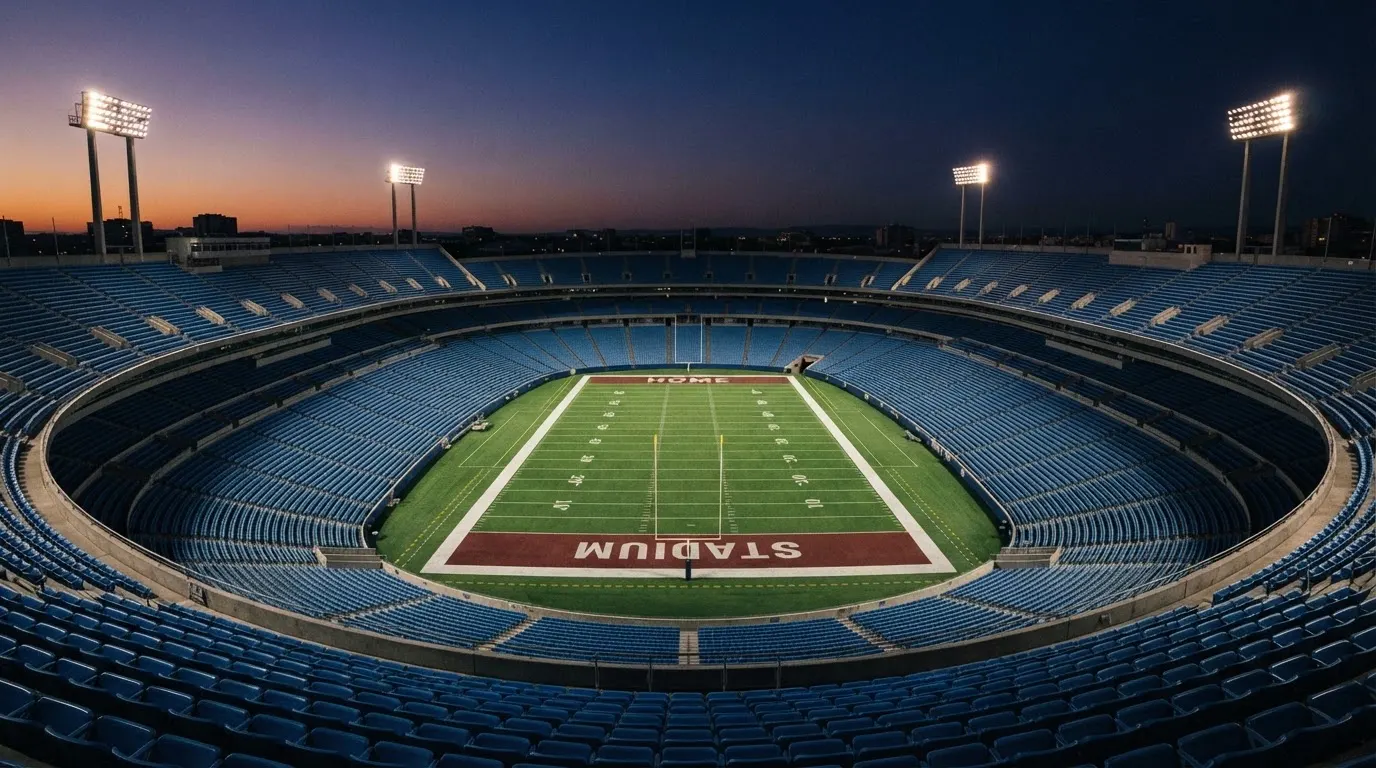
The principal live markets are: next play (run or pass), next scoring play type (touchdown, field goal, safety), current drive result, updated spread, updated total, and moneyline after every score. Prices update at every whistle; many operators suspend the market between plays for one to two seconds while the new line is built, and that pause is the cost of a price that reflects the new state of play rather than the old one. Cash out on American football is offered as a full cash out (close the bet at the current price) and, with some operators, a partial cash out (lock in part of the stake and let the rest ride). On a sport where a single touchdown can swing a spread by seven points in an instant, cash out is not a small thing: the operator’s cash-out price is its own internal model of value, and that price carries its own margin on top of the underlying line.
The mechanics are plain: cash out settles the bet at the price displayed at the moment of the request, not at the price that prevailed a second earlier. If the operator’s price is 1.91 and the bettor accepts, the bet is over and 1.91 is the price. Live streaming of NFL games is offered by several of the bookmakers covered later in this guide – in-play without a video feed is guesswork, and a feed pinned to a specific operator’s markets tends to be the cleanest match between picture and price.
In-play is not legally restricted in Great Britain; the controls are the operator’s licence conditions and customer-protection duties. The Commission does not write a rule that says “in-play on NFL is allowed”, and it does not write one that bans it either. The market exists because each licensed operator has decided to build it, and the price a punter sees is the price that operator chose to offer. Watch the suspension between plays: that is the gap in which the line is rebuilt, and the gap in which a stale screen bet loses its price.
Predictions, tipsters and the working end of a strategy
Tipsters, predictions, model subscriptions, free picks, premium picks – the market for advice on American football betting is loud and the success rate is rarely published in a way that an outsider can verify. A short list of working principles:

- A tip is a forecast, not a guaranteed outcome. Anyone selling “locks” is selling certainty nobody possesses, because the bookmaker’s own model disagrees with the punter’s model precisely as often as the punter wins.
- Closing-line value is the cleanest measure of a tipster’s edge. A tip that beats the closing price over hundreds of bets is doing something the closing market has not caught up with; a tip that loses more often than the closing line is worse than random.
- Bankroll management matters more than any tip. A flat one or two per cent of bank per bet is the working figure; anything larger turns a winning streak and a losing streak into the same thing – a busted bankroll.
- College football (NCAA) is a thinner market than the NFL. Liquidity is lower, lines move more violently on injury news, and a tipster whose record is built on college needs a longer sample to be meaningful.
A punter who buys tips for a living is paying for someone else’s time, not for someone else’s certainty. A punter who builds their own model starts with the closing line as the benchmark and asks whether their own estimate of the outcome beats it, sample after sample. The bookmaker’s margin is built into the closing line; beating it consistently is hard, and that is the honest framing of what a tip is worth.
No tipster in this market is required to publish results, no regulator checks the claims, and a tip that wins ten in a row at the start of a season is no proof of edge – it is a small sample. Treat the people selling certainty as you would any other salesperson.
Bet types and how American football odds are built
American football has its own vocabulary for prices and selections, and it borrows from two traditions. Punters die from covers or spreads: a points handicap set by the bookmaker, with the favourite giving points and the underdog receiving them. The price on each side is normally close to evens (1.91 / 1.91) and the spread is set to balance the book rather than to reflect the real probability. A spread of Patriots −3.5 means New England must win by four or more; a spread of +3.5 means the underdog must lose by three or fewer, or win outright.
The moneyline is the outright winner: Patriots to win, Seahawks to win, no points adjustment. The favourite’s moneyline is short (1.30, 1.20, even shorter for heavy favourites); the underdog’s is long (3.50, 4.50, longer for heavy underdogs). The bookmaker builds the moneyline so that the two prices imply a probability that sums to more than 100 per cent, and the gap is the margin.
The total (over/under) is the combined score: the bookmaker sets a line, the punter takes over or under, and a push – a line landed exactly – makes the bet void unless a tie is offered as a selection. A push on a spread or total is rare but specified in the rules: an NFL game that finishes exactly on the quoted total makes those bets void, with the stake returned.
A combination bet is two or more selections whose odds multiply: a Patriots spread at 1.91 and an over 47.5 at 1.91 becomes 3.65 if both win, 0 if either loses. The price is larger, but every leg adds a margin to the product, and a four-leg combination at 1.91 per leg already carries a bookmaker’s edge in the region of 16 per cent compounded – the kind of figure that explains why accumulators are marketed loudly and settled silently.
A bet builder (sometimes a same-game multi) combines markets from one event: Patriots spread, total over, and the first scoring play to be a field goal, all in one slip. The legs multiply and the whole bet pays only if every leg wins. A bet builder is a combination bet with the spread and the total locked to the same fixture, and its margin is the compounded margin of each leg.
Exchange betting works differently. A betting exchange is a betting intermediary where punters back and lay against each other; the operator takes a commission on net winnings rather than building a margin into the price. On an exchange the price is set by the back-and-lay of the market itself, and the operator’s take is the commission – typically two to five per cent of net winnings. For a market with sharp liquidity (NFL spreads, Premier League football) the exchange price is the cleanest price available, and the closing exchange price is what serious bettors treat as the “no-margin” benchmark. American football has thinner exchange liquidity than association football, but the major fixtures are there.
Financial spread betting on American football is a different product altogether, and it is regulated by the Financial Conduct Authority rather than the Gambling Commission. Punters who take a position on the points spread, the total or the outright winner make a stake per point and win or lose a stake-per-point multiple of the difference between the quoted spread and the final outcome. Losses can exceed the deposit, which is the defining risk of the product. Spreadex runs that kind of book and is FCA-regulated for the spread side and Gambling Commission-regulated for the fixed-odds side.
The bookmaker’s margin, in plain language: every price the bookmaker offers is slightly worse than the true probability of that outcome would warrant, and the gap between the implied probabilities of all outcomes and 100 per cent is the margin. On a two-way market at 1.91 / 1.91, the implied probability is 52.4 per cent on each side, summing to 104.8 per cent – a margin of about 4.8 per cent. That is the working band for a balanced NFL spread. On a moneyline the gap is wider because the prices are less symmetric.
Sports and tournaments: the shape of the American football calendar
The National Football League runs 32 teams in two conferences – 16 in the AFC and 16 in the NFC – with each side playing 17 games across an 18-week regular season. Seven teams per conference reach the single-elimination playoffs: the four division winners and three wild cards. The season ends in the Super Bowl, the most wagered single fixture in the American football calendar for British punters.
Super Bowl LX was played on 8 February 2026 at Levi’s Stadium in Santa Clara, California; the Seattle Seahawks beat the New England Patriots 29-13, with Kenneth Walker III named MVP. The next Super Bowl will be played in early February 2027.
Beyond the NFL, three competitions drive the rest of the betting calendar:
- The NCAA college football season runs from late August to early January, culminating in the College Football Playoff National Championship. College markets are thinner than NFL markets and lines move more violently on news; a college line published at midday can be unrecognisable by kickoff.
- The Canadian Football League (CFL) plays on a longer field, with different rules (three downs, a larger end zone, a rouge on missed field goals), and British bookmakers typically offer a small fixture list when the season runs.
- The XFL and USFL spring leagues have come and gone; coverage at licensed British bookmakers depends on the year.
For British punters the NFL is the only American football competition with a permanent, year-round market; the rest cycle in and out as their seasons run. A bookmaker’s “American football” tab is in practice an NFL tab for most of the season, with college markets layered on top during the autumn and winter, and the Super Bowl as the year’s peak.
The top ten licensed bookmakers for American football
The ranking below is built around three working questions. Does the bookmaker offer a deep American football market? Does it run live in-play and cash out on the NFL? Does it publish the kind of welcome offer that survives contact with its own terms? Every brand listed is on the Gambling Commission’s public register against a remote betting licence for Great Britain; a brand’s place on this list is not a recommendation and the licence is the threshold for inclusion, not a marker of quality.
| Bookmaker | Licence holder and account number | What its own terms say on the key subject |
|---|---|---|
| Copybet | Copybet UK Limited · account 53774 | Best Odds Guaranteed all day every day on UK and Irish racing; pays first past the post on horse racing even if the runner is later disqualified |
| Star Sports | Star Racing Limited · account 9177 | Trader line on 08000 521 321 for opening accounts, placing bets and customer queries, plus email support at [email protected] |
| Midnite | Midnite Limited · account 101839 | In-play events, an acca builder, popular accas and price boosts with stated maximum-stake limits |
| BetUK | LeoVegas Gaming PLC · account 39198 | Welcome package of four £10 free bets split across football accumulators and multiples, opt-in required, seven-day expiry |
| Fitzdares | Fitzdares Limited · account 400 | Cash out, accumulators, Lucky 15s, specials and ante-post on American football alongside horse racing, football, tennis, rugby, cricket and golf, with in-play live odds |
| Unibet | Platinum Gaming Limited, Gibraltar · account 45322 | Bet £20 on minimum odds of 2.0 to receive £40 in free bets, seven-day expiry, debit card or instant bank transfer, GB customers |
| Lottoland | EU Lotto Limited · account 38991 | Casino, lottery betting, sports betting and scratchcards in a single product, Gambling Commission licence for GB customers |
| BetVictor | BV Gaming Limited · account 39576 | Best Odds Guaranteed on UK and Irish racing, enhanced live race streaming, BetFinder and Smart Stats |
| William Hill | WHG (International) Limited · account 39225 | Best Odds Guaranteed on UK and Irish racing from 8 AM on race day on single and multiple bets, excluding ante-post, tote and pari-mutuel; Football Acca Boost on accas of two or more legs at 1/5 or bigger, up to a £10,000 maximum per online bet, running until 30 May 2027 |
| Sky Bet | SBG Sports Limited · account 67370 | Free bets expire 30 days after crediting, single or each-way markets only, non-withdrawable, stake not returned with winnings |
The columns above name the operator, the licence holder and account number as they appear on the Commission’s public register, and what the operator’s own terms state on a single named subject. Any American football offer is in addition to the racing and casino features listed in the third column – the column holds one fact each, not a complete list of features.
Copybet
Copybet runs Best Odds Guaranteed on UK and Irish racing all day every day and pays first past the post on horse racing even if the winner is later disqualified, a horse-racing feature that gives the racing side of the book a distinctive shape. The product offers a distinctive shape, with the American football offering sitting inside a broader racing-led product. For a British punter whose interest in American football is the Super Bowl and the playoffs rather than week-by-week NFL action, the racing guarantees are a real draw; for a punter whose betting is NFL-only, they are irrelevant. Copybet UK Limited holds the licence against Gambling Commission account 53774.
Star Sports
Star Sports runs a phone-a-trader model that is otherwise structurally wrong for a retail-grade online customer: 08000 521 321 is the line for opening an account, placing a bet and asking a customer query, alongside an email support address at [email protected]. A punter who values talking to a human before placing an American football bet, rather than tapping a betting slip, is the natural customer. A punter who wants a slick in-play NFL interface is not. Star Racing Limited operates the site under Gambling Commission account 9177.
Midnite
Midnite’s product page names in-play pricing, an acca builder, popular accas and price boosts with stated maximum-stake limits, which is a working combination for the NFL calendar: the in-play for week-by-week action, the builder for same-game combinations, the boosts for headline prices on marquee fixtures. Its welcome offer asks for a £5 minimum stake at minimum odds of 2.0 within 14 days of sign-up, with £25 in free bets and 50 free spins crediting on settlement and expiring after 7 days. A punter whose NFL interest is the headline match-up each week is the natural fit. Midnite Limited holds the licence under Gambling Commission account 101839.
BetUK
BetUK’s welcome package is four £10 free bets – two football accumulators of four or more selections and two multiples of two or more – with a minimum £10 deposit, a sports bet placed within seven days, opt-in required and seven-day expiry from issue. The structure of the free bets splits the value across accumulators and multiples, which makes the package best suited to a punter who already builds accas on the NFL and Premier League fixture list; a punter who bets singles will leave part of the value on the table. LeoVegas Gaming PLC holds the licence under Gambling Commission account 39198.
Fitzdares
Fitzdares is one of the few British-licensed brands that names American football in its feature list: cash out, accumulators, Lucky 15s, specials and ante-post markets across horse racing, football, tennis, rugby, cricket, golf and American football, with in-play live odds. A punter whose NFL interest runs from week-one pre-season to the Super Bowl finds the full set of markets under one roof; the brand’s racing roots show in the Lucky 15 and ante-post vocabulary. Fitzdares Limited holds the licence against Gambling Commission account 400.
Unibet
Unibet has run since 1999 and the UK site is operated by Platinum Gaming Limited out of Gibraltar, against Gambling Commission account 45322. The welcome offer is £40 in free bets for a £20 qualifying bet at minimum odds of 2.0 (1/1), paid on settlement, expiring within 7 days of issue, for new GB customers using a debit card or instant bank transfer. The qualifying bet at minimum odds of 2.0 is the working gate: a punter who wants to bet the NFL moneyline favourites at 1.30 will not qualify; a punter who takes spreads, totals or modest underdogs at evens or longer will. The American football coverage sits inside a broader international product.
Lottoland
Lottoland runs casino, lottery betting, sports betting and scratchcards inside a single app, with a Gambling Commission licence for customers in Great Britain. A punter whose interest in gambling is broader than sports – lottery draws, scratchcards, slots – and who wants the NFL and the NCAA on the same product finds the combination here; a punter who wants a sports-only specialist finds it elsewhere. EU Lotto Limited operates the platform under Gambling Commission account 38991.
BetVictor
BetVictor’s racing features – Best Odds Guaranteed on UK and Irish racing, enhanced live race streaming, the BetFinder feature and Smart Stats – are the headline features, with American football covered inside a broader international sportsbook. A punter whose interest in the NFL is the weekend card and whose interest in the rest of the year is British and Irish racing finds the combination under one roof. The licence is held by BV Gaming Limited against Gambling Commission account 39576.
William Hill
William Hill runs Best Odds Guaranteed on UK and Irish racing from 8 AM on race day, on single and multiple bets, excluding ante-post, tote and pari-mutuel bets. The Football Acca Boost covers accas of two or more legs with each selection at 1/5 (1.20) or bigger, with a boost from 3 per cent on a double up to 200 per cent on twenty or more legs, capped at a £10,000 maximum boost per online bet, running until 30 May 2027. The boost is a structural feature for a punter whose NFL interest runs through accumulator combinations rather than single selections, and the cap of £10,000 is the ceiling on what the boost itself can pay out. The licence is held by WHG (International) Limited against Gambling Commission account 39225.
Sky Bet
Sky Bet’s free-bet rules are spelled out plainly on its support page: free bets expire 30 days after crediting, can be used only on single or each-way markets (not multiples), excluding virtuals, are non-withdrawable and do not return the stake with winnings. A free bet of £10 that wins at 3.0 pays out £20 of free-bet winnings – the £10 stake is not returned. That is the standard “free bet where the stake is not returned” construction, and the rule that excludes multiples shapes which bets the free-bet balance is best used on: singles or each-way bets on the NFL moneyline, spread or total, not the four-leg acca. The licence is held by SBG Sports Limited against Gambling Commission account 67370.
American football betting in Great Britain: the underlying picture
The shape of the market in Great Britain is set by three things. The first is the licence: every commercial bookmaker offering bets to customers in Great Britain needs a Gambling Commission licence, and the Commission’s public register is the test of who holds one. A licence is a precondition, not a quality mark – a place in this article’s ranking is not a recommendation, and the register lists many more brands than this article names.
The second is the calendar. American football is a seasonal sport, and a British bookmaker’s American football tab is in practice an NFL tab from September to February, with the College Football Playoff layered on top in December and January, the Super Bowl as the year’s peak, and a thinner offering in the off-season. A punter who wants to bet the NFL year-round finds year-round markets; a punter whose interest is a single annual fixture finds a market built around that fixture.
The third is the scoring. American football’s scoring in clumps – touchdown 6, extra-point kick 1, two-point conversion 2, field goal 3, safety 2 – shapes both the live market and the pre-match market. A pre-match spread is set on the expected margin of victory in a sport where the median margin is small; a total is set on the expected combined score in a sport where the median total sits in the mid-40s. The bookmaker’s margin is built into every line; beating that margin over a sample of bets is the working definition of a long-term edge.
The fundamentals: 11 players per team on the field, professional and college games lasting 60 minutes in four 15-minute quarters. Touchdown 6 points, extra-point kick 1, two-point conversion 2, field goal 3, safety 2 awarded to the defence. The NFL runs 32 teams, 16 in the AFC and 16 in the NFC, with each side playing 17 games across an 18-week regular season and 14 teams (seven per conference) reaching the single-elimination playoffs. A punt who knows the scoring and the structure of the season reads the betting line with a more realistic sense of what a seven-point favourite actually represents.
Legality and regulation: the Gambling Commission’s regime
Great Britain has no statutory list of permitted sports or markets. A bookmaker serving customers in Great Britain needs a Gambling Commission licence wherever it is based, since the Gambling (Licensing and Advertising) Act 2014 closed the “white-list” route through which operators based in other jurisdictions had previously served British customers without a Commission licence. A Curaçao, Maltese or Gibraltar licence is not a substitute for a Commission licence at the point of consumption; the test is whether the operator holds a Commission licence as shown on the public register, not whether the operator holds some other licence elsewhere.
The licence categories are: remote general betting standard (real events), remote general betting standard (virtual events), remote general betting limited, remote pool betting and remote betting intermediary (the betting exchange licence). The brands reviewed in this article all hold remote general betting standard (real events) licences against the licence holders named in the table above.
The public register can be searched by business name, trading name, domain or account number, and it is the whole test of whether a brand holds a licence. The Commission’s licence conditions and codes of practice (LCCP) set the operating conditions: customer verification before the first bet, GAMSTOP participation, social responsibility and safer-gambling duties, marketing conditions, and the financial and technical standards a remote operator must meet. Identity checks are in place before the first deposit or the first qualifying bet, including when the qualifying bet is a free bet or bonus: no anonymous play at a licensed site. A Curaçao or Maltese-licensed operator that does not verify British customers at the point of consumption is not on the Commission’s register and is not bound by these conditions, which is the working distinction between the licensed and unlicensed sides of the market.
Financial spread betting sits under a separate regulator – the Financial Conduct Authority – and a spread-bet provider that takes positions on American football spreads, totals or outright winners needs an FCA authorisation for the spread-bet side and a Gambling Commission licence for any fixed-odds betting it offers alongside. Spreadex holds both: FCA-regulated for the spread side, Commission-regulated for the fixed-odds side. The FCA side has its own consumer-protection rules, and the defining risk of financial spread betting is that losses can exceed deposits.
Responsible gambling, GAMSTOP and the wider safety net
The Gambling Commission’s safer-gambling framework runs through several channels, and the licensed bookmakers covered in this article participate in all of them.
GAMSTOP is the national multi-operator online self-exclusion scheme and a mandatory licence condition for online operators since 31 March 2020. A punter who registers with GAMSTOP is blocked from opening new accounts, depositing or betting with every participating online operator for a chosen period – six months, one year, five years, or five years with auto-renewal – and after the minimum period the exclusion stays in place for a further seven years unless the punter asks GAMSTOP to remove it. GAMSTOP covers online sites and apps; betting shops use a separate service. Every bookmaker reviewed in this article is a GAMSTOP participant.
A financial vulnerability check (LCCP condition 3.4.4, in force since 30 August 2024) applies to licensed remote betting when a customer’s deposits minus withdrawals exceed £150 in a rolling 30 days (since 28 February 2025). The check is a public-record check – bankruptcy, county court judgments and similar – and not a credit-reference or income check. Financial risk assessments (the “affordability checks” the press refers to) are announced as a staged plan, with no start date published at the time of writing, and the working phrasing is “announced, staged, no start date” rather than “in force”.
Deposit limits are a separate requirement: operators must offer a gross deposit limit on a fixed time frame. The first changes applied from 31 October 2025 and a second phase was postponed to 30 September 2026, and whether the second phase is in force is not established in the public record. Operators must offer the limit; the level is the customer’s choice. There is no state-set deposit ceiling or loss ceiling for betting in Great Britain.
Help is offered through GamCare, the National Gambling Helpline, GambleAware, the NHS gambling clinics and Gamblers Anonymous. Fitzwilliam Sports links to GambleAware, GAMSTOP and Gamblers Anonymous on its own page; other brands do the same under their safer-gambling tabs. The licensed side of the market has the safety net built in. The unlicensed side does not: an unlicensed operator is not on GAMSTOP, not on the Commission’s complaints route, not bound by an approved dispute-resolution body, and a British punter with funds withheld by an unlicensed operator has no British consumer redress.
Crypto and anonymity: the honest picture
No British-licensed bookmaker accepts cryptocurrency as a deposit method for American football betting in the routine sense of “deposit in Bitcoin, bet in Bitcoin, withdraw in Bitcoin”. The licensed side of the market runs on debit cards, bank transfers and – depending on the operator – a closed-loop e-wallet; credit cards are banned for gambling in Great Britain since 14 April 2020, including credit-card-funded payments through an e-wallet. Identity is verified before the first deposit or the first qualifying bet, including with a free bet or bonus; “no verification on first deposit” is not a feature of the licensed side of the market.
A punter who wants to bet with cryptocurrency in the routine sense is on the unlicensed side of the market. An unlicensed operator is not bound by the Commission’s marketing conditions, the 10x bonus cap, the £150 vulnerability check or the GAMSTOP participation requirement; it is not covered by the Commission’s complaints route; it has no British consumer redress; and it is not obliged to verify identity before the first deposit. A British punter with funds withheld by an unlicensed operator has lost the protection the licensed side provides. The framing in this article is plain: anonymous betting is possible on the unlicensed side, and a punter who chooses that side is choosing to give up the protections that come with the licensed side.
A British named-account rule, a state list of permitted payment methods at licensed operators, and any rule for or against cryptocurrency deposits at licensed operators are not established in the public record; payments are described qualitatively and only from each operator’s own terms.
Bonuses, free bets and the headline-versus-real arithmetic
The bookmaker’s welcome offer is built to convert a click into a deposit and the deposit into a settled bet on the operator’s product. The marketing line and the settled terms are not the same thing, and the gap between them is the book’s profit on the campaign. Three examples from the table above:
- Unibet: £40 in free bets for a £20 qualifying bet at minimum odds of 2.0. The qualifying bet has to win or it has to settle as a winning bet at the minimum price; the free bets expire within 7 days; the stake is not returned on a free-bet win.
- BetUK: four £10 free bets – two football accumulators of four-plus legs and two multiples of two-plus – on a £10 minimum deposit, with a sports bet placed within 7 days, opt-in required, free bets expiring after 7 days.
- Midnite: £25 in free bets and 50 free spins on a £5 minimum pre-match bet at minimum odds of 2.0 within 14 days, free bets and spins expiring after 7 days.
The free-bet value of a “stake not returned” free bet on a market at odds of 3.0 is the free-bet amount multiplied by (odds minus 1) divided by the odds, scaled by the market’s payout share. On a market at 3.0 with a 95 per cent payout share, a £10 free bet is worth roughly £10 × (3.0 − 1) / 3.0 × 0.95 = £6.33, not £10 and not £20. That is the working figure for a free bet where the stake is not returned.
The promotion rules in force since 19 January 2026 cap wagering requirements on bonuses at 10x (a £10 bonus at 50x needs £500 of bets; under the cap no more than £100), and ban mixed-product promotions – an offer that requires gambling on two or more product types, such as “bet on football to get free spins”. Whether the cap applies to free bets with no wagering condition, and any cap on the money value of a bonus, are not established in the public record. No promo codes are reproduced in this article: every licensed operator offers the welcome deal through its own sign-up flow, and the rules above are the rules that apply once the bet is placed.
The bookmaker’s margin on a balanced two-way market: what the price hides
The margin is what the bookmaker keeps of every unit bet on the market, and the calculation belongs to the writer of this page. Take an illustrative two-way market at decimal odds of 1.90 / 1.90 (fractional 9/10) – a balanced price on a typical NFL spread or total, used here as an example rather than a quoted price.
The payout share of a two-way market is the reciprocal of the sum of the reciprocals of each outcome’s decimal odds. For 1.90 / 1.90, that is 1 ÷ (1/1.90 + 1/1.90) = 1 ÷ (0.5263 + 0.5263) = 1 ÷ 1.0526 = 0.95. The margin is 1 minus the payout share, or about 5.0 per cent. The same calculation at 1.91 / 1.91 gives a payout share of about 95.3 per cent and a margin of about 4.7 per cent; at 1.85 / 1.85 the margin widens to roughly 8.1 per cent.
The honest framing: a balanced NFL spread at 1.91 / 1.91 carries a margin in the region of 4.5 to 5 per cent, with a band that runs from below 4 per cent at the most efficient books to above 6 per cent at the least efficient. The margin is the bookmaker’s edge before any free-bet or bonus value is layered on, and the band’s midpoint is the figure the rest of this article uses when it talks about the cost of betting.
For context, a four-leg combination at 1.91 per leg carries a compounded margin in the region of 16 to 18 per cent – the kind of figure that explains why combination bets are marketed loudly and settled quietly. A bet builder across three or four markets on the same game compounds the same edge. An exchange price carries the operator’s commission rather than a built-in margin, and the commission on net winnings is the operator’s take.
Frequently asked questions about American football betting
How is a bet on American football placed?
The bettor selects an NFL, NCAA or CFL fixture from the bookmaker’s American football tab, chooses a market – spread, moneyline, total, or a combination bet – enters the stake, confirms the selection, and the bet is placed at the displayed price. Live bets are placed during a game through the bookmaker’s in-play tab, with the price updated by the operator at every score or significant event.
What is American football betting?
American football betting is wagering on the outcome of NFL, NCAA or CFL games – the outright winner, the points spread, the total combined score, or a combination of markets – with a licensed bookmaker serving customers in Great Britain. The sport scores in clumps (touchdown 6, field goal 3, safety 2) and the bet types are built around that structure. In Great Britain a bookmaker serving customers needs a Gambling Commission licence; the Commission’s public register is the whole test of who holds one.
Where are the best odds on American football found?
The best odds on a given selection are the highest price available across the bookmakers the bettor holds accounts with. The closing exchange price is the working benchmark for a serious bettor; the closing line at a sharp bookmaker is the working benchmark where an exchange market is thin. A punter who holds three or four accounts can price-check a selection before placing a bet, and a price differential of a tenth of a point (1.91 versus 1.80) compounds into a meaningful edge over a season.
How is it checked that a bookmaker holds a Gambling Commission licence?
The Commission’s public register is searchable by business name, trading name, domain or account number at the Commission’s own website, and a brand that appears on the register against a remote betting licence for Great Britain is licensed. The register lists the licence holder’s name and the categories of licence held; a brand that does not appear on the register, or appears only with a non-remote licence, is not licensed to take bets remotely from customers in Great Britain.
How is the return on a bet worked out from the stake and the odds?
Return = stake × decimal odds. Profit = stake × (decimal odds minus 1). On a £10 bet at decimal odds of 3.0 the return is £30 and the profit is £20. A combination bet’s decimal odds are the product of the decimal odds of each leg: two legs at 2.0 and 3.0 make 6.0, three legs at 1.91 / 1.91 / 1.91 make about 6.97. On a free bet where the stake is not returned, the free-bet value is the free-bet amount multiplied by (odds minus 1) divided by the odds.
What is the bookmaker’s margin and how is it seen in the odds?
The margin is what the bookmaker keeps of every unit bet on a market, and it is built into every price the bookmaker offers. On a two-way market at 1.91 / 1.91 the implied probability is 52.4 per cent on each side, summing to 104.8 per cent – a margin of about 4.8 per cent. The margin is the difference between the sum of the implied probabilities and 100 per cent. The narrower the margin, the more of every pound bet the book returns to bettors on average; the wider the margin, the more it keeps.
US & other team sports – Boxing betting
Content created by the «Boxing betting» team
