
Darts betting tips for 2026: form, value and the honest maths behind every tip
 Available in US
Every punter searching for darts betting tips meets the same wall: a tipster names a player, gives a price, and asks you to trust their number over the market’s. The market is not neutral either — the bookmaker’s margin sits inside every price, so even a “fair” 2.00 is rarely exactly fair. What follows is the guide underneath the tips: how a prediction is assembled from form, statistics and the line-up, what makes one price better than another once the margin is unwound, and why staking discipline matters more than the next tip in your inbox. It is not a tip sheet. No player is tipped here, and no one should bet on the page’s word.
Data current as of 27 October 2026 and checked against the Gambling Commission’s public register.
The sport underneath the market
Darts on screen is a quiet sport: two players, a stage, a scorer. The market underneath it is loud. Prices move on every visit to the board, in-play markets refresh after every leg, and outright books for the PDC World Championship or the Premier League fill up months before a dart is thrown. Knowing what you are betting on starts with the format.
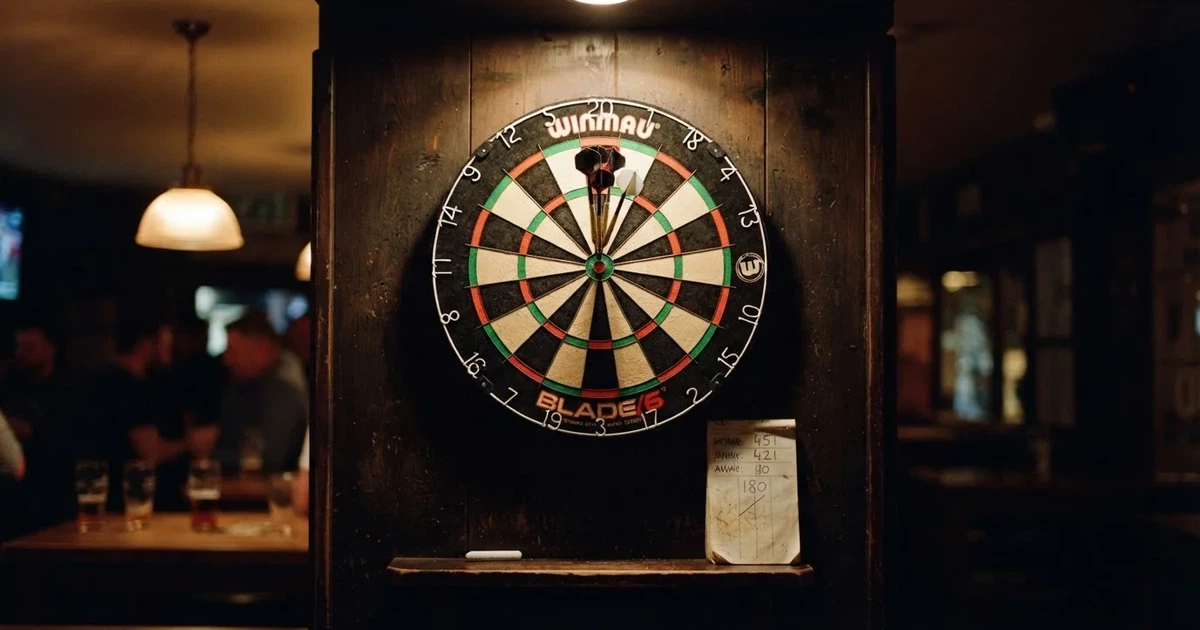
A standard dartboard carries twenty numbered segments, each split into single, double and treble areas. The bullseye is worth fifty, the outer bull twenty-five. The highest possible three-dart finish is one-seventy — treble twenty, treble twenty, bullseye — and the minimum possible leg is nine darts. In 501, the format that fills most televised schedules, both players start at 501 and must finish on a double or the bullseye. That last rule shapes almost every market on the board: a player chasing the game cannot grind out singles to land on a round number, they have to attack doubles, and the bookmaker’s prices on a checkout reflect that constraint.
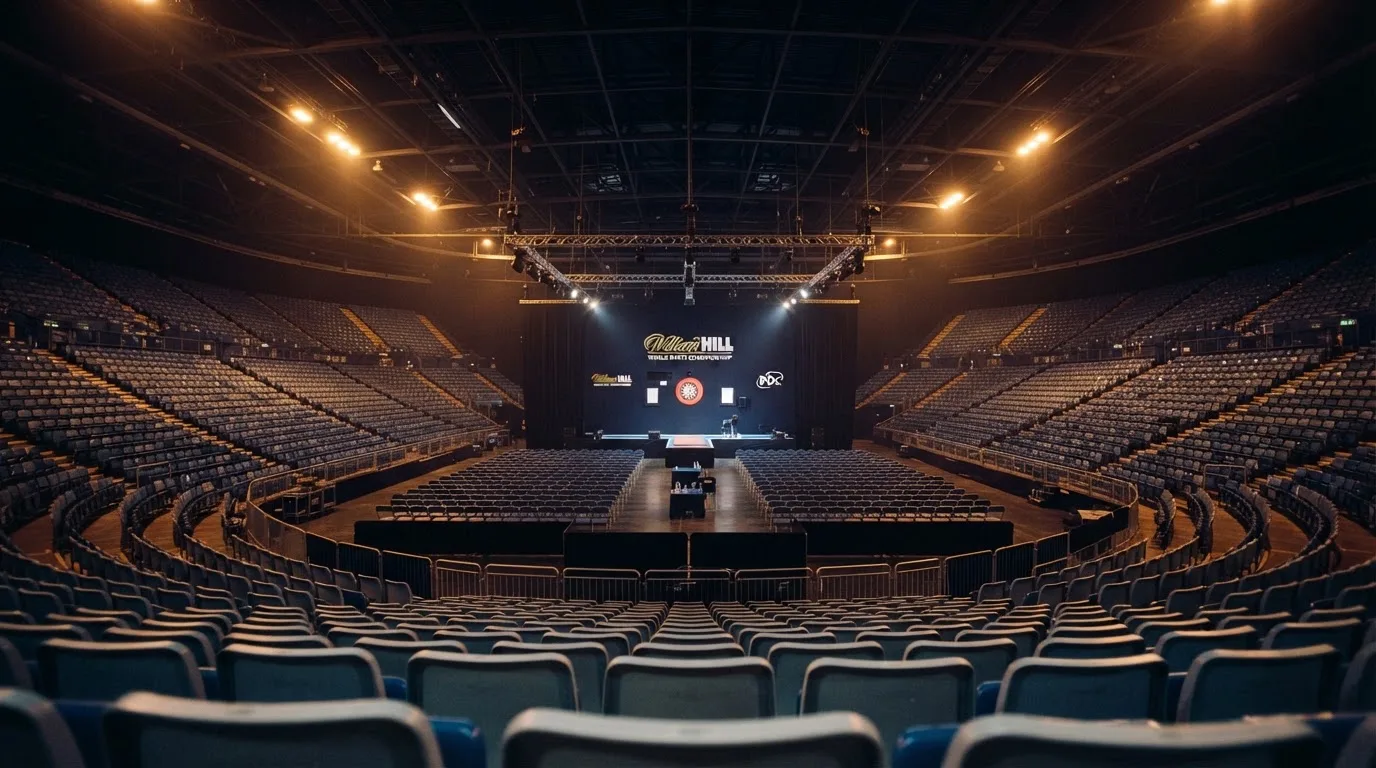
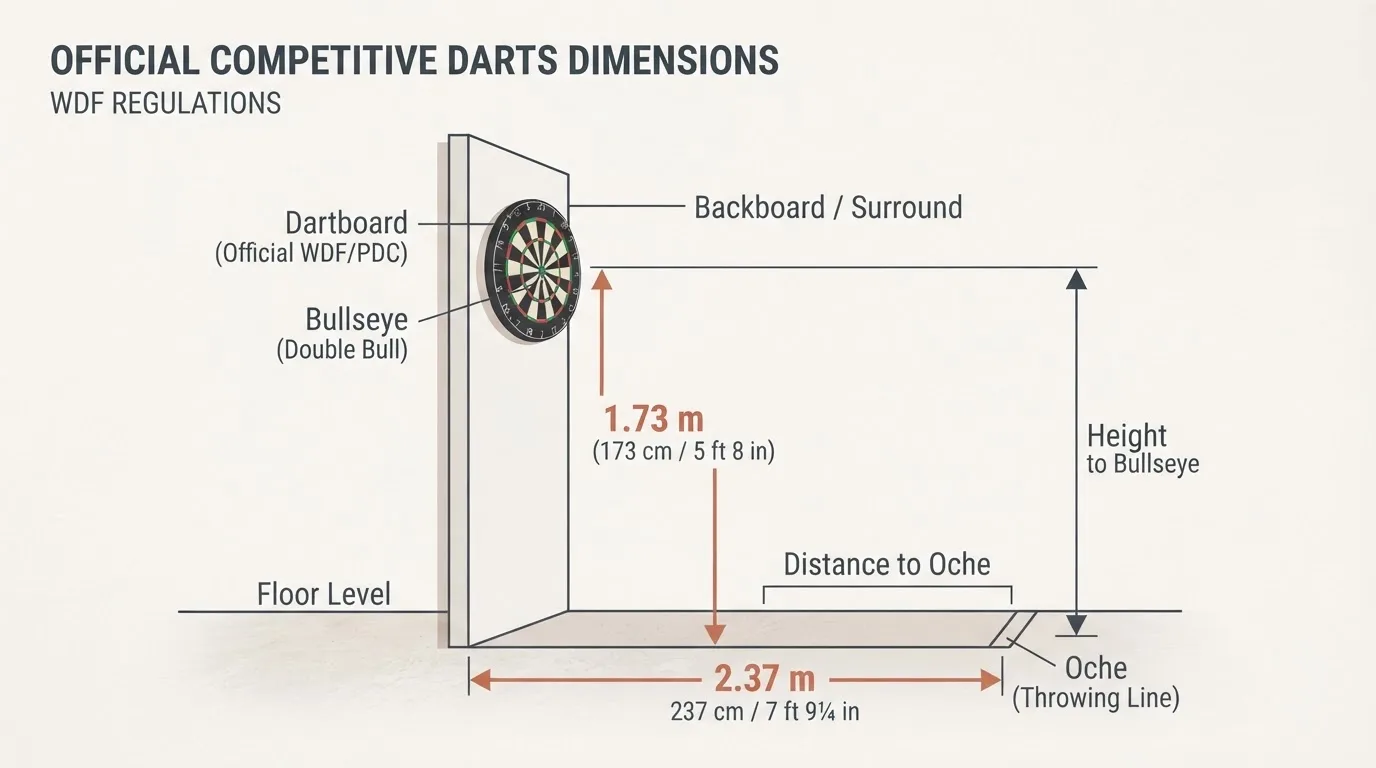
The standard throw distance is 2.37 metres — seven foot nine — and the bullseye sits 1.73 metres off the floor. Those numbers govern how a tournament is set up but not how it is priced. Pricing is driven by the players, the format and the round. The PDC World Championship runs over the Christmas and New Year period at Alexandra Palace, and rounds lengthen as the field narrows: rounds one and two first to three sets, rounds three and four first to four, quarter-finals first to five, semi-finals first to six, the final first to seven. The 2025/26 edition ran from 11 December 2025 to 3 January 2026 with 128 players, and Luke Littler beat Gian van Veen 7–1 in the final — the prize fund £5,000,000, £1,000,000 to the winner.
Two governing bodies share the professional game: the Professional Darts Corporation (PDC) and the World Darts Federation (WDF). The PDC runs the marquee tournaments and the broadcasts the markets follow. Premier League Darts, the World Grand Prix and the World Matchplay sit alongside the World Championship on the PDC calendar, with European Championship, Grand Slam and Players Championship Finals filling the gaps. Most outright books on this site concentrate on the PDC side; the WDF carries a longer tail of smaller events whose markets vary widely.
The takeaway for a reader who bets: a price on a darts match is a price on a leg-by-leg contest decided by doubling out. That single rule explains why the favourites do not always win — a player with the higher average who misses doubles gets beat, and a player trailing the match can pile in trebles with nothing to lose.
The licensed landscape in Great Britain
The set of operators a reader sees named below is not the whole market. There are several hundred remote betting licences in force in Great Britain, and the Commission’s public register lists every one of them. The ten brands reviewed here are a curated sample, not the legal test of who is licensed and who is not. That test is the register itself: searchable by company name, trading name, domain or account number, it is what tells a reader whether a brand holds a current licence and under which categories.
The point of the licence, beyond legality, is what comes with it. A Gambling Commission remote licence brings GAMSTOP membership, the marketing rules in the LCCP and the Remote Technical Standards, a Commission complaints route and access to approved alternative dispute resolution. It also brings the credit-card ban, the 18+ age rule, identity verification before the first deposit and the financial vulnerability check at higher spend. The brand pays General Betting Duty — currently fifteen per cent of gross profit on remote bets, moving to twenty-five per cent from 1 April 2027 on the same base — not the customer, who pays no tax on winnings. None of that is decoration. It is what separates a GB-licensed site from an offshore one.
The ten brands below all hold a current Gambling Commission remote general betting standard (real events) licence. The table records the licence number, the licence holder named on the register, and what the operator’s own terms say about the subject this page is built on. The trailing column reads the operator’s site rather than the register, because the register tells you whether the licence exists, not what the operator does with it.
| Brand | Gambling Commission licence number and licence holder | What the operator’s own terms state on the key’s subject |
|---|---|---|
| Paddy Power | 039439-R-319330-013 (PPB Counterparty Services Limited) | Bet Builder+, Popular Bet Builders, Super Sub (a bet rolls over to a substitute), expanded Win More markets, player and ACCA stats |
| Betmaster | 065699-R-339929-002 (BM Solutions GB Ltd) | A general sportsbook licence covering fixed-odds betting; terms and markets set out in the operator’s house rules |
| BetGoodwin | 002927-R-327985-008 (Goodwin Racing Limited) | Best Odds Guaranteed on all UK and Irish horse and greyhound racing, up to £1,000 |
| Sporting Index | 027343-R-308898-011 (Sporting Index Limited) | Fixed-odds free bets unlocked by a qualifying £10 bet at minimum odds of 1/2; spread-bet legs are stated separately; the qualifying bet cannot be placed in play or cashed out |
| LiveScore Bet | 056859-R-332720-005 (LiveScore Betting and Gaming (Gibraltar) Limited) | Debit cards (Visa, Mastercard), Apple Pay, PayPal, Pay by Bank (Open Banking), Revolut Pay |
| Midnite | 101839-R-342850-001 (Midnite Limited) | In-play events, acca builder, popular accas, price boosts with maximum-stake limits; £5+ pre-match bet at EVS (2.0) or greater within 14 days unlocks £25 in free bets and 50 free spins, valid 7 days |
| DAZN Bet | 048756-R-327274-019 (DZBT Limited) | Minimum deposit £5 by debit card, Apple Pay, Paysafecard, Trustly, Skrill; £20 by PayPal; no processing fees |
| Lottoland | 038991-R-319408-020 (EU Lotto Limited) | Casino, lottery betting, sports betting and scratchcards in one app; GB licensing stated in the operator’s terms |
| Fitzwilliam Sports | 048760-R-335434-009 (SBKI Limited) | Phone and live chat open 09:00 to 21:00, seven days a week; messenger replies within roughly 90 seconds |
| William Hill | 039225-R-319373-015 (WHG (International) Limited) | Best Odds Guaranteed on UK and Irish horse racing from 8 AM on race day, on single and multiple bets; not ante-post, tote or pari-mutuel |
A licence is a floor, not a ceiling. The above each carry the minimum legal infrastructure and add something different — a payments stack on LiveScore Bet, a wide feature set on Paddy Power, a BOG-prominent horse-racing offer on BetGoodwin and William Hill, a tight combination-bet core on Midnite. The verdict on each is below the cluster review.
Statute, jurisdiction and the point of a licence
The Gambling Commission licenses the commercial market under the Gambling Act 2005, covering Great Britain — England, Scotland and Wales. Northern Ireland sits under older legislation and is outside the 2005 Act; the headline “GB-licensed” is honest shorthand, “UK-licensed” overstates it. Since the Gambling (Licensing and Advertising) Act 2014, an operator whose remote facilities are used in Great Britain needs a Commission licence wherever it is based. A Curaçao, Maltese or Gibraltar licence does not substitute. The Commission was given, or is about to receive, court-order DNS blocking powers against unlicensed sites, but blocking is not currently in operation on a national scale and would not change the underlying rule.
Financial spread betting is regulated by the Financial Conduct Authority, not the Commission. Spreadex, for instance, is regulated by the FCA for spread betting and by the Commission for fixed-odds betting, and is explicit that spread-betting losses can exceed the deposit. That category — spread bets — is not covered by the 2005 Act’s normal betting framework and is a different proposition from a punt on a darts match.
What may be bet on is not set out in a statute. There is no list of permitted markets and no rule against in-play betting, novelty markets, esports or political bets. An operator offers markets under its own terms and the LCCP. ESports are treated like any other event; virtual events sit under a separate licence category. Bets on politics, television and novelty markets run at GB bookmakers with no statutory prohibition found. There is no statutory cap on stakes in sports betting; operators set their own maximums.
Enforcement is disruption, not blocking: cease-and-desist notices, search-engine referrals, work with registrars, hosts and payment providers. The customer who bets on an unlicensed site commits no offence under the 2005 Act, but loses what the licence brings — no GAMSTOP coverage, no Commission complaints route, no British dispute-resolution body, no consumer redress if funds are withheld, no protection under the bonus cap or the £150 vulnerability check. Honest framing: licensed means checks, limits and consumer protection but also verification before the first bet; unlicensed means none of those protections and the realistic risk of funds being withheld.
Responsible gambling and the protection package
A gambling guide that does not name the help available is not a complete guide. The minimum age at a GB-licensed site is eighteen. Name, address and date of birth are verified before a customer can deposit or gamble, including on a free bet or bonus. A credit card cannot be used for gambling in Great Britain; that ban includes credit-card-funded payments through an e-wallet. Debit cards and bank-based payments sit outside the ban.
GAMSTOP is the national multi-operator online self-exclusion scheme, free to use and a mandatory licence condition for online operators since 31 March 2020. Exclusion periods are six months, one year, five years, or five years with auto-renewal; after the minimum period the exclusion remains in force for a further seven years unless the customer asks GAMSTOP to lift it. GAMSTOP covers online sites and apps; betting shops use a separate service. Customer protections vary by brand, and the better operators — Unibet, for instance, lists deposit limits, a Player Profile test, product restrictions and self-exclusion, supported by live chat and signposts to BeGambleAware, GamCare, GAMSTOP, Gambling Therapy and the BGC — surface these in plain language on the safer-gambling page rather than burying them in the small print.
The financial vulnerability check — LCCP condition 3.4.4, in force since 30 August 2024 — applies at licensed remote operators when a customer’s deposits minus withdrawals exceed £150 in a rolling thirty days, with full operation since 28 February 2025. It is a public-record check (bankruptcy, county court judgments), not an income check and not a credit reference check. The broader affordability assessments the press calls “financial risk assessments” were announced by the Commission in a staged plan on 7 July 2026 with no start date — write “announced, staged, no start date,” not “in force.” Operators must offer a gross deposit limit on a fixed time frame; the first changes have applied since 31 October 2025, a second phase was postponed to 30 September 2026 and whether it is now live is not established.
Help is free and confidential. The National Gambling Helpline (run by GamCare) is open twenty-four hours. GambleAware funds treatment and education. The NHS runs gambling clinics across Great Britain. Gamblers Anonymous runs peer-support meetings. The first call from someone who has lost more than they meant to is the one that costs nothing and starts a real change.
Bonuses, free bets and what they actually cost
The market in darts betting offers is loud and the margin is wider than most sportsbooks admit. A bookmaker’s headline number — a “free £25” or a “100% bonus” — is a marketing price, the same way a price on a player is a marketing price: built to be inviting, not to be read at face value. A guide that does not unwrap the offer is a guide that has joined the marketing.
A free bet is a stake the operator credits to you, usually with a win-only settlement — your stake is not paid back with a winning return. A bonus is a matched amount on your deposit, with a wagering requirement you must clear before withdrawing. Both come with conditions. The conditions are where the offer lives or dies. Three of them matter, and they matter more on a sport like darts, where prices are tight and margins thin.
First, the minimum odds for a qualifying bet, which caps the markets where the offer can be unlocked. Midnite’s £25-in-free-bets offer requires a £5 pre-match bet at EVS (2.0) or greater, set within fourteen days of sign-up, with free bets and free spins valid for seven days. A reader on a bookmaker requiring 4/6 (about 1.67) cannot place a qualifying bet on a heavy favourite in 501; that flips the offer from a welcome present into a forced march into a specific market.
Second, the wagering requirement, capped at 10x by the Commission’s promotion rules in force since 19 January 2026. A £10 bonus at 50x — what several offshore offers still advertise — would have required £500 of qualifying bets; under the cap no bonus at a GB-licensed site can ask for more than £100 of qualifying bets. The cap applies to bonuses. Whether it applies to free bets with no wagering condition, and any cap on the value of a bonus itself, are not settled in the available material.
Third, free-bet expiry and settlement rules. A £25 free-bet bundle with a seven-day clock expires quietly if the punter does not use it; if the bet wins, only the profit comes back, not the stake. The arithmetic is straightforward: a free £10 bet at 4/1 (5.00) returns £40 in profit, the same stake at the same price with cash returns £50. The £10 difference is the cost of using the bookmaker’s money instead of your own, and it is exactly that not a “free” outcome.
Mixed-product promotions are banned under the same January 2026 rules. An offer tying a bet to free spins on a slot — “bet on the darts to get fifty spins” — is now an offer a licensed brand cannot run. That is consumer-protection law with teeth. The bonus cap and the cross-product ban together raise the floor on what a licensed offer can be.
A spread-bet bookmaker like Sporting Index packages free bets differently. The stated offer is a £10 fixed-odds bet at minimum odds of 1/2 unlocking three £10 fixed-odds free bets, three £5 Total Goals spread bets, three £5 Winning Favourites spread bets and a £1 Race Index spread bet, with the qualifying bet barred from in-play and cash-out. A spread leg on a darts event is not what those tokens unlock — Total Goals and Race Index sit on football and horse racing. The mixed bundle is a way of sampling the spread side with low stakes; on darts specifically it works through the fixed-odds free bets.
For a reader, the questions are always the same. What is the qualifying bet, what minimum price is required, what is the wagering factor, what is the expiry, and is the free-bet stake returned with a win? Answer them every time. The bookmaker’s answer is in the terms; the maths is yours.
Live betting and cash out on darts
Darts is, by structure, an in-play sport. A match is played in legs, a leg lasts minutes, and a price on the next leg or the match winner is the operator’s real-time read on momentum. Most GB bookmakers offer live markets on televised PDC events through the whole match, with prices refreshed after each leg. The shape of those markets is the operator’s choice, not the regulator’s.
The maths of an in-play price is the same as a pre-match price, with one extra layer of noise: the operator is updating on partial information. A player who is two legs up and throwing first has a higher chance of winning the next leg than the pre-match odds implied, but not as high as a naive live glance would suggest. The bookmaker’s margin is still in the book. A punter who takes 2.10 on the favourite mid-match is paying the same commission they would have paid pre-match, only with less time to think about it.
Cash out is the bookmaker’s offer to settle a bet before the event is over, at a price the bookmaker sets. The price is computed from the current live odds on the same selection. The catch is that the cash-out price has its own margin, on top of the live margin, and the bettor who routinely cashes out is paying margin twice. For darts specifically, with legs settling in seconds, cash-out looks more useful than it is. A live bet on a player to win the next leg at 2.50, cashed out at 1.80 after two darts, is a pay-now price the bookmaker has discounted for the privilege of paying now.
The cases where cash-out earns its keep are clear and rare. A bet written before a leg is won, settled during the leg to lock in profit, is one. A bet written on a multi-leg accumulator where one selection is already won and the rest look shaky, settled to bank the partial return before the remaining legs go wrong, is another. Most other cash-outs are the operator’s margin dressed as a favour.
Live streaming is a separate question. Several GB bookmakers stream selected PDC events to logged-in customers, sometimes through a partnership, sometimes through the bookmaker’s own studio. The terms vary; the principle does not. A free stream with an active bet balance is common; a stream that requires placing a bet in the last twenty-four hours is common too. The price of admission is a bet, which is exactly what the bookmaker wanted.
Predictions, strategy and the meaning of value
A prediction is a reasoned statement about a probability. A tip is a prediction wrapped in a stake. The difference between a tipster who prints a price and a punter who makes money is not the prediction — both can be right — but the price at which the prediction is traded. That is what “value” means in betting: a price higher than the true probability of the outcome, with the bookmaker’s margin already stripped out. Value is what the tipster is selling, when the tipster is selling anything at all.
How a prediction is built is the part no marketing copy explains. Form is the baseline: the last twenty or fifty legs, the average in the last televised tournament, the head-to-head record on the same stage. Statistics are the next layer: doubles-hit percentage, percentage of legs won on throw, the break-of-throw rate. The line-up is the third: who pulled out, who replaced them, who has played this season at all. A prediction without those three legs is a guess dressed as analysis.
The bookmaker’s market price is the fourth leg, and the most important. A prediction of forty per cent that meets a market price of 2.20 (implied forty-five per cent) is a no-bet, even if the prediction is right: there is no edge at that price. The same prediction against a market price of 3.00 is a value bet: the price offered is 3.00, the true probability is two-point-five, and the difference is what the punter wants to keep. Doing the unwinding requires reading the bookmaker’s margin and that is the subject of the next section.
Bankroll discipline is the part that turns a method into a result. A punter with a five per cent edge, betting two per cent of bankroll per selection, has a steady if unspectacular run; the same punter doubling down to twenty per cent on a “sure thing” risks ruin on the first upset. Staking is the mechanism through which edge becomes money, and there is no shortcut. Flat stakes, fixed percentages of bankroll, or Kelly fractions in the 0.25 to 0.5 range are the conventional formulae. None of them protect a punter who bets on prices worse than their true probability, because no staking system can.
The honest limit of a prediction is the same on darts as on football. A bookmaker’s margin is a deduction from every price on every market, and no tipster — including this page — can tell a reader who will win. The tip is a reason to look at the price, not a reason to skip it. The punter who skips the price and trusts the tip loses the part of the page that does the work.
Bet types, odds and how the margin sits inside the price
A darts bet is, structurally, a wager on a countable event. The match winner. The next leg. The highest checkout in the match. The outright winner of the tournament. The market shape on each is the operator’s design; the maths is the same. A price in decimal form is the amount returned per £1 staked, including the stake. £10 at 3.00 returns £30, profit £20. £10 at 1.50 returns £15, profit £5. The arithmetic is straightforward.
The harder question is what the price implies. A price of 2.00 on team A and 2.00 on team B in a two-way market implies a fifty per cent probability of each, which together sum to one hundred per cent — a “fair” book. The bookmaker does not run a fair book, however, because the fair book pays them nothing. They run a book of 1.90 against 1.90, which implies 52.6% on each side (1 ÷ 1.90 = 0.5263), totalling 105.3%. The extra 5.3% is the margin — the bookmaker’s built-in edge across the whole market. The margin in real darts markets varies: 1X2 match winner often sits at five to seven per cent, handicaps higher, outright books much higher because the field is longer.
A worked example with the page’s illustrative two-way market at 1.90 against 1.90 makes the move concrete. The payout share of the market is 1 ÷ (1 ÷ 1.90 + 1 ÷ 1.90), which is 1 ÷ (0.5263 + 0.5263) = 1 ÷ 1.0526, just under 95.0%. The margin is 1 − 0.950, around 5.0% to 5.3% depending on rounding. Anyone who backs either side at those prices is paying roughly a five per cent commission on the bet. None of that money is returned as a fee; it is baked into the return. It is the price of admission to the bookmaker’s market and the reason no price on any outcome is ever a “true” reflection of probability.
The same arithmetic on a three-way market — say a match with a draw option — produces a higher margin, because the operator must build in for three outcomes and the book gets thicker. The shape of the overround scales with the number of outcomes. The closer to a coin-toss the market is, the lower the margin tends to be; the more outcomes there are, the more commission is taken and the harder value is to find.
The implications for a punter flow from this. Where two operators offer the same match, the one with the lower margin returns more on any winning bet. The “best odds” guarantee and the price-boost button are bookmaker language for the same fact: a price higher than the line, for a selection the bookmaker wants to be on. A punter looking for value prices every book they can access, takes the highest, and skips the rest. Margin is what makes that discipline matter.
The other bet types are combinations of that base. An accumulator multiplies the odds of the legs into one price; the commission compounds with the number of legs. A bet builder or same-game multi does the same within a single match. A handicap bet levels the difference between a favourite and an outsider by giving one side a points advantage. An outright winner bet on a tournament is a long-odds bet on a player to win the whole event; the field is wide and the margin tall, often fifteen to twenty per cent and sometimes higher on PDC World Championship futures early in the draw. The bet type chosen shifts the price, the margin and the kind of analysis that supports it. None of them changes the book’s edge.
The reviewed bookmakers
Paddy Power
Paddy Power sits on a Commission licence held by PPB Counterparty Services Limited and packages a deep feature set around its core sportsbook: Bet Builder+, the Popular Bet Builders carousel, Super Sub (a bet rolls over to the substitute if the selected player is replaced mid-event), the expanded Win More markets and player and ACCA stats overlays. The bundle is denser than most and especially tuned to football, with darts covered through match-winner, set-correct-score and outright markets rather than through custom-built features. The Super Sub mechanic is a real differentiator — most brands will void a bet when a player pulls out mid-event; Paddy Power rolls it forward. For a punter who likes accumulators across multiple sports, the depth here is the main draw; for a punter looking for darts-specialist pricing it is not.
Verdict. A strong generalist with the broadest feature set in the licensed set. Darts prices are competitive but not category-leading; the value is in the construction tools, not the line.
Betmaster
Betmaster is a general sportsbook on a Commission licence held by BM Solutions GB Ltd, a Maltese-registered company. The site presents as a fixed-odds book with a broad sports menu and standard market depth: match winner, handicap, correct score, outrights on the PDC World Championship, the Premier League and selected WDF events. There are no standout darts-specific features in the available material, no Best Odds Guaranteed, no acca-insurance offer documented in the public terms. The brand is one of several on a white-label or shared-platform model with a Maltese operating company behind a GB remote licence.
Verdict. A standard GB-licensed sportsbook without a darts-specific pitch. The appeal is the licence itself: GAMSTOP coverage, the bonus cap, the £150 vulnerability check, source-of-funds rules — all the things the licence brings, with a vanilla product on top. A punter who values the licence and not the flair lands here.
BetGoodwin
BetGoodwin is operated by Goodwin Racing Limited on a Commission licence and built around horse and greyhound racing with a BOG offer on all UK and Irish markets up to £1,000. Darts markets exist on the sportsbook but are not the centre of gravity; the deep racing orientation is the brand’s identity. A punter who mixes darts bets with regular weekend racing has a usable site, and the BOG headline is a real gain on the racing side. On darts specifically there is no equivalent headline offer.
Verdict. A racing-first book with a darts market attached. The licence and the racing depth earn the place; the darts book is competent rather than specialised.
Sporting Index
Sporting Index is a spread-betting specialist on a Commission licence held by Sporting Index Limited, and fixed-odds betting is a smaller part of the business than spread. The new-customer offer packages fixed-odds free bets with Total Goals, Winning Favourites and Race Index spread tokens — the kind of bundle a spread newcomer might use to sample the firm’s spread side. The qualifying £10 fixed-odds bet at minimum odds of 1/2 unlocks the whole bundle, with the qualifying bet barred from in-play and cash-out. A punter looking to sample spread bets at low stake has a structured way in; a punter looking for a darts-only sportsbook is on the wrong site.
Verdict. A spread-betting shop with a fixed-odds shelf as a side offering. The value proposition is spread, not darts; the fixed-odds free bets are the door in.
LiveScore Bet
LiveScore Bet is run by LiveScore Betting and Gaming (Gibraltar) Limited on a Commission licence and packages a clean sportsbook whose main retail proposition is the simultaneous live scores feed. The payments list is a differentiator: debit cards (Visa, Mastercard), Apple Pay, PayPal, Pay by Bank (Open Banking) and Revolut Pay. Pay by Bank is the live Open Banking route; Revolut Pay is a payment-method-app of growing acceptance. The combination is broader than several competitors and meaningful for a punter who wants the deposit to land first time. Darts coverage is standard sportsbook fare: match winner, set betting, highest checkout, outrights on the televised events.
Verdict. A payments-forward sportsbook with a useful feature in the live scores feed. The payment method is the clearest gain on top of a competent darts market.
Midnite
Midnite is operated by Midnite Limited on Commission licence 101839 — among the newer GB-licensed operators — and brand-pitches around an in-play feed, an acca builder and price boosts with maximum-stake limits. The welcome offer is specific: a £5+ pre-match bet at EVS (2.0) or greater within fourteen days of sign-up unlocks £25 in free bets and fifty free spins, valid seven days. The minimum-odds threshold and the fourteen-day qualifying window are tighter than several competitors, and the boost caps on popular selections are explicit. The product is mobile-first, esports-aware and tight on cross-event promotions.
Verdict. A mobile-first brand with a short-window welcome offer. The acca builder and the price boosts are the centre of gravity; the welcome requires pre-match discipline and the seven-day expiry on the bonus pushes quick use rather than slow planning.
DAZN Bet
DAZN Bet is operated by DZBT Limited on a Commission licence and runs a general sportsbook with the DAZN media parentage. The payments are a defined feature: minimum deposit £5 by debit card, Apple Pay, Paysafecard, Trustly and Skrill, and £20 by PayPal, with no processing fees. The £5 floor across four methods is below most GB sportsbooks’ £10 default; the £20 PayPal floor is a real constraint for punters who prefer the wallet. The product presentation is a sportsbook with mainstream sports and a competitive darts menu in season.
Verdict. A general sportsbook with a low deposit floor. The DAZN brand carries the marketing and the football product is broad; the darts book is an ordinary sportsbook with a useful floor on deposits.
Lottoland
Lottoland is run by EU Lotto Limited on a Commission licence and is unusual in the licensed set for combining casino, lottery betting, sports betting and scratchcards in one app. The lottery side is the heritage — betting on the outcome of foreign lotteries is the original product — and the sportsbook is a newer addition. A punter who plays the lottery and wants a single wallet for an occasional dart bet has a place to consolidate. A punter looking for a deep darts book does not.
Verdict. A consolidated casino-lottery-sportsbook with a General Betting Duty licence on the sports side. The convenience is multi-product in one app; the specialism is not darts.
Fitzwilliam Sports
Fitzwilliam Sports is operated by SBKI Limited on a Commission licence and runs a small sportsbook with a distinctive customer-service footprint: phone and live chat open 09:00 to 21:00, seven days a week, and messenger replies generally within ninety seconds. The firm sits in the long tail of GB sportsbooks — not a household name, no flashy welcome offer documented, but licensed, customer-service-forward and active. Darts coverage is present but not the centre of the product.
Verdict. A smaller GB sportsbook with a service-led proposition. The convenience is the phone and the chat; the product is a standard sportsbook offering with a GB licence behind it.
William Hill
William Hill is run by WHG (International) Limited on a Commission licence and is one of the longest-established names in British betting. The BOG headline — Best Odds Guaranteed on UK and Irish horse racing from 8 AM on race day, on single and multiple bets, not ante-post, tote or pari-mutuel — is the heritage offer, and the brand is broader than racing. Darts markets on televised PDC events are deep and the outrights on the World Championship are priced competitively. The product is large, mature and supported by strong safer-gambling infrastructure.
Verdict. A heritage British bookmaker with the deepest darts menu and the widest race-day BOG on the licensed list. The drawback is the size of the firm and the slower pace of feature change; the gain is the depth of the markets and the licence history.
What to take from the comparison
Three patterns emerge across the ten reviews. First, the brand that wins on features is not the brand that wins on margin or pricing. Paddy Power carries the broadest feature set; Midnite carries the tightest combination-bet core; LiveScore Bet carries the broadest payments stack. None of them is documented as the lowest-margin book on darts.
Second, the bonus offers concentrate at the new-customer end. Midnite’s £25-in-free-bets welcome is the most concrete promotional structure in the set; Sporting Index’s fixed-odds-plus-spread bundle is the most complex; the rest run standard sportsbook welcome offers or are quiet on the bonus side. There is no darts-only loyalty programme documented, and there are no darts-season leaderboards in the available material.
Third, the licence is the constant. All ten brands hold a current Gambling Commission remote betting licence, all are GAMSTOP members, all enforce the 18+ rule, all verify identity before the first deposit. The licensed set is what a reader comparing options should be looking at, and none of these ten is “the only” one. Outside the set, an unlicensed site offers no Commission complaints route, no British dispute-resolution body and no guarantee of funds — the realistic risk on any unlicensed platform.
The choice between them turns on what the punter wants from a book. A racing-first punter lands on BetGoodwin or William Hill for the BOG headline. A feature-first punter lands on Paddy Power for Super Sub and the carousel, or on Midnite for the acca builder and the boosts. A payments-first punter lands on LiveScore Bet for Pay by Bank and Revolut Pay, or on DAZN Bet for the £5 deposit floor across four methods. A spread newcomer lands on Sporting Index. A lottery player landing a sportsbook on the side lands on Lottoland. A service-first punter lands on Fitzwilliam Sports for the 09:00 to 21:00 phone line. A punter who simply wants the licence and not the flair lands on Betmaster.
Frequently asked questions
How do I bet on darts?
Pick a licensed GB sportsbook from the public register, complete sign-up with name, address and date of birth (the operator is required to verify these before the first deposit), deposit with debit card, Apple Pay, PayPal or another non-credit-card method, then open the darts section and choose a market — match winner, set betting, highest checkout, outright on a televised tournament. Place the stake, confirm the price on the bet slip, and the bet is on.
What is darts betting?
It is fixed-odds wagering on Professional Darts Corporation and World Darts Federation events through a licensed bookmaker. The common markets are match winner on a televised leg-by-leg contest, set betting across an entire match, handicap lines, highest checkout, total 180s and outrights on tournaments like the PDC World Championship or Premier League Darts. In-play markets are offered by most GB sportsbooks with prices refreshed after every leg.
How does darts handicap betting work?
A handicap evens up a market by giving one player a leg or set head start. A favourite at -1.5 sets must win by two sets or more for the bet to land; an underdog at +1.5 sets wins on the bet if they lose by one set or win outright. The handicap is the bookmaker’s tool for offering prices on mismatched players without writing a 1.01 on the favourite and 21.00 on the dog. The arithmetic on a handicap is the same as on any spread market: the line is added to the side’s actual count and the result is what settles the bet.
What is a value bet, and why is no tip ever certain?
A value bet is a price higher than the true probability of the outcome once the bookmaker’s margin is unwound. If a punter’s estimate of a player’s chance is forty per cent and the price offered implies thirty-three per cent (3.00 or longer), there is edge at the price. No tip is ever certain because a probability is not a prediction of outcome — a forty per cent chance happens four times out of ten in the long run, not every time, and a “sure thing” is the language of someone who has not run the arithmetic on the margin.
What is the bookmaker’s margin, and how can it be seen in the odds?
The margin is the commission the bookmaker takes across a market, written into every price rather than charged separately. In a two-way book at 1.90 against 1.90 the implied probabilities of the two outcomes sum to 105.3% rather than 100%, and the extra 5.3% is the margin — the share of every unit bet the bookmaker keeps on average. It is read by adding the implied probabilities (1 ÷ decimal odds) of all outcomes in a market and subtracting 100%. The thicker the margin, the harder value is to find.
How is the return on a bet worked out from the stake and the odds?
Return = stake × decimal odds. Profit = stake × (decimal odds − 1). A £10 bet at 3.00 returns £30 (£20 profit). A combination bet multiplies the odds of the legs into one price, so a treble at 2.00, 3.00 and 4.00 reads 24.00; £10 returns £240 (£230 profit) if all three legs win. The punter pays margin on every leg and on the combined price in the same way, and there is no “free” combination to escape it.
Tennis, darts & cue sports – Boxing betting
Content created by the «Boxing betting» team
