
Futsal Betting Tips in 2026 — How Predictions Get Built
 Available in US
*Current as of 27 October 2026, checked against the Gambling Commission’s public register.*
Futsal betting tips are not tips in the sense of a name and a number on a slip. They are a way of looking at the small-sided game that sits between football and indoor five-a-side, then asking the bookmaker whether the price on offer is bigger than the chance you have worked out. The first half of this guide is about the sport itself: how a futsal match actually runs, how it differs from football, and which rules shape the markets a bookmaker offers. The second half is about the price: what a margin is, why no tipster can guarantee a winner, and how to read odds the way a serious punter does. The third walks through the licensed operators for this market in Great Britain and what each one says about offers, payments and safer gambling.

The page is a guide, not a tip sheet. No picks, no predicted scorelines and no promise of a win appear below. What does appear is what a prediction rests on — form, statistics, the line-ups and the bookmaker’s own margin — and what each of those costs the person staking the bet.
How a Futsal Match Actually Runs
A futsal match pits two teams of five players against each other on a hard court, with up to nine substitutes and unlimited changes. The standard international court is 40 metres by 20 metres, and the ball is a size 4 — smaller and heavier than a football, with a lower bounce that suits a tight, quick-passing game rather than the long aerial duels of the outdoor pitch. The match is two 20-minute periods with the clock stopped at dead-ball situations, and each side has a single one-minute timeout per period.

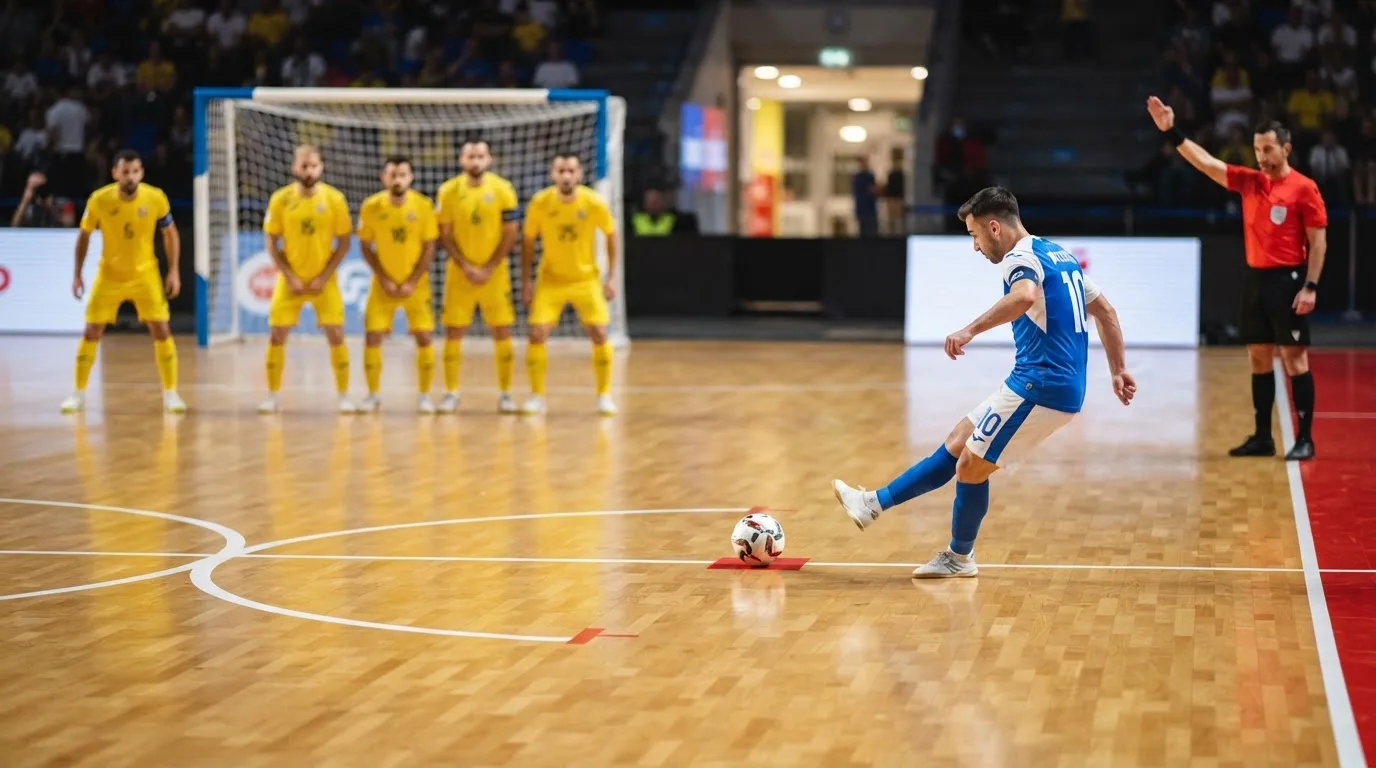
Those mechanical facts shape everything a bookmaker prices. A shorter clock keeps totals markets tight; a court half the size of a football pitch compresses shooting angles; size-4 ball behaviour rewards quick combinations and finishes from closer range. The accumulated-foul rule is the one most newcomers miss: from the sixth foul in a period onwards, the opposing team gets a direct free kick from the second penalty mark — ten metres out, no wall — until the period ends. That single rule produces a stream of late-period free kicks worth more than the equivalent in football, and any model built on football totals will misprice the late stages of a futsal half until it is corrected.
The sport itself has been around for the best part of a century. Futsal was invented in 1930 in Montevideo by Juan Carlos Ceriani, originally for YMCA play, and FIFA is the highest governing body. The first FIFA-organised futsal World Cup was held in 1989; the inaugural FIFA Futsal Women’s World Cup was held in the Philippines in 2025. That tournament history is short enough that a futures market — “winner of the next World Cup” — only opens occasionally, and most bookmakers price it for a brief window around the qualifying draws rather than year-round.
Where Futsal Markets Sit in the Bookmaker’s Catalogue
Futsal sits inside the wider sportsbook rather than as a tab on its own. A bettor looking for live futsal will usually find it under the in-play football column, sometimes tucked under a “Specials” tab and occasionally flagged as “Futsal” near the bottom of the sport list. The market depth reflects fixture depth: where there is one elite men’s futsal league on a Saturday afternoon, the same bookmaker might carry a hundred football fixtures; where the day holds a knockout round of the UEFA Futsal Champions League, the catalogue reverses on its head and football briefly becomes the smaller column.
Three things shape how much of the sport a bookmaker will price. First, the data feed — a lot of futsal coverage is automated, and the liquidity is what pushes a bookmaker into “Offered” or “Suspended” market by market. Second, the settled-result pipeline: a market that takes three days to settle after a late postponement discourages aggressive pricing. Third, the bookmaker’s own commercial decision about who its futsal customers are. A specialist that carries twenty lines per match — corner handicaps, total goals in each period, exact score grids — and a generalist that posts a 1X2 with a small handful of totals are pricing for two different readers.
The bigger sportsbook brands tend to carry the FIFA World Cup qualifiers and the continental club competitions around their fixtures, the men’s and women’s top-tier national leagues in the heavy futsal nations (Brazil, Spain, Portugal, Russia) and a season-long set of outrights. Below that, the catalogue shrinks to one or two lines per match or disappears entirely.
Top 10 Licensed Bookmakers for Futsal in Great Britain
The list below is the shortlist of Gambling Commission-licensed bookmakers considered in this guide. Inclusion is a licence fact, not a recommendation, and the page says what each one offers to a futsal punter rather than which one is best. Every operator below holds a remote general betting standard (real events) licence and is registered for online play in Great Britain.
| Bookmaker | Gambling Commission remote licence | Licence holder | What the operator’s terms state on futsal |
|---|---|---|---|
| BetTom | 064959-R-339314-003 (Commission account 64959) | Bet Tom Limited | Sports welcome offer of 50% back as a free bet up to £50, with a matching 50% back up to £50 as free slot funds for casino play; full terms apply |
| VBet | 044662-R-324273-022 (Commission account 44662) | SCGO Limited | App carries a Bet Builder, pre-match and in-play betting, live streaming and a live calendar with results and stats |
| DAZN Bet | 048756-R-327274-019 (Commission account 48756) | DZBT Limited | Deposits from £5 by debit card, Apple Pay, Paysafecard, Trustly and Skrill, and from £20 by PayPal, with no processing fees |
| Betfred | 039544-R-319290-010 (Commission account 39544) | Petfre (Gibraltar) Limited | App features Bet Builder, Sub Switch, Racing Post data, Extra Places, live casino and bingo |
| DragonBet | 064908-R-339041-003 (Commission account 64908) | DragonBet Ltd | Cash out is offered both in-play and pre-match; live streaming is offered for racing |
| Fafabet | 057385-R-333191-006 (Commission account 57385) | Taichi Tech Limited | Best Odds Guaranteed applies to UK and Irish horse racing win and each-way bets from 9am on race days |
| London Bet | 066162-R-340278-004 (Commission account 66162) | Thistle Bet Limited | The app combines sports betting (football, tennis, horse racing, greyhounds, darts, golf, cricket, NFL, NBA, MLB, snooker) with Pragmatic Play casino slots and live in-play betting |
| Octobet | 062545-R-337248-006 (Commission account 62545) | Octopus Game Limited | Best Odds Guaranteed applies to UK and Irish horse racing, up to £150 per customer per race |
| Geoff Banks | 054095-R-330366-010 (Commission account 54095) | GB Sports Advisors Limited | Live in-play prices and ante-post prices on future events |
| LiveScore Bet | 056859-R-332720-005 (Commission account 56859) | LiveScore Betting and Gaming (Gibraltar) Limited | Accepts debit cards (Visa and Mastercard), Apple Pay, PayPal, Pay by Bank (Open Banking) and Revolut Pay |
Spread-betting on sports outside financial markets carries a separate risk that does not apply to fixed-odds betting. Spreadex, for instance, is regulated by the FCA for spread betting and by the Gambling Commission for fixed-odds betting, and states that spread-betting losses can exceed the deposit. That is a different proposition to laying a fixed-odds price on a futsal match and is not what this shortlist compares.
A reader choosing between these ten is choosing what kind of account they want. Betfred and VBet stack the platform with bet-builder tools; DragonBet and Geoff Banks lean on niche pricing on smaller leagues; LiveScore Bet and DAZN Bet centre the account around fast deposit flows with familiar methods. Futsal coverage is genuine on each, but the catalogue depth varies match by match — the question of “who prices futsal best” is settled more by the next fixture list than by the brand name.
What Futsal Betting Actually Means in Great Britain
“Futsal betting” describes any wager placed on a futsal match at a bookmaker licensed to take bets from customers in Great Britain. A bettor in England, Scotland or Wales who opens an account, passes the identity check and deposits a stake in pounds is doing exactly that — placing a wager from Great Britain on a real futsal fixture, under a remote general betting standard (real events) licence. The licence category matters because virtual events and pool betting sit under different categories and have different rules.
The phrase covers the 1X2 (home win, draw, away win) on a league fixture, totals on goals scored in one or both periods, handicaps on goal difference, and a long tail of proposition bets on first goalscorer, race to N goals and period winner. Each of those bets settles under the bookmaker’s published rules, which look up into the match data feed the operator subscribes to. Where the data feed is partial — a low-tier men’s league in a smaller futsal nation, a women’s friendly the feed does not recognise — markets dry up or settle on a smaller set of rules.
Outside Great Britain, the same phrase can mean something different. A punter in a country without a UK-style regulatory framework may be placing bets on the same matches through an offshore operator, with no licence fact to lean on and no British complaints route if a withdrawal is held. The rest of this guide sticks to the Great Britain context, where the Gambling Commission is the regulator and the public register is the only authoritative test of who holds a licence.
Legality and Regulation in Great Britain
The whole commercial gambling market in Great Britain is licensed by the Gambling Commission under the Gambling Act 2005. Since the Gambling (Licensing and Advertising) Act 2014, an operator whose remote facilities are used in Great Britain has to hold a Commission licence, wherever the operator itself is based. A Curaçao, Maltese or Gibraltar licence is not a substitute; the licence has to be a Commission licence, and it has to be in force at the moment the bettor opens the account. Operating without one is an offence under section 33 of the 2005 Act, aimed at the operator.
The Commission’s public register is the only authoritative list. It can be searched by business name, trading name, domain or account number, and it is the whole test of whether a brand holds a licence. A brand’s home page can claim anything it likes about being “fully licensed” — the register is what counts, and a check on the register, by account number, is the part of opening an account that has to come first.
Minimum age is 18 across the whole market. Since 7 May 2019, identity, address and date of birth have been verified before a customer can deposit or gamble, including with a free bet or a bonus. Credit cards are banned for gambling in Great Britain since 14 April 2020; that ban covers credit-card-funded payments through an e-wallet. Debit cards and bank-based payments are not covered by the ban. A British named-account rule, a state list of permitted payment methods or any rule about cryptocurrency deposits at licensed operators are not part of the framework.
For the reader, the practical question is: “Is the operator I’m opening with on the register, and is the licence current?” That is a question that takes thirty seconds and saves months of grief.
Responsible Gambling and Player Protection
The Commission’s player-protection regime runs through three channels: a national self-exclusion scheme, financial checks at higher spend, and the help services available to anyone whose gambling has stopped being fun.
GAMSTOP is the national multi-operator online self-exclusion scheme, and it has been a mandatory licence condition for online operators since 31 March 2020. Exclusion can run for six months, a year, five years, or five years with auto-renewal, and after the minimum period the exclusion stays in place for a further seven years unless the customer asks GAMSTOP to remove it. GAMSTOP covers online sites and apps; betting shops use a separate service. Every brand on the shortlist above participates in GAMSTOP, and an opt-out is not a setting a customer can change quietly mid-bet.
A financial vulnerability check is a Commission condition that applies to remote betting where a customer’s deposits minus withdrawals exceed £150 in a rolling 30 days. It is a public-record check — things like bankruptcy or county court judgments — and it is not an income check and not a credit reference check. The Commission has announced a staged plan for broader financial risk assessments, with no start date at the time of writing; the published regime is “announced, staged, no start date” rather than “in force”.
Operators also offer the everyday controls: deposit limits on a fixed time frame, time-out periods, product restrictions, self-exclusion at the operator level and reality checks that prompt after a set period at the screen. The first deposit-limit changes have applied since 31 October 2025; a second phase is on the regulatory timetable for 30 September 2026, and whether it is live at any given moment is not something the page can settle — the operator’s account page is the right place to look.
Help is available outside the bookmaker too. GamCare runs the National Gambling Helpline; GambleAware funds treatment and education; the NHS runs gambling clinics; Gamblers Anonymous runs meetings. The licensed operators carry links to these services and require safer-gambling messaging in their own marketing.
The discipline on the punter’s side is the part no regulator can supply. Bankroll discipline, staking rules, a stop-loss before the session starts — the everyday tools that turn gambling from a reaction into a decision. A bookmaker can offer safer-gambling tools, but the choice whether to use them belongs to the customer.
Bonuses, Free Bets and What They Actually Cost
A welcome bonus at a licensed operator is a marketing expense, and the marketing expense comes back to the customer in three places: the size of the bonus, the conditions attached to it, and the value of the price the bonus is locked to. Promotion rules in force since 19 January 2026 cap wagering requirements on bonuses at 10x (a £10 bonus at 50x used to need £500 of bets; under the cap no more than £100). Mixed-product promotions — an offer that requires gambling on two or more product types — are banned under the same rules. A futsal punter looking at a sportsbook welcome offer should know the cap and check the small print before settling on one over another.
A free bet is not a refund in cash. The stake is usually not returned with the win, so a £10 free bet at odds of 3.00 returns £20 profit plus the original £10 stake being treated as the £10 token, not as cash — the net is £20 in the pocket, not £30. The rule is the rule across most licensed operators in Great Britain, and the same condition reappears as a footnote in nearly every promotion. A “risk-free” bet refunded as a free bet is the same mechanism with a friendlier word on the page; the stake being non-returnable is what makes it cheap for the operator.
An accumulator insurance pays out as a free bet if one leg of a multi-leg wager loses, and the cash value of that free bet comes back under the same stake-not-returned rule. A price boost raises the decimal odds on a named selection for a short window; a best-odds-guaranteed offer upgrades the starting price to the larger of the taken and the on-course price on horse and greyhound racing (not on futsal). Each of those has its own shape, and conflating them flatters the marketing copy.
The arithmetic that matters is the value of the offer in real money, after turnover and minimum price, on the markets that promotion actually applies to. A futsal punter betting singles has no use for an acca-insurance line; a futsal punter betting small stakes has no use for a bonus that requires a £500 turnover on £5 increments. Matching the offer to the punter’s pattern is the difference between “a bit extra” and “a small print I never finish clearing”.
Live Betting and Cash Out on Futsal
Live futsal betting is offered by most licensed operators with a sportsbook of any size, and the depth of the live catalogue mirrors the depth of the pre-match one. A bookmaker with a strong in-play team on football will usually staff futsal at the same level — fewer than a hundred markets in a major fixture, fewer again in a friendly. The clock-stopping rule in futsal affects how live markets feel more than how they price: a stoppage is a moment to settle a position rather than to chase a price that has moved three ticks in two minutes.
Cash out lets a punter lock in a position before the final whistle. DragonBet offers cash out both in-play and pre-match; other operators offer it on selected markets only, and the markets offered tend to be the high-volume ones. The price offered at cash out is the bookmaker’s own, not an exchange lay; the bookmaker’s margin sits inside it, and the punter is taking the other side of the same firm that laid the original bet. A futures bet on a tournament winner cannot be cashed out mid-tournament; a pre-match 1X2 on a friendly can. The shape of the catalogue matters more than the headline.
Live streaming is offered by some operators for racing and a handful of other sports, and futsal coverage is patchy. Where a live stream is available the operator states it on the fixture page; where it is not, the bookmaker’s data feed is what carries the live prices. The gap between a streamed match and a data-only match is one of the operational differences between a heavy and a thin in-play product.
Watching the live market is mostly a discipline question. The bookmaker’s price moves with goals and cards, and the punter who has a thesis on each period winner will find better value before the whistle than during it. Live betting is a tool for a defined plan; it is not a substitute for having one.
How Predictions Are Built — and Why No Tip Is Ever Certain
A prediction rests on a stack of inputs: recent form (the team’s last five results), the strength of the squad on the day (absences, returning players, the starting five), the tactical match-up (a press-heavy side against a build-up side), the historical record between the two sides, and the home advantage. A good prediction weights each input, justifies the weights from prior results, and produces a probability for each outcome.
That probability is then compared with the bookmaker’s odds. Where the prediction says the away side wins 45% of the time and the bookmaker’s odds imply a 50% chance — decimal odds of 2.00 — the prediction says the price is short, and the right bet, in theory, is to pass. Where the prediction says the away side wins 45% and the bookmaker’s odds imply 40% (decimal odds of 2.50 and above), the prediction says there is value in backing the away side, because the price overpays relative to the chance.
What that formulation does not do is promise a win. A 45% probability is a 55% probability of losing, and over a small sample — a single weekend’s fixtures, a single tournament — variance swamps the edge. Bankroll discipline is what keeps a positive expected value profitable over weeks and months; staking too much on any one selection turns a small edge into a sharp loss the first time the result goes the wrong way.
Tipsters — paid or free — are not a shortcut. A tipping record with a Strike Rate of 55% at Average Odds of 1.80 produces long-run profit; a record at 60% at Average Odds of 1.40 produces long-run loss. The history matters more than the hype, and the history has to be independently auditable to count.
Bet Types and How Odds Are Read
A single bet is one selection, one outcome. A double is two selections, both must win. An accumulator (“acca”) is any number of selections, from three upwards, all must win for the bet to pay out. The decimal odds of each leg multiply into one price: three legs at 1.80, 2.10 and 2.40 produce a single combined decimal price of about 9.07. A combination bet’s edge erodes with each added leg, because each leg carries its own margin and the margins compound.
An each-way bet on futsal is rare — each-way is a horse-racing and greyhound-racing construct, paying on the place as well as the win. A lay bet on a betting exchange is not a feature of fixed-odds operators, and Spreadex’s financial-spread product is a separate FCA-regulated market. A bet builder (or “same-game multi”) is a combination bet built from markets within a single match — first goalscorer plus total goals over 4.5, say — and a bookmaker with VBet’s app offers the tool natively, with restrictions on which markets can be combined.
How decimal odds work. A £10 stake at odds of 1.90 returns £19 if the bet wins — the £10 stake plus £9 profit. The fractional equivalent is 9/10 (the same price, written as profit over stake). “Evens” is 1/1 or 2.00 decimal. Fractions below 1/1 are “odds-on”, and the payout is smaller than the stake. The bookmaker’s margin sits inside the gap between the true odds on all outcomes and 100% — see the worked calculation below.
A “boosted odds” offer is a price increase on a single named selection for a short window. The offer is a marketing expense funded from the bookmaker’s house, not from the margin on the market; the bettor’s expected value rises only if the boosted price is still better than the underlying market. A “best odds guaranteed” applies to UK and Irish horse racing under specific conditions (the SP bigger than the taken price on win and each-way bets from 9am on race days in Fafabet’s terms, for instance); it does not apply to futsal.
The Bookmaker’s Margin, Worked as a Two-Way Example
The margin is the share of every pound staked that the bookmaker keeps, on average, over the long run. For an illustrative two-way market priced at 1.90 against 1.90 — a notional 50/50 contest — the calculation runs as follows.
The implied probability of each outcome at decimal odds of 1.90 is 1 ÷ 1.90, or about 52.63%. With two outcomes priced the same, the total implied probability is 1 ÷ 1.90 plus 1 ÷ 1.90, or about 105.26%. A fair book, where the bookmaker takes no cut, would total 100%. The difference — here about 5.26 percentage points, give or take a fraction depending on the rounding — is the bookmaker’s margin on this market.
In pounds, that means for every £1 staked across both outcomes in equal measure over the long run, roughly 95p returns to the customer as winnings and roughly 5p stays with the bookmaker as gross profit. The exact figure is sensitive to the rounding the operator uses and to the shape of the book on either side of the line, and most real two-way markets do not land exactly on 50/50 — a heavy favourite will be priced short on one side at odds of 1.40 and long on the other at, say, 2.80, and the margin of that book is larger. The point is the structure, not the digits: every price the bookmaker offers carries the margin inside it, and the bettor’s job is to back outcomes whose true probability is larger than the price implies.
For futsal specifically, the margin on 1X2 markets is generally larger than on a top-tier football match — the liquidity is lower, the data feed is patchier, and the bookmaker’s risk is harder to hedge. Some bookmakers post small-market margins of 7% or higher on selected futsal fixtures, against a typical football match of about 5%. A value bet is exactly the question of whether the punter’s probability estimate clears that larger margin by enough to make the bet positive expected value.
What a Winning Bet Returns
The arithmetic of a winning bet is the simplest thing on the page. A £10 stake at odds of 3.00 returns £30 — the £10 stake plus £20 profit. A £10 stake at odds of 1.50 returns £15 — the £10 stake plus £5 profit. The decimal odds tell the whole story: stake times odds equals return, and return minus stake equals profit. For a combination bet, the odds of each leg multiply into one combined price, and the same rule applies: stake times the combined odds equals the return.
Where the conversion gets in the way is between fractional and decimal. Fractional odds of 5/1, decimal odds of 6.00. Stake of £10 at 5/1 returns £60 profit plus the £10 stake for £70 total. Stake of £10 at evens (1/1) returns £10 profit for £20 total. The bookmaker’s margin applies to the decimal form, and the page uses decimal odds throughout to keep the comparison direct.
Bet Tom
Bet Tom Limited operates BetTom under Gambling Commission account 64959, and holds the standard remote betting licence for real events. The sports welcome offer is 50% back as a free bet up to £50, with a matching 50% back up to £50 in free slot funds, on the operator’s stated terms. The site positions itself as a sports-led account with casino on the side.
A futsal punter weighing Bet Tom against the rest of the shortlist is weighing welcome offer shape rather than futsal-specific depth. The 50% back as a free bet works for a punter staking on sport; the matching casino component is wasted on a punter who does not play casino. A bettor who already has an account here under a verified identity can move quickly, and the same identity and payment setup covers futsal in-play as covers any other sport.
The verdict turns on what the punter bets next. Bet Tom suits a punter who wants a sports-shaped welcome and is happy with a casino-linked carrot on the side; a strictly sports-only bettor may leave money on the table by treating the casino slots as a gift.
VBet
SCGO Limited operates VBet under Gambling Commission account 44662, and is licensed for remote general betting. The app carries a Bet Builder, pre-match and in-play betting, live streaming and a live calendar with results and stats. The feature surface is the deeper one of the shortlist.
Live streaming on VBet is the operational advantage for a punters who wants to watch as well as bet, and the live calendar with stats is the tool for a punter who wants the data behind the price. Bet Builder is a feature most of the licensed operators carry now; on VBet the same tool extends to futsal. A reader looking for the operator that does the most “above the price” — not the price itself, but the things you do with it — finds VBet nearer the top of that list than the bottom.
The limit is liquidity. A feature-heavy operator on a low-volume sport still prices off the data feed, and the depth of markets can be thinner than the feature count suggests. Where the daily fixture list is strong, the difference is invisible; where it is thin, the operator carries the catalogue by itself and the punter is betting into a wider spread.
DAZN Bet
DZBT Limited operates DAZN Bet under Gambling Commission account 48756, and operates under a remote general betting licence. Deposits start at £5 by debit card, Apple Pay, Paysafecard, Trustly and Skrill, and at £20 by PayPal, with no processing fees. The deposit floor is the flat-low value of the account, and the no-processing-fee language is meaningful on a small-stake punter who recycles the deposit multiple times per week.
A bettor paying in from a Skrill e-wallet finds DAZN Bet more usable than one whose only payment is PayPal, where the floor doubles. The sportsbook is conventional: 1X2, totals, handicaps, in-play at major events. Futsal pricing on DAZN Bet is mainstream rather than specialist; a punter looking for a heavy-futbal catalogue will look elsewhere.
The verdict fits a punter who keeps deposits small and recycles them often, and who is happy with mainstream pricing on niche sports rather than specialist depth. For a punter who wants PayPal as the primary deposit, the £20 floor is the cost of the account.
Betfred
Petfre (Gibraltar) Limited operates Betfred under Gambling Commission account 39544, and is authorised for remote general betting. The app features Bet Builder, Sub Switch, Racing Post data, Extra Places, live casino and bingo. The Betfred app is a heavyweight, with a feature list longer than most of the shortlist.
A futsal punter looking at the Betfred app is looking at a platform that was built around horse racing and football, with a long tail of other sports under it. Bet Builder works across most fixtures the bookmaker carries; Sub Switch is a same-race horse-racing tool. Futsal bettors will use the Bet Builder side of the feature set rather than the racing side.
The right customer is a punter who values the platform on the football side of the book and wants a familiar account to do futsal at as well. The wrong customer is a futsal-only punter, who is paying for a horse-racing feature set they will not use.
DragonBet
DragonBet Ltd operates DragonBet under Gambling Commission account 64908, and holds a remote general betting licence. The site offers cash out both in-play and pre-match, and live streaming is offered for racing. The cash-out offer is the standout line on the page — cash out pre-match is unusual among licensed operators, and where it is offered it is usually only on selected markets.
A futsal punter who closes positions before the whistle, rather than riding the result through, has the option here in a way most operators do not match. Pre-match cash out is also the tool for a punter who likes to scalp a closing line change before kick-off. Live streaming of racing is irrelevant for futsal.
The verdict suits a scalper and a trade-out punter; the punter who bets once and walks away pays for a feature they will not use.
Fafabet
Taichi Tech Limited operates Fafabet under Gambling Commission account 57385, and is licensed for remote general betting. Fafabet pays Best Odds Guaranteed on UK and Irish horse racing win and each-way bets from 9am on race days, with the bigger of the taken price or the starting price paid out at settlement. The racing offer does not apply to futsal.
Fafabet’s general sportsbook is mainstream: 1X2, totals, in-play at major events, and the depth of markets on a futsal fixture is what any other mainstream bookmaker would carry. The brand identity is around racing; a futsal punter at Fafabet is using the same account as a racing punter, with the same verification and the same payments.
The verdict is a punt for whom Fafabet is the same account as the racing account, and the racing offer is a bonus on the side. A strictly futsal-only punter pays for the racing set.
London Bet
Thistle Bet Limited operates London Bet under Gambling Commission account 66162, and operates under the standard remote betting licence. The app combines sports betting (football, tennis, horse racing, greyhounds, darts, golf, cricket, NFL, NBA, MLB, snooker) with Pragmatic Play casino slots and live in-play betting. The published UK age rating is 17+ on the App Store, and the operator’s stated audience is broad.
A futsal punter at London Bet is at a brand that leans on a wide sportsbook rather than depth in any one sport. Futsal coverage exists, but the catalogue is mainstream rather than specialist. The App Store age rating is one to flag — the operator’s own terms set the gambling age at 18, and a wallet registered to an under-18 cannot be used for gambling regardless of the App Store rating.
The verdict suits a punter who keeps a wide sports book across many sports, and London Bet’s value proposition is the catalogue breadth rather than futsal-specific depth.
Octobet
Octopus Game Limited operates Octobet under Gambling Commission account 62545, with a remote general betting standard (real events) licence. Best Odds Guaranteed applies to UK and Irish horse racing, up to £150 per customer per race. The BOG cap is the variation that sets Octobet apart from Fafabet on racing terms.
A futsal punter at Octobet is at a brand whose sportsbook is generalist, with the depth of markets on a futsal fixture at the level of any mainstream bookmaker. The £150-per-race cap on the BOG offer is the operational parameter a horse-racing punter checks; a futsal punter ignores it.
The verdict suits a punter who keeps horse racing on the side and reads the small print on BOG caps. A futsal-only punter pays for the racing offer.
Geoff Banks
GB Sports Advisors Limited operates Geoff Banks under Gambling Commission account 54095, with a remote general betting standard (real events) licence. The brand carries live in-play prices and ante-post prices on future events. The bookmaker is a smaller licensed brand with a niche on ante-post markets.
Ante-post is the longer-term pre-tournament market, settled at the end of the tournament rather than the end of the match. On a major futsal tournament — the UEFA Futsal Champions League knockout, the FIFA Futsal World Cup — a price on the outright winner opens months in advance and settles when the final is played. A bettor who wants to back a side months before the tournament finds the ante-post price at operators like Geoff Banks. The liquidity is lower than the in-play price; the price-to-book ratio is wider; the patient’s premium is what the bookmaker pays to carry the position.
The verdict suits a punter who picks tournaments, not matches. A single-match punter pays for the ante-post infrastructure they will not use.
LiveScore Bet
LiveScore Betting and Gaming (Gibraltar) Limited operates LiveScore Bet under Gambling Commission account 56859, with a remote general betting standard (real events) licence. The site accepts debit cards (Visa and Mastercard), Apple Pay, PayPal, Pay by Bank (Open Banking) and Revolut Pay. The payments list is the widest of the shortlist.
A futsal punter at LiveScore Bet has the same product as every other mainstream licensed operator on the sportsbook side. The differentiator is payments: Pay by Bank and Revolut Pay are two of the methods most of the shortlist does not carry, and a punter with a Revolut account in particular finds LiveScore Bet faster to set up. The verification is the standard Commission regime: identity, address and date of birth before the first deposit, including for a bonus-eligible account.
The verdict suits a punter who pays by a method the rest of the shortlist does not take, and who is happy with mainstream pricing across all sports.
How to Use This Guide
The shortlist above is a comparison, not a recommendation. Inclusion on the list means the operator holds a current Commission remote licence under the betting standard (real events) category; the order is publication order. The decision on which operator to open with rests with the punter and is shaped by the punter’s own pattern — what they bet, how much, how often, and which payment rails they want to use.
The archive below is a guide; it is not advice on which side to back in any fixture. No outcome can be known in advance. The bookmaker’s margin sits inside every price, and the value bet’s edge is the gap between the punter’s probability and the bookmaker’s implied probability — a small edge, even when it is real, and one that vanishes over a small sample. Bankroll discipline is what turns an edge in theory into a result in practice.
Frequently Asked Questions
How does betting on a futsal league work?
A betting on a futsal league means picking a selection — usually a 1X2, a total, a handicap or a combination market — on a real-money wager at a licensed operator’s sportsbook. The bet settles on the result of the fixture after the match ends, under the bookmaker’s published rules. Futsal-specific rules apply, and the accumulated-foul free-kick rule from the sixth foul of a period is a feature the betting pricing often reflects.
What is a value bet, and why is no tip certain?
A value bet is a wager at a price the punter judges to be bigger than the true probability of the selection — the punter’s probability estimate clears the bookmaker’s implied probability. The edge is real but small, and over a small sample the variance overwhelms it. A tip is never certain because outcomes depend on a finished match, and no result is known in advance.
What is the bookmaker’s margin, and how is it seen in the odds?
The bookmaker’s margin is the share of every pound staked the bookmaker keeps over the long run, and it sits inside every decimal odds on every market. Implied probability is 1 ÷ decimal odds; the margin is the gap between the total implied probability across the outcomes and 100%. A market priced at 1.90 against 1.90 carries about 5% margin.
How is the return on a bet worked out from the stake and the odds?
The return on a winning bet is stake × decimal odds, and the profit is return − stake. A £10 stake at odds of 1.50 returns £15 in total — £10 stake and £5 profit. For a combination bet the decimal odds of each leg multiply into a single combined price, and the same formula applies.
How is a Gambling Commission licence checked?
The Commission’s public register can be searched by business name, trading name, domain or account number. The licensee’s licence status, categories and effective dates are on the register; a check against the register is the only authoritative test of whether a brand holds a current GB licence. A statement on the brand’s own home page is not a substitute.
Which safer-gambling tools does a licensed bookmaker have to offer?
A licensed bookmaker has to offer deposit limits, time-out, product restrictions, self-exclusion and access to GAMSTOP as a minimum; GAMSTOP self-exclusion is mandatory for online operators and has been since 31 March 2020. Help services — GamCare, GambleAware, NHS gambling clinics, Gamblers Anonymous — are signposted by every licensed operator, and the safer-gambling controls are the customer’s choice to set and use.
Football – Boxing betting
Content created by the «Boxing betting» team
