
Futsal Betting Odds: How the Markets Are Built and Where to Find Them
 Available in US
Futsal sits in an odd corner of the sportsbook. Five-a-side, two periods of twenty minutes, a court forty metres long. The pools are thinner than football’s, the in-play coverage spottier, and the welcome offer a reader sees on the landing page is rarely the price that pays out when the bet lands. This guide is about what futsal odds price in practice, which licensed bookmakers actually carry the sport, and what the margin inside the prices costs a bettor who never reads it.

The figures below are current as of 27 October 2026 and were checked against the Gambling Commission’s public register for the licence numbers cited.
Futsal as a betting sport: what the fixtures look like
Futsal was codified in 1930 in Montevideo, designed by Juan Carlos Ceriani for YMCAs needing a football-like game for indoor courts. FIFA is now its highest governing body, and the first FIFA Futsal World Cup was held in 1989. The women’s equivalent only arrived last decade: the inaugural FIFA Futsal Women’s World Cup took place in the Philippines in 2025.
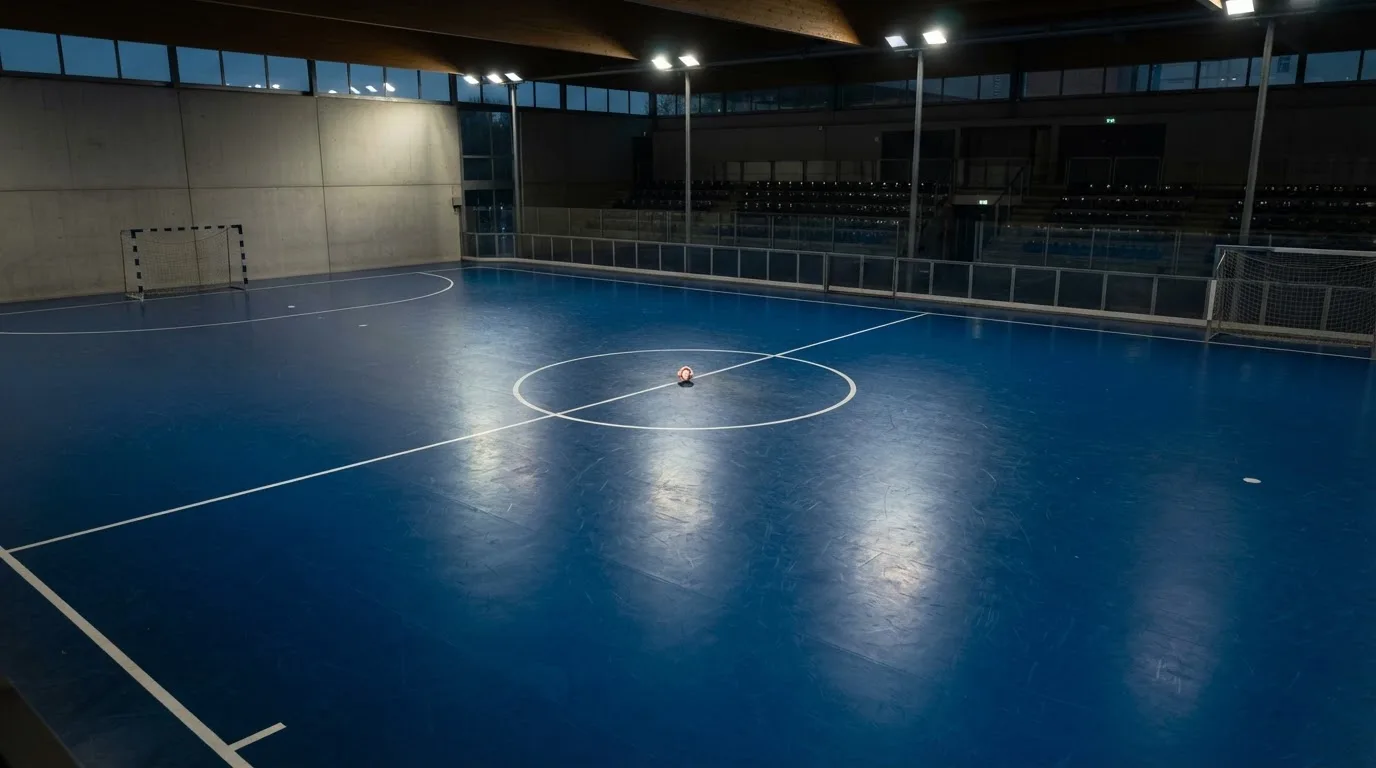
The sport itself is small, fast and high-scoring relative to football. Two teams of five — one of them a goalkeeper — play on a court forty metres by twenty, with up to nine substitutes and unlimited interchanges. The match is two 20-minute periods, and the clock stops at dead-ball situations. Each side has one timeout per period. The ball is size 4, smaller and heavier than a football, with a lower bounce; it stays on the deck rather than looping over defenders.
That last point matters when the markets open. Futsal throws up more goals per match than eleven-a-side football, more rebounds off goalkeeper saves and rebounds off the boards, and more direct shots from outside the penalty area. The stat profile is closer to indoor five-a-side than to its outdoor cousin, and the books that price the sport have to account for goal clusters, not for the steady 1-1 or 0-0 rhythms that dominate football modelling.
For bettors, the rules do something else: from the sixth accumulated foul in a period, the opposing team gets a direct free kick from the second penalty mark — ten metres out — with no wall allowed. Late in a period, accumulated fouls become a market in their own right. A side sitting on five fouls with eight minutes to play is in a different game from one sitting on two.
How this page ranked the licensed bookmakers
The comparison below ranks ten Gambling Commission-licensed remote operators that carry futsal or a sportsbook wide enough to include it. The ranking is a shortlist, not an endorsement: a licence on the Commission’s register is the entry condition, and what separates the ten is what each one adds on top — in-play depth, bet builder availability, welcome terms, payout speed. The list draws on what each operator’s own site and app state, checked against the Commission’s public register on 16 October 2026.

The angle throughout is consequence. A welcome offer that looks generous on the landing page may carry a turnover requirement that takes fifty bets at minimum price to unlock. A “best odds” tag on a market may be the same price the next bookmaker is showing. A live cash-out button only does something if the market is priced deep enough to react to the next goal. The comparison looks at what each operator’s offering actually costs the punter who uses it.
Where licensed UK bookmakers stand on futsal betting
The table below sets the ten featured operators side by side. Each row states the Gambling Commission account number, the named licence holder on the register, and what that operator’s own terms say about futsal or the wider sportsbook it lives in. Cells where an operator’s own page does not address the question carry the no-data marker; the gaps are part of the picture, not an apology for them.
| Brand | Gambling Commission remote licence and licence holder | What the operator’s own terms say about futsal and the wider sportsbook |
|---|---|---|
| Copybet | Account 53774, held by Copybet UK Limited | Best Odds Guaranteed applies all day, every day on UK and Irish racing; first past the post is paid on horse racing even when the winner is later disqualified |
| Betmaster | Account 65699, held by BM Solutions GB Ltd | Covers football, cricket, horse racing, NFL and eSports, including League of Legends and Dota 2 |
| Fitzwilliam Sports | Account 48760, held by SBKI Limited | Dublin bookmaker with capped membership; welcome is a “High Stakes Welcome” subject to compliance criteria; offers instant deposits, fast withdrawals, timeouts and deposit limits, and links to GambleAware, GamStop and Gamblers Anonymous |
| NetBet | Account 39170, held by Netbet Enterprises Limited | Daily Boosts, Profit Boosts and free bet offers; a Bet Builder with instant dynamic odds; sports stats for major leagues |
| BetTom | Account 64959, held by Bet Tom Limited | Sports welcome is 50% back as a free bet of up to £50, with a matching 50% back up to £50 as free slot funds for casino play |
| DragonBet | Account 64908, held by DragonBet Ltd | Welsh football and rugby markets, racing, American football, in-play betting and bet builder markets |
| Hollywoodbets | Account 53028, held by Hollywoodbets International UK Limited | New players who deposit £10 or more by card get their stake back as a free bet of up to £30 on a first qualifying losing accumulator (stake £10+, 3+ legs, odds of 4/1 or greater, settled within 7 days); one free bet per customer |
| Spreadex | Account 8835, held by Spreadex Limited | Combines fixed-odds and spread betting in one app; one-click, auto and partial cash out; Bet Builder across fixed odds or spreads; live streaming of UK and Irish horse racing, greyhounds, tennis, NFL and selected football; FCA-regulated for spread betting |
| BetVictor | Account 39576, held by BV Gaming Limited | Best Odds Guaranteed on UK and Irish horse racing; enhanced live race streaming; BetFinder feature for racing bets; Smart Stats |
| BoyleSports | Account 39469, held by Boylesports Enterprise | UK sports welcome is £20 in free bets when a £10 bet is placed; €30 in free bets for a €10 bet for Irish players |
The licence figures in the middle column are the account numbers that appear on the Commission’s public register for each operator. They are the check the reader runs, not the brand’s own claim about itself. Several brands sit under the same parent — Ladbrokes and Coral, Paddy Power and Betfair — but the ten above are presented on their own trading names, each under a single licence holder.
The legal frame: a Great Britain licence and what it actually covers
A bookmaker taking remote bets from customers in Great Britain needs a Gambling Commission licence. That requirement holds wherever the operator is based, since the Gambling (Licensing and Advertising) Act 2014 amended sections 33 and 36 of the Gambling Act 2005. A Curaçao, Maltese or Gibraltar licence is not a substitute for serving GB customers; the test is the Commission’s public register, not the operator’s claim. Licensed operators use .com as well as .co.uk, so the domain proves nothing on its own.
Northern Ireland sits outside the 2005 Act and runs under older law. A “GB licence” regulates England and Wales and Scotland, never Northern Ireland. The Commission’s own licence categories are specific: remote general betting standard (real events), remote general betting standard (virtual events), remote general betting limited, remote pool betting, and remote betting intermediary (the licence for betting exchanges). A licence for virtual events is not a licence for real matches, and an exchange licence is not a bookmaker licence. The ten featured operators above all hold the remote general betting standard (real events) category, which is the one a futsal market falls under.
Financial spread betting — the kind Spreadex offers alongside fixed odds — is regulated by the Financial Conduct Authority, not by the Commission. Spread betting losses can exceed deposits, and that risk is the operator’s own disclosure under FCA rules. It is a different product line on the same app, with different consumer protection.
What may be bet on, and what controls the markets
There is no statutory list of permitted bets or markets in Great Britain. The Commission grants a licence for a category and the operator offers markets under its own rules and the Licence Conditions and Codes of Practice (LCCP). In-play betting is permitted under those rules; it is not “unrestricted” as a legal conclusion, because the operator’s licence conditions and customer-protection duties still apply. Esports are treated like any other event under the same category; bets on politics, TV shows and novelty markets are offered by GB bookmakers and no statutory prohibition was found. No statutory cap on stakes in sports betting was found either; operators set their own maximum stakes and may restrict individual customers.
Credit cards have been banned for gambling in Great Britain since 14 April 2020 (LCCP condition 6.1.2), and that ban extends to credit-card-funded payments through an e-wallet. Debit cards and bank-based payments are not covered by the ban. Identity verification runs before the first deposit: name, address and date of birth are checked, and since 7 May 2019 that check applies to free bets and bonuses as well as to cash play. Anonymous play at a licensed site is not possible.
Bonuses, marketing and what the new rules cap
The Commission’s powers over advertising run alongside the CAP Code (non-broadcast) and the BCAP Code (broadcast), enforced by the ASA. CAP Code section 16: marketing must be socially responsible, must not be of strong appeal to under-18s, and no one who is or seems to be under 25 may be featured gambling or play a significant role in an advertisement. That rule is about who appears in the ad, not who may bet.
Promotion rules in force since 19 January 2026: wagering requirements on bonuses are capped at 10x. A £10 bonus at 50x wagering would have required £500 of bets; under the cap no more than £100 of qualifying wagering can be required. Mixed-product promotions — an offer that requires gambling on two or more product types such as betting, casino, bingo and lottery, for example “bet on football to get free spins” — are banned. Whether the cap applies to free bets that carry no wagering condition, and any cap on the money value of a bonus, are not established.
Tax: what the player pays, and what the operator pays
The player pays no tax on betting winnings in Great Britain. General Betting Duty is the operator’s tax on gross profits and sits at 15%; from 1 April 2027 a new remote betting rate of 25% applies within it, while remote bets on UK horse racing, bets on self-service betting terminals in licensed premises, pool betting and in-person betting stay at 15% (HM Government policy paper of 26 November 2025). Until 1 April 2027 the remote rate stays at 15%. Spread betting carries its own rates: 3% on financial, 10% on other. Whether operators pass the higher duty on through tighter odds is not established; a reader should not be told they are charged duty.
Offshore: what a non-GB licence costs the punter
A GB licence is compulsory at the point of consumption. Providing gambling facilities in Great Britain without the licence the Act requires is an offence under section 33 of the Gambling Act 2005 — on summary conviction up to 51 weeks’ imprisonment, a fine up to level 5, or both; six months in Scotland. The offence is aimed at the operator. No offence aimed at a customer who merely bets on an unlicensed site was found; the cost of doing so is loss of protection rather than prosecution. No GAMSTOP coverage, no Commission complaints route, no approved dispute-resolution body, no British consumer redress if funds are withheld, and not bound by the 10x bonus cap or the £150 vulnerability check. Enforcement against unlicensed operators runs through cease-and-desist notices, search-engine referrals, work with registrars, hosts and payment providers. The Commission has been given, or is about to receive, court-order DNS blocking powers; ISP blocking is not in operation and should not be written as if it were.
Licensed does not mean risk-free. Identity verification before the first bet, source-of-funds questions at higher spend, and a Commission complaint route that takes weeks are the trade for the protection. Unlicensed means none of them, with the additional risk that funds held by an unlicensed entity are harder to recover if the site stops paying out. Neither is “the safe choice” by default; the choice is what protections the punter wants and is willing to be verified for.
Responsible gambling: what a licensed bookmaker has to put on the page
Every GB-licensed online operator takes part in GAMSTOP. GAMSTOP is the national multi-operator online self-exclusion scheme and a mandatory licence condition for online operators since 31 March 2020. Exclusion periods run six months, one year, five years, or five years with auto-renewal; after the minimum period the exclusion stays in place for a further seven years unless the customer asks GAMSTOP to remove it. GAMSTOP covers online sites and apps. Betting shops use a separate service.
A financial vulnerability check (LCCP condition 3.4.4, in force since 30 August 2024) applies to licensed remote betting when a customer’s deposits minus withdrawals exceed £150 in a rolling 30 days — that rolling threshold is live since 28 February 2025. The check is a public-record review (bankruptcy, county court judgments and the like), not an income check and not a credit reference check. Financial risk assessments — the “affordability checks” of the press — are announced in a staged plan (Commission article of 7 July 2026), with no start date. The state of play is announced, staged, no start date, not in force.
Deposit limits are a separate obligation. Operators must offer a gross deposit limit on a fixed time frame under RTS 12; the first changes have applied since 31 October 2025, a second phase was postponed to 30 September 2026, and whether it is live is not established. There is no state-set deposit or loss ceiling for betting — limits are the customer’s choice, set inside the operator’s safer-gambling tools. The minimum age is 18.
The help lines that a licensed operator links to are GamCare (which runs the National Gambling Helpline), GambleAware, the NHS gambling clinics network, and Gamblers Anonymous. Fitzwilliam Sports, one of the ten featured operators, links to GambleAware, GamStop and Gamblers Anonymous on its homepage; readers comparing operators can use that as the template the others follow, because the LCCP requires each licensed site to surface those links in practice.
Bonuses and free bets: what they cost the punter who clears them
The marketing word is “free”. The arithmetic is rarely free. A welcome offer that hands back a first losing accumulator as a free bet up to £30 — Hollywoodbets’ sports welcome, on which a £10+ acca with three or more legs at odds of 4/1 or greater is refunded up to £30 if it loses within seven days — is a one-shot rebate that costs the operator the free bet only when the punter’s first qualifying bet loses. A £20-in-free-bets welcome on a £10 qualifying bet, the kind BoyleSports runs, is the same shape: a small qualifying outlay against a fixed free-bet return.
The cost of those offers sits in the free bet’s value, not in its headline number. A free bet whose stake is not paid back with a win is worth the free-bet amount times (odds − 1) divided by odds, multiplied by the payout share of the market it is placed on. A £30 free bet at decimal odds of 4.00 on a market with a 95% payout share is worth roughly £30 × (4 − 1) ÷ 4 × 0.95 = £21.38 in expected value. The same £30 paid back as cash on a losing bet would be worth £30 minus the margin of the qualifying market — closer to £28.50 if the qualifying market carried a 5% margin. The headline number is the same; the cost to the operator is not.
Wagering requirements, where they still exist, are now capped at 10x. A £10 bonus at 50x wagering — £500 of qualifying bets to clear — is no longer permitted in Great Britain. A £10 bonus at 10x wagering takes £100 of qualifying bets. The cap does not apply to free bets that carry no wagering condition, and no cap on the money value of a bonus has been set. The punter’s job is to check the operator’s own terms for the wagering multiple on the specific offer before claiming it, because the headline value is rarely the only number that matters.
Mixed-product promotions are banned since 19 January 2026, so an offer that requires gambling on football to unlock free spins on a slot is no longer permitted. BetTom’s sports welcome, which returns 50% as a free bet up to £50 on the sports side and a matching 50% back up to £50 as free slot funds on the casino side, is structured as two separate offers rather than as a single mixed promotion. The distinction matters: one is a sportsbook credit, the other is casino credit with its own rules.
Live betting and cash out on futsal
Live betting on futsal is offered by GB-licensed operators under their own in-play licence conditions. The shape of the markets is narrower: 1X2, next goal, total goals, sometimes a handicap, sometimes a half-time / full-time line. Bet builder products — same-game multis — are more common on football than on futsal because the underlying market data is deeper. Bet Builder+ at bet365 combines markets from one event into a single bet available pre-match and in-play; whether the futsal event the punter wants is in the eligible list is a check against the operator’s own builder, not a general rule.
Cash out is the practical lever for live futsal. Spreadex offers one-click, auto and partial cash out across its fixed-odds and spread books. Partial cash out closes a slice of the position and leaves the rest running; auto cash out sets a threshold the punter picks in advance. Both are useful in a sport where a goal can flip the lead inside a minute and where the bookmaker’s in-play margin tends to widen at exactly the moments a punter most wants to close. The cost of the cash-out button is that the offer the bookmaker makes on a cash out is below the fair value of the position; the gain is that the punter does not need to wait for the market to settle to lock in a profit or a loss.
Live streaming of futsal is rarer than live streaming of football. Spreadex streams UK and Irish horse racing, greyhounds, tennis, NFL and selected football; the football coverage is selective and futsal is not the first port of call. A punter watching the match through the bookmaker’s stream is reading the in-play prices alongside the picture; a punter watching through a separate feed is reading the prices with a delay, which is the disadvantage that any in-play strategy has to price in.
The momentum moves fast in futsal. Five fouls in a period puts the next foul at the ten-metre mark with no wall. A side two goals down with eight minutes to play is still in the game because the clock is short and the substitutions are unlimited; a side two goals up at the same point is in a different position because the other side has to chase. The markets that price these states — total goals, next goal, handicap — are where live betting has its edge, and where the in-play margin tends to bite.
Bet types and odds: how the prices are built
Futsal markets are a smaller version of the football set. 1X2 (home / draw / away), match result with handicap, total goals over / under, next goal, correct score, sometimes a half-time / full-time line. The big leagues — Liga Nacional de Futsal (Brazil), the Spanish LNFS, the Portuguese Liga Placard, the Russian Superliga, the Italian Serie A, the F-League in Japan, plus the FIFA Futsal World Cup and the UEFA Futsal Champions League — drive the depth. Outside those competitions the menu thins.
Odds come in two formats on a British bookmaker’s site: fractional (5/1, 11/4, evens) and decimal (6.00, 3.75). A fractional price of a/b converts to decimal by a ÷ b + 1. Five-to-one is 5 ÷ 1 + 1 = 6.00. Eleven-to-four is 11 ÷ 4 + 1 = 3.75. Evens, the British 1/1, is 1 ÷ 1 + 1 = 2.00. Odds-on means the fractional price is shorter than evens — 4/6, 1/2, 2/5 — and the decimal price is between 1.00 and 2.00.
What the margin costs the punter
The margin is what the bookmaker keeps of every unit bet on a market. Take a two-way market priced at 1.90 / 1.90 in decimal form (9/10 each way in fractional). The payout share is 1 ÷ (1/1.90 + 1/1.90) = 1 ÷ (0.5263 + 0.5263) = 1 ÷ 1.0526 = 0.95, or 95%. The margin is 1 − 0.95 = 0.05, or 5%. The same market priced at 1.85 / 1.85 gives a payout share of 1 ÷ (1/1.85 + 1/1.85) = 1 ÷ 1.0811 = 0.9249, or about 92.5%, and a margin of about 7.5%. The 1.90 / 1.90 book is cheaper than the 1.85 / 1.85 book by 2.5 percentage points of margin on every pound staked.
That margin compounds across the legs of an accumulator. A four-leg acca at 1.90 on each leg has combined odds of 1.90⁴ = 13.0321, and the combined payout share is roughly 0.95⁴ = 0.8145, or about 81.5%. The margin on the combined bet is closer to 18.5%. A four-leg acca at 1.85 on each leg has combined odds of 1.85⁴ = 11.7086 and a combined payout share of roughly 0.9249⁴ = 0.7314, or about 73.1%. The headline payout of the bigger-priced acca is lower and the margin is heavier. The acca insurance product some operators sell — a refund as a free bet if one leg lets the punter down — does not change the margin on the bet that does win; it changes the cost of the bet that does not.
In practice, futsal margins vary by market. The 1X2 on a FIFA Futsal World Cup group match is typically priced tighter than a Brazilian Liga Nacional fixture at 02:00 UK time, because the liquidity and the data behind the World Cup line are deeper. Handicap and total-goals markets tend to carry wider margins than 1X2 on the same match, because the bookmaker has less data on those lines. The punter’s edge is in comparing margins across bookmakers on the exact market, not in chasing the headline price on a single book.
How a return is worked out
A single bet at decimal odds returns stake × odds. A £10 stake at 3.75 returns £37.50, of which £27.50 is net profit. A double at 3.00 and 4.00 has combined odds of 12.00 and returns £120 on a £10 stake, of which £110 is net profit. A treble multiplies three odds, a four-fold multiplies four, and so on. The maths is the same whether the bet is on football, futsal or horse racing; the sport does not change the arithmetic.
Each-way betting — common on horse racing, rarer on futsal — places two equal-stake bets: one on the win, one on the place. The total outlay is twice the unit stake; the place terms vary by race and by operator. A bet builder, sometimes called a same-game multi, is a combination bet whose legs are all from one event; the combined odds multiply, and the margin compounds. A Lucky 15, a Yankee, a Heinz and a Goliath are multiples with a fixed number of selections and a fixed structure — 15, 11, 57 and 247 bets respectively on a four-, four-, six- and eight-selection card — and the total stake is the unit stake times the number of bets.
What “best odds” really means on a futsal market
Best Odds Guaranteed is a horse-racing promotion that pays the starting price if it is higher than the price the punter took. Copybet and BetVictor both offer Best Odds Guaranteed on UK and Irish horse racing; it does not apply to futsal, where there is no starting price in the racing sense. A “boosted odds” or “enhanced price” tag on a futsal market is a single-event price concession for a limited time or stake, and the boosted price still carries the operator’s margin.
The punter’s job on price is to compare the same market across two or three books at the same moment, because the margin varies and the headline moves. A 1.90 / 1.90 book on the match result is a 5% margin market; a 1.85 / 1.85 book on the same match is a 7.5% margin market. The 5p on the decimal price is worth more than 5p in headline terms — it is worth 2.5 percentage points of margin on the punter’s stake.
Predictions and strategy: what the markets actually let the punter do
A prediction on a futsal match is a forecast of goals, foul accumulation and momentum. None of those is knowable in advance; the markets price them and the punter’s edge, if any, is in the price relative to the punter’s own estimate. The operator’s data — team form, head-to-head, foul counts, expected goals — is the same data the operator prices into the line; the punter’s edge, where one exists, is in information the market has not fully absorbed.
Bankroll management is the discipline that turns a small edge into a long-run profit and stops a small edge from being wiped out by variance. The shape of a bankroll rule is simple: stake a fixed percentage of the bank on each bet, never chase a loss with a bigger stake, and stop when the stop-loss is hit. The rule does not need futsal-specific tuning; it needs the punter to stick to it. The bookmaker does not need the punter to lose, but the bookmaker’s margin means the punter must win at a rate above the margin to come out ahead, and variance will produce losing runs even at a winning rate above the margin. A staking plan that grows the stake during a losing run, or that loads a single high-confidence bet with a large percentage of the bank, is the plan that turns a winning strategy into a losing one.
Stats software for futsal is thinner than for football. The mainstream providers cover the FIFA tournaments and the major European leagues; the Brazilian, Asian and Russian leagues are patchy. A punter with an edge on Brazilian Liga Nacional foul accumulation has to build the dataset themselves or pay for a niche provider, and that cost is part of the edge calculation. The punter who chases tips without a price discipline is paying for someone else’s tip without the price edge that turns a tip into a long-run profit.
The honest framing of a futsel prediction is that nobody can know the outcome. A “sure” bet, a “lock”, a system that wins — none of those exist. A tip that names a winner without naming the price is not analysis; it is a guess. The market’s own prices, compared across two or three books, are the most efficient estimate of the probabilities that exists in public, and the punter’s job is to find prices that are higher than their own estimate of the probability — not to find outcomes that are certain.
The ten operators, one by one
What follows is each of the ten featured operators with what its own terms, its app listing and its Gambling Commission record actually say. The verdicts at the end of each block are the comparison’s own judgement — what the brand is worth taking, and for whom — not a description of the operator repeated from the row above.
Copybet
Copybet runs under Gambling Commission account 53774, held by Copybet UK Limited. Its headline promotion is Best Odds Guaranteed all day, every day on UK and Irish racing, with first past the post paid even when the winner is later disqualified. The racing focus is the centre of the brand; the sportsbook carries football, futsal and the wider set under the same licence. For a punter whose betting is split between racing and the ball sports, the BOG tag is the practical edge. For a futsal-only punter, the racing-heavy marketing is irrelevant. The brand suits a multi-vertical punter who races a few times a week and wants the racing price locked at the higher of taken and starting price; the futsal menu sits underneath.
Betmaster
Betmaster runs under Commission account 65699, held by BM Solutions GB Ltd. The app covers football, cricket, horse racing, NFL and eSports — League of Legends and Dota 2 are named. Futsal is not named on the app listing, but football and esports coverage indicate the menu is broader than the racing-led brands. For a punter whose betting mixes the mainstream ball sports with the eSports verticals, Betmaster is a single-app option. The licence is in order; the offering is mainstream rather than specialist. This platform provides a straightforward experience for multi-sport bettors, avoiding the complexity of dedicated niche sites.
Fitzwilliam Sports
Fitzwilliam Sports runs under Commission account 48760, held by SBKI Limited. It is a Dublin bookmaker with capped membership, and its welcome is a “High Stakes Welcome” subject to compliance criteria — a different shape from the £10-qualifying welcome on most UK-licensed apps. The site offers instant deposits, fast withdrawals, timeouts and deposit limits, and links to GambleAware, GamStop and Gamblers Anonymous. The capped membership is the brand’s signature: it is not open to every applicant, and the welcome requires the punter to be accepted at the higher tier. For a punter who qualifies and bets at higher stakes, the offer is calibrated to that level. For a casual punter, the capped membership is a closed door. The brand suits a vetted, higher-stake punter who has been accepted into the membership; the futsal menu sits underneath the racing-led core.
NetBet
NetBet runs under Commission account 39170, held by Netbet Enterprises Limited. The offering is Daily Boosts, Profit Boosts and free bet offers, a Bet Builder with instant dynamic odds, and sports stats for major leagues. The bet builder with instant pricing is the practical edge: a punter building a same-game multi on futsal sees the combined price update as each leg is added. For a punter who builds accumulators and bet builders, the dynamic pricing is faster than re-quoting a static slip. This feature significantly streamlines the process of assembling complex bets compared to other providers.
BetTom
BetTom runs under Commission account 64959, held by Bet Tom Limited. The sports welcome is 50% back as a free bet of up to £50 on the sports side and a matching 50% back up to £50 as free slot funds on the casino side. Two separate offers, one on each product — a structure that sits inside the post-19 January 2026 ban on mixed-product offers by separating the sports and casino credits. For a punter who plays both sports and casino, the welcome is two-for-one. For a sports-only punter, the casino half is irrelevant. This setup caters well to customers with broad interests, although sports purists might find the added casino value less relevant.
DragonBet
DragonBet runs under Commission account 64908, held by DragonBet Ltd. The app features Welsh football and rugby markets, racing, American football, in-play betting and bet builder markets. The Welsh football and rugby focus is the brand’s signature; futsal is not named. For a punter with a Welsh sport interest — the Welsh Premier League, the regional rugby — the brand is a specialist. For a futsal-only punter, the menu is too narrow. The brand suits a Welsh-sport punter who wants the regional markets priced deeper than the mainstream books do; the futsal menu sits inside the wider sportsbook and is unlikely to be a strength.
Hollywoodbets
Hollywoodbets runs under Commission account 53028, held by Hollywoodbets International UK Limited. The sports welcome is stake back as a free bet of up to £30 on a first qualifying losing accumulator — stake £10+, three or more legs, odds of 4/1 or greater, settled within seven days; one free bet per customer. The shape is a one-shot rebate: the punter’s first qualifying acca is refunded up to £30 if it loses inside seven days. For a punter whose first bet is an acca and who is comfortable at the 4/1 minimum price, the offer is a free safety net on the first bet. For a punter who bets singles, the qualifying shape does not fit. The offer effectively functions as a safety net for acca specialists, assuming they meet the minimum odds and leg requirements.
Spreadex
Spreadex runs under Commission account 8835, held by Spreadex Limited, and is also regulated by the FCA for spread betting. The app combines fixed-odds and spread betting in one product; one-click, auto and partial cash out; Bet Builder across fixed odds or spreads; live streaming of UK and Irish horse racing, greyhounds, tennis, NFL and selected football. The combination of fixed odds and spread betting is the brand’s signature — the punter can take a spread position on a football index and a fixed-odds position on the same match in the same app. Spread betting losses can exceed deposits. For a punter who understands the spread product, the dual offering is the edge. For a punter who only bets fixed odds, the spread side is a risk not a feature. The brand suits a punter who actively uses spread betting alongside fixed odds and reads the FCA-regulated side as a deliberate choice; a futsal punter looking for fixed-odds only will find the same menu but with the spread overlay to navigate.
BetVictor
BetVictor runs under Commission account 39576, held by BV Gaming Limited. The offering is Best Odds Guaranteed on UK and Irish horse racing, enhanced live race streaming, a BetFinder feature for racing bets and Smart Stats. The racing focus is the centre of the brand; Smart Stats is the data-led feature for the major sports. For a punter whose betting centres on racing with a sports statistical overlay, BetVictor is a mature option. For a futsal-only punter, the racing-led marketing is irrelevant. The brand suits a punter who races weekly and uses the data-led features for the ball sports alongside; the futsal menu sits under the wider sportsbook.
BoyleSports
BoyleSports runs under Commission account 39469, held by Boylesports Enterprise. The UK sports welcome is £20 in free bets when a £10 bet is placed; €30 in free bets for a €10 bet for Irish players. The shape is the standard small-qualifier, larger-free-bet welcome — a £10 outlay unlocks £20 in free bets, with the Irish version paying €30 on the same €10 outlay. For a UK punter opening a new account, the welcome is a 2x return on a £10 qualifier. For a punter who bets in euros from a UK account, the Irish welcome is not available. The brand suits a UK punter opening a new account and willing to place a £10 qualifying bet to unlock £20 in free bets; the futsal menu sits inside the wider sportsbook.
Frequently asked questions on futsal betting odds
How do I bet on a futsal league?
Pick a licensed bookmaker from the Commission’s public register and open an account. Verify your identity — name, address and date of birth — before the first deposit. Open the futsal or football tab, find the fixture you want and pick a market: 1X2, total goals, handicap, sometimes a bet builder. Enter a stake within the operator’s minimum and maximum, confirm the bet, and wait for settlement. Cash out, where it is offered, can close the position before the match ends.
How can I check that a bookmaker holds a Gambling Commission licence?
Search the Commission’s public register by business name, trading name, domain or account number. Each licence holder has a Commission account number (Copybet is 53774, BetVictor is 39576, and so on), a list of licence categories, and a registered address. A licence on the register is the whole test; a brand’s own claim about being licensed is not a substitute for the register entry.
How is the return on a bet worked out from the stake and the odds?
In decimal odds, return = stake × odds. Net profit = stake × (odds − 1). A £10 stake at decimal odds of 3.75 returns £37.50, with £27.50 as net profit. For fractional odds a/b, decimal odds = a ÷ b + 1, and the same formula applies on the converted price. A combination bet’s odds multiply across the legs.
What is the bookmaker’s margin, and how can I see it in the odds?
The margin is what the bookmaker keeps of every unit bet on a market. The payout share is the inverse of the sum of the reciprocal odds across all outcomes of one market; margin = 1 − payout share. A two-way market priced at 1.90 / 1.90 in decimal has a payout share of 95% and a margin of 5%. The same market at 1.85 / 1.85 has a payout share of about 92.5% and a margin of about 7.5%. Wider margins mean more of the punter’s stake is kept by the bookmaker on average across the outcomes of the market.
How do fractional odds such as 5/1 convert to decimal odds such as 6.00?
Decimal odds = a ÷ b + 1 for a fractional price of a/b. Five-to-one is 5 ÷ 1 + 1 = 6.00. Eleven-to-four is 11 ÷ 4 + 1 = 3.75. Evens, the British 1/1, is 1 ÷ 1 + 1 = 2.00. The decimal price already includes the stake; the fractional price states the profit only and the stake is added back when the bet is settled.
Which tools for controlling play does a licensed bookmaker have to offer?
A licensed remote operator must offer GAMSTOP self-exclusion (six months, one year, five years, or five years with auto-renewal), deposit limits on a fixed time frame, timeouts, and links to GamCare, GambleAware and the NHS gambling clinics. A financial vulnerability check applies once deposits minus withdrawals exceed £150 in a rolling 30 days. A punter who wants a hard limit can set a deposit ceiling inside the safer-gambling tab; a punter who wants a longer break can register with GAMSTOP and the exclusion applies across every GB-licensed online operator.
Football – Boxing betting
Content created by the «Boxing betting» team
