
The cost of a spread bet: picking a UK platform that won't ruin you
 Available in US
*Data current as of 27 October 2026, verified against the Gambling Commission’s public register.*
Most readers land on this page because they’ve heard that “you can spread bet on sport” and want to know which UK firm offers it. The honest answer sits somewhere uncomfortable: sports spread betting is a niche product offered by a handful of UK bookmakers, and it is one of the few ways a bettor can lose several times their deposit on a single outcome. The wider choice — fixed-odds sportsbooks licensed by the Gambling Commission — outnumbers the spread specialists by an order of magnitude, and that is where the bulk of the comparison below sits.
What follows walks through the regulation that wraps every platform named here, the responsible-gambling machinery the licence requires, the strategy folklore around “beating the spread”, the bet types and settlement rules, the sports the spread firms quote, and the mechanics of how a spread bet is actually priced and paid. Then comes the ranking of ten licensed operators and the calculation that turns a price into the bookmaker’s margin — the single number that decides whether any welcome offer is worth the wagering it asks for.
The licence that decides who can take your bet
Every bookmaker named below holds a remote operating licence from the Gambling Commission for Great Britain. That is the threshold question, because the Act makes it an offence at the operator end to take a bet from someone in Great Britain without one. A Curaçao, Malta or Gibraltar licence does not authorise a bookmaker to serve GB customers; since the Gambling (Licensing and Advertising) Act 2014, the licence has to be held wherever the operator is based if its remote facilities are used in Britain.
The Commission’s public register is searchable by business name, trading name, domain or account number, and is the only test that matters for the question “is this firm licensed?”. Brands that hold a remote general betting standard (real events) licence may run a fixed-odds sportsbook; only a sub-set of those — Sporting Index and Spreadex among the ten here — also offer spread bets. A third licence class, remote betting intermediary, is for betting exchanges and is not a spread-betting licence.
Financial spread betting — on indices, FX, shares — is regulated by the Financial Conduct Authority, not the Commission. Spreadex is the firm named here that holds both regulators: the FCA for financial products and the Commission for fixed-odds and sports spread betting. That dual status matters because the duty regime differs: 3 per cent on financial spread bets and 10 per cent on other spread bets is the operator’s tax, not the player’s.
Northern Ireland sits outside the Gambling Act 2005 and runs its own older regime. A “GB-licensed” platform does not mean a GB licence regulates Northern Ireland, and no brand named below should be relied on there without that jurisdiction’s own check.
One framing the page refuses: no bookmaker is “the only licensed” one. The register lists several hundred remote betting licence holders; this comparison covers ten.
The protection that comes with the licence, and what it costs
A licence is not just a permission to take bets. It bundles a set of player-protection conditions the operator must run, and several of those touch the wallet directly.

Identity is the first of them. Since 7 May 2019, every Commission-licensed remote operator has to verify a customer’s name, address and date of birth before the first deposit — including for free bets and bonuses. There is no anonymous play at any bookmaker named below, and that is the licence working as intended. The same machinery is what makes a £150-per-month financial vulnerability check possible: when a customer’s net deposits (deposits minus withdrawals) clear £150 across a rolling 30 days, the operator runs a public-record check for county court judgments, bankruptcies and similar markers. It is not an income or credit-reference check; it is a flag for trouble that already shows on public files. A separate, more intrusive tier — the financial risk assessments that the press calls “affordability checks” — has been announced in a staged plan, with the Commission confirming a phased rollout but no firm start date. Until that lands, the £150 mark is the trigger that matters.
Deposit limits are an obligation, not a choice. Since 31 October 2025, remote operators have had to offer a customer-set gross deposit limit on a fixed time frame; a second phase was postponed to 30 September 2026. There is no state-set ceiling on how much a customer can deposit. The figure a customer types into their own account is the cap that applies, and any Commission action against an operator is about the offering, not the amount.
Bonuses carry their own ceiling. Since 19 January 2026, wagering requirements on bonuses are capped at ten times the bonus amount: a £10 bonus can ask for at most £100 of qualifying bets, regardless of the small print. The same rulebook also banned mixed-product promotions — an offer that asks the customer to bet on football to unlock free spins, for example. Free bets whose only condition is placing them, with no wagering attached, sit in a grey area the page does not have a settled answer on; the figure to watch is the multiplier, not the headline.
Self-exclusion runs through GAMSTOP, which every remote bookmaker named below participates in as a licence condition. The minimum exclusion period is six months, with options at one year, five years, or five years with auto-renewal; once the chosen term ends, the exclusion stays in place for a further seven years unless the customer asks GAMSTOP to remove it. The scheme covers online sites and apps only; high-street betting shops use a separate register. For readers who have already enrolled, none of the ten bookmakers below will accept a bet until the term is up.
The credit-card ban (since 14 April 2020, under LCCP condition 6.1.2) blocks any credit-card-funded payment at a GB-licensed operator, including an e-wallet funded from a credit card. Debit cards and bank transfers are unaffected. Cryptocurrency acceptance at licensed operators is not established as a settled rule; each platform’s terms page is the only source.
The unpaid side of the bargain: a customer never pays tax on betting winnings in Great Britain. General Betting Duty is the operator’s tax, currently 15 per cent on gross profits, with a remote-specific rate of 25 per cent scheduled from 1 April 2027 on remote bets other than pool betting, UK horse racing and self-service terminals. Spread betting carries its own rates — 3 per cent on financial bets and 10 per cent on other bets — and again the duty is the operator’s. Whether that duty finds its way into the prices offered to customers is not established, so the page does not claim it does.
Help when the betting has gone too far: GamCare runs the National Gambling Helpline, GambleAware funds treatment, the NHS operates gambling clinics, and Gamblers Anonymous runs meetings. These are the routes the licence funds; using them costs nothing.
Strategy folklore and what it costs to chase
“Best bets against the spread” and “sports spread betting tips” are search terms that pull in a steady stream of tipster sites and X threads, and the first thing to say plainly is that nobody can know a result in advance. Any service claiming to do so is selling forecasts at a price that includes the seller’s margin. The page does not name a winning system because there isn’t one.
What does work in this market is the same discipline that works in fixed-odds betting: a staking plan that sizes each bet as a small fraction of a defined bankroll, a stop-loss that closes the session when the day is down by a set amount, and a refusal to chase losses by doubling stakes. Spread betting makes that last rule unforgiving. Because profit or loss equals the stake multiplied by the number of points by which the result differs from the bet level, doubling a stake after a loss is not the Martingale of even-money fixed-odds; it is the Martingale of a market where the loss can be much larger than the stake. A losing run can wipe out a bank several times over before the next winning bet arrives.
The other piece of folklore worth deflating is the “buying the favourite” reflex. In a Winning Favourites spread market, the favourite’s price is set by the layers in points; the more obvious the favourite, the shorter the spread the firm quotes and the lower the payout per unit won per point. The bet that looks easy is usually the bet that pays least when it lands and loses most when it doesn’t.
Bankroll discipline is also the rule that decides whether a welcome offer is worth taking at all. A free bet whose stake is not returned with a win is worth a fraction of its face value: for a free bet of £10 at decimal odds of 3.00, on a market with a 95 per cent payout share, the expected value is roughly £10 × (3.00 − 1) ÷ 3.00 × 0.95, which is about £6.33. The headline is £10; the realistic value is the figure the calculation produces. A wagering requirement that asks for ten times the bonus in qualifying bets adds the operator’s margin to the cost of clearing.
What a spread bet actually is, and what it costs
A spread bet is a wager on whether a number — runs in a cricket innings, goals in a football match, points in a basketball game, the index of a horse race — will be higher or lower than a range the bookmaker quotes. The customer buys (bets the result will be above the top of the range) or sells (bets it will be below the bottom), and the stake is multiplied by how far the result lands from the chosen level.
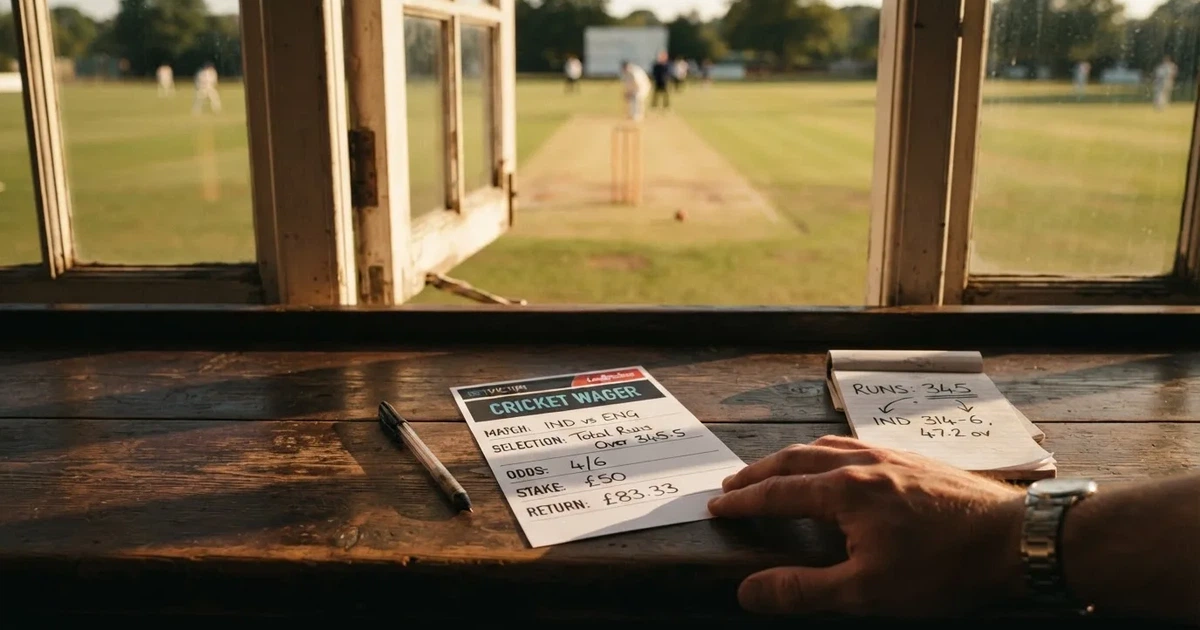
Cricket makes the arithmetic plain. With a quoted spread of 340 to 350 runs and a stake of £1 per unit, buying at 350 wins £50 if the team scores 400 and loses £50 if it scores 300. There is no ceiling on the win and no floor on the loss short of the bookmaker’s own limits. A spread bet on a Twenty20 total of 140 to 160 runs can settle in either direction by a number that looks small and pays back in a number that doesn’t.
Football uses the same mechanics on total-goals, total corners or Supremacy markets (the goal difference between the two sides). A Supremacy spread of 0.4 to 0.6 goals on a 1–0 home win settles the favourite buyer at −0.4 goals (a loss of 0.4 × stake) and the outsider seller at +0.6 goals (a win of 0.6 × stake). On a 3–0 home win, the favourite buyer wins 2.4 × stake and the outsider seller loses 2.4 × stake. The numbers feel small; the multiplication is what does the damage.
Fixed-odds betting, by contrast, pays the stake times the decimal odds and stops there. A £10 single at 3.00 returns £30 and cannot return less than zero on a winning bet. Spread betting has no equivalent of “you can’t lose more than your stake”, and that single difference is why the FCA-regulated version of the product has carried a margin warning for years and why the Commission-licensed version carries the same warning on the operator’s own homepage.
The North American point-spread bet — the one US and Canadian sportsbooks run — looks similar and settles very differently. There the spread is a handicap (say, the favourite giving 6.5 points), the price is set around −110 on both sides (1.91 decimal), and a result that lands exactly on the spread is a push: the stake is refunded and the bet is void. Sports spread betting as practised by Spreadex and Sporting Index has no such push rule; the result either wins or loses by however many units the spread produces.
Financial spread betting, regulated by the FCA, is a different product again. The collateral a customer has to post is typically 5 to 10 per cent of total exposure, and losses are not capped by a single stake. The “spread” in financial spread betting is the bid-offer around a market price, not a sports range; the stake is multiplied by the number of points the underlying moves. The same arithmetic, the same risk profile, and a tax regime the operator pays at 3 per cent rather than the 15 per cent that fixed-odds bookmakers pay.
What gets priced and how it settles
Sports spread betting firms quote ranges on the totals markets the bettor would expect from a fixed-odds sportsbook — runs, wickets, goals, points, games in a set — and on the derivatives those totals support. Settling a spread bet requires a result that both sides agree on, and the agreement is reached before the bet is placed: the quoted spread is the settlement range, and the result lands inside, above or below it.
Cricket: team runs, innings runs, player runs, wickets, sixes, partnership runs at fall of wicket. The quoted spread on a one-day team total in the 240 to 280 range is settled against the official score; a rain-reduced target becomes the settled number if Duckworth–Lewis–Stern applies.
Football: total goals, Supremacy (goal difference), total corners, bookings, total shots, time of first goal. Sporting Index’s “Total Goals” spread is the most-cited example; the quote on a Premier League match might be 2.6 to 2.8 goals and settle anywhere from zero to a six-goal thriller, with the unit multiplier running in tenths of a goal.
Horse racing: Race Indexes settle against an industry figure that combines the winning distances and the number of runners. The Racing Post’s “RP Ratings” race index is the reference most firms quote, and the spread is set around the projected figure for the race in question.
Basketball, American football, rugby, tennis: each sport has its own vocabulary of totals — points, games, sets, aces — and each spread is sized to the volatility of the league in question. NFL spreads are wider than NBA spreads; rugby sevens quotes are tighter than rugby union; cricket quotes depend on the format. The general rule: the wider the spread, the larger the unit move per result, and the larger the potential win or loss per unit staked.
Spread bets settle at the end of the event or the market window. Some markets are closed before the final whistle — the Supremacy market, for example, settles at full time and ignores extra time unless the firm’s rules say otherwise. Each firm’s product page states which version of “full time” applies, and the only safe answer before placing a bet is to read that page.
How a spread bet is priced and why the margin matters
The price of a spread is not the same kind of number as a decimal odds price. A spread of 2.6 to 2.8 goals is the range inside which the bookmaker expects the result to land, and the range’s width is what the bookmaker keeps. A tighter range means the firm is more confident in its number; a wider range means less confidence or more margin.
For a market with a single binary outcome — the favourite wins or the outsider wins — the equivalent of a margin is the spread itself. A bookmaker quoting 2.6 to 2.8 on a 2.7 expected total is offering a 0.2-unit margin on each side of the expected result; the closer the spread to the true mean, the harder the bet is to win, and the further the spread from the true mean, the easier it is. Quoted spreads are usually wide enough that the firm profits regardless of which side the bettor takes, but a bettor who has done their own modelling can find value on one side of a mispriced range.
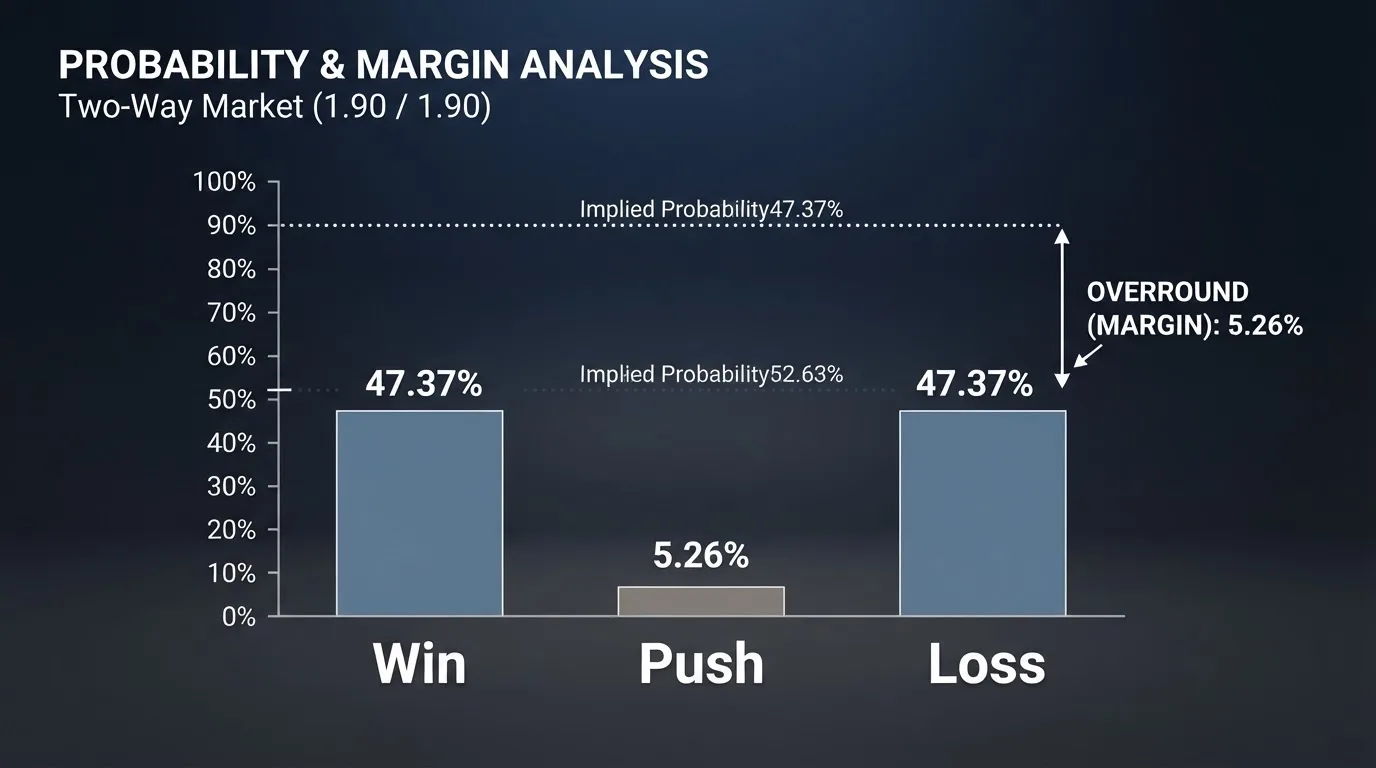
The decimal odds comparison works on the fixed-odds side. A two-way market priced at 1.90 / 1.90 (fractional 9/10, sometimes written 10/11 the other way) returns £1.90 on a £1 stake on either outcome. The bookmaker’s margin, called overround or juice, is what the two prices leave out: 1 ÷ (1/1.90 + 1/1.90) = 1 ÷ (0.5263 + 0.5263) = 1 ÷ 1.0526 = 0.9500, or a 95.0 per cent payout share, leaving a margin of 5.0 per cent. That is the arithmetic the calculation below runs; it is the only figure a bettor needs to compare one bookmaker’s price with another’s on a single market, and it is the figure the welcome-offer headline usually tries to distract from.
What the calculation does not say: a 5 per cent margin is an average over many bets, not a charge on a single stake, and a winning bet never pays the margin. The margin is the long-run cost of betting at that bookmaker at that price on that market. A bettor who places ten £10 bets at 1.90 / 1.90 and wins five loses £5 on average — not £5 on a single bet, but £5 spread across the ten.
The calculation, run for this page: at illustrative two-way decimal odds of 1.90 and 1.90, the payout share is 1 ÷ (1/1.90 + 1/1.90) ≈ 95.0 per cent, and the margin is therefore roughly 5.0 per cent. The exact figure depends on whether the example is meant as a representative sportsbook price or as a snapshot from a real event on a real day; presented as a band, a margin somewhere between 4.5 and 5.5 per cent is what the maths produces for prices in the 1.85 to 1.95 range on a balanced two-way market.
That 5 per cent is also the cost a welcome offer has to overcome before it adds value. A £10 free bet at 3.00 on the same market is worth £10 × (3.00 − 1) ÷ 3.00 × 0.95 ≈ £6.33 in expected terms; a £10 bonus that demands £100 of qualifying bets at the same margin costs £5 in expected turnover; the offer is positive only when its expected value exceeds its expected cost.
The ten licensed platforms, ranked by what they offer the spread bettor
The platforms below are ordered by how well they fit the reader who came here looking for a spread betting platform. The top of the list is where the product is most native — fixed-odds and spread betting under one roof, both settled by the same firm — and the list walks down through fixed-odds sportsbooks that run a comparable welcome offer and product set without the spread-betting core. Every platform is licensed by the Gambling Commission for remote general betting standard (real events) and is named against an account number a reader can verify on the public register.
| Operator | Gambling Commission remote licence | What the operator’s own terms say |
|---|---|---|
| Spreadex | 008835-R-104580-022 (Spreadex Limited) | Spread betting losses can exceed the deposit; FCA-regulated for financial spread betting |
| Sporting Index | 027343-R-308898-011 (Sporting Index Limited) | Spread bets settle against quoted ranges; free-bet package covers fixed odds and spreads |
| Coral | 054743-R-330863-014 (LC International Limited) | Fixed-odds sportsbook with Cash Out and bet builder; welcome offer in free bets |
| Sky Bet | 067370-R-341330-005 (SBG Sports Limited) | Fixed-odds sportsbook; free-bet tokens after a small qualifying stake |
| Dabble | 065677-R-340363-005 (Dabble Sports UK Ltd) | Fixed-odds sportsbook; social-feed product; free bets on first deposit |
| Swifty Sports | 058957-R-334734-006 (Swifty Global (UK) Ltd) | Fixed-odds sportsbook with Best Odds Guaranteed, Cash Out, daily price boosts and live streaming |
| Betfred | 039544-R-319290-010 (Petfre (Gibraltar) Limited) | Fixed-odds sportsbook with Bet Builder, Sub Switch and Extra Places |
| Lottoland | 038991-R-319408-020 (EU Lotto Limited) | Lottery-led product with sports betting added; Gambling Commission licensed for GB customers |
| 888sport | 039028-R-319297-014 (888 UK Limited) | Fixed-odds sportsbook with Cash Out, Bet Builder, racing streams and boosted odds |
| VBet | 044662-R-324273-022 (SCGO Limited) | Fixed-odds sportsbook with Bet Builder, live streaming and in-play calendar |
Spreadex — the only operator on this list where spread betting is the headline product
Spreadex is the firm that exists because spread betting exists. Its Commission account covers remote general betting standard (real events), and the FCA regulates the financial spread-betting side of the same business. The homepage carries the warning that has defined the product since the FCA first put pen to paper: spread betting losses can exceed the deposit.
The sports spread product covers football, cricket, horse racing, rugby, golf and a smaller set of American sports. Cricket runs and Total Goals are the most quoted markets, with horse racing through Race Indexes and football through Supremacy. The new-customer offer lands £60 in free bets for a £10 fixed-odds qualifying bet, and the free bets can be used across fixed odds and spread betting. The qualifying bet has to be placed within 28 days of opening the account.
The verdict: for a reader who has decided they want sports spread betting rather than a fixed-odds sportsbook, this is the primary choice. The licence register, the FCA dual regulation and the warning on the homepage are what the rest of the market cannot match; the welcome offer is one of the larger free-bet packages attached to a spread-betting firm and the £10 trigger is one of the lowest in this comparison.
Sporting Index — the other home of sports spread betting
Sporting Index runs the same product set as Spreadex and shares the Commission’s general betting standard licence. The new-customer offer is structured differently, with a £10 fixed-odds qualifying bet at minimum odds of 1/2 unlocking three £10 fixed-odds free bets, three £5 Total Goals spread bets, three £5 Winning Favourites spread bets and a £1 Race Index spread bet. The qualifying bet cannot be placed in play or cashed out early — a constraint that excludes a category of fixed-odds strategies some readers default to.
The product depth is close to Spreadex across the same sports, with Race Indexes the more quoted line. The welcome package is the better fit for a reader who plans to spread bet immediately, because it bundles spread markets into the bonus itself; the £1 Race Index stake is the part that exposes the reader to spread mechanics before they commit a larger bank.
The verdict: a serious alternative for the reader who has decided spread betting is the product. Smaller bonus amounts across more markets suit a reader who plans to learn by trading, and the in-play and cash-out exclusion on the qualifying bet is a small constraint most readers will not notice.
Coral — the established fixed-odds sportsbook
Coral runs a fixed-odds sportsbook with Cash Out, bet builder and a full football and racing schedule. The Commission account is held by LC International Limited, the same Ladbrokes-Coral parent that runs Ladbrokes; the welcome offer is £40 in free bets for a £20 qualifying bet at minimum odds of 2.0 (1/1), with the free bets issued within seven days and expiring seven days after issue.
The product set is the kind a high-street chain builds over decades: deep racing, multiple price boosts, a football coupon that runs from the Premier League down to the Conference. Coral does not offer sports spread betting, and the gap matters for the reader who came here looking for one.
The verdict: the right choice for a fixed-odds reader who wants a familiar product set and a substantial welcome package. Fixed-odds betting is the complete product here, and the spread-betting markets found elsewhere are not part of the current offer.
Sky Bet — the broadcaster’s sportsbook
Sky Bet’s licence is held by SBG Sports Limited, and the welcome offer is £30 in free bets credited as three £10 tokens after a £5 deposit and a 5p qualifying bet at odds of 1/1 or greater. The 5p minimum is the lowest in this comparison, and the three-token structure means the bonus can be split across three bets at three different prices rather than spent on a single line.
The product set is what a media-backed sportsbook offers: live streaming, in-play betting, a strong football schedule, a bet builder. Sky Bet does not run spread markets.
The verdict: the right choice for the reader who wants the smallest possible qualifying stake and a free-bet package they can deploy across more than one bet. This sportsbook does not offer spread betting, and it is a better fit for a punter whose strategy stays with fixed odds.
Dabble — the social-feed sportsbook
Dabble is the newer product on this list, and the social-feed mechanic — bets shown alongside other customers’ bets — is the part the homepage spends its word count on. The Commission licence is held by Dabble Sports UK Ltd. The welcome offer is £10 in free bets on a £10 first-deposit qualifying bet, with minimum odds, a seven-day expiry and no returned stake.
The product set is a standard fixed-odds sportsbook with a social wrapper. There are no spread markets.
The verdict: the right choice for the reader who likes the social-feed mechanic and wants a clean £10-for-£10 welcome. Not the right choice for a spread-betting reader, and the no-returned-stake condition is the part a reader should weigh before committing the qualifying bet.
Swifty Sports — the racing-led sportsbook
Swifty Sports’ licence is held by Swifty Global (UK) Ltd. The product set is racing-led and adds Best Odds Guaranteed, Cash Out on horse racing and football, daily price boosts, live streaming and in-play betting; the app’s listing notes Bet Builder as a feature that is coming soon.
The welcome offer is described in the App Store listing without the same minimum-stake detail that the longer-running brands publish; the product page is the only source a reader has for the current terms.
The verdict: the right choice for a reader whose betting is horse-racing-heavy and who wants Best Odds Guaranteed on every ride. Spread betting is not on the menu. The focus is fixed-odds racing, and the bet-builder feature is not yet live.
Betfred — the high-street chain’s sportsbook
Betfred’s licence is held by Petfre (Gibraltar) Limited, and the app carries Bet Builder, Sub Switch (the substitute-player prop on football), Racing Post data, Extra Places on selected races, live casino and bingo. The welcome offer runs through the same shape as the rest of the market — a qualifying bet unlocking free bets — and the headline product strength is racing.
There are no spread markets.
The verdict: the right choice for a reader who wants a high-street brand’s product depth and a strong racing schedule. The platform is restricted to fixed-odds markets.
Lottoland — the lottery-led platform with a sportsbook
Lottoland’s licence is held by EU Lotto Limited, and the product is structured around lottery betting with a sportsbook attached. The App Store listing describes casino, lottery betting, sports betting and scratchcards under one roof.
The welcome offer is described in the listing without the same minimum-stake detail the longer-running brands publish, and the product’s centre of gravity is lottery, not sport.
The verdict: the right choice for a reader whose betting is lottery-led and who wants a sportsbook in the same account. Not the right choice for a spread-betting reader, and the lottery-led product is the part that decides which reader the platform suits.
888sport — the established online sportsbook
888sport’s licence is held by 888 UK Limited. The product set covers pre-match and in-play betting, Cash Out, Bet Builder, racing streams, BetFinder form tools, a live bet feed and daily boosted odds. There are no spread markets.
The welcome offer runs through the same shape as the rest of the market.
The verdict: the right choice for a reader who wants a deep online sportsbook with racing streams and form tools in the same product. Fixed-odds betting is the exclusive focus.
VBet — the multi-product sportsbook
VBet’s licence is held by SCGO Limited, and the app runs Bet Builder, pre-match and in-play betting, live streaming and a live calendar with results and stats. There are no spread markets.
The welcome offer runs through the same shape as the rest of the market.
The verdict: the right choice for a reader who wants a multi-product sportsbook with live streaming and a bet builder.
The protection that comes from going offshore, and the cost of taking it
A bookmaker licensed outside Great Britain — Curaçao, Malta, Gibraltar alone — is not licensed to serve GB customers without a Commission licence, and the page has no brand on this list that asks a reader to make that trade. The reason the chapter exists is that several search results for “best spread betting platform UK” include firms that hold no Commission licence and would fail the public-register check. The trade is plain enough to state once.
The cost: a GB-licensed bookmaker runs GAMSTOP, the £150 vulnerability check, the 10x bonus cap and the identity check at the first deposit. An unlicensed firm runs none of those. There is no Commission complaints route if a firm withholds funds, no approved dispute-resolution service is bound to hear the case, and no British consumer protection applies. There is no statutory ban on a customer placing a bet with an unlicensed firm; the offence is at the operator end. The honest framing is that going offshore trades every protection the licence buys for whatever price advantage the unlicensed firm offers — and whether there is a price advantage in the first place is not established, because the firms involved do not publish the same audited payout shares the licensed firms do.
Enforcement is disruption, not blocking: cease-and-desist notices, search-engine delistings, work with registrars, hosts and payment providers. The Commission has been given, or is about to receive, court-order DNS blocking powers, and ISP-level blocking is not in operation as a settled fact. The page does not name unlicensed firms because naming them is advertising them, and the comparison above is the licensed alternative.
The arithmetic that decides whether any of this is worth it
A bookmaker’s margin is the only number a bettor needs to compare one price with another. For a two-way market at decimal odds of 1.90 and 1.90, the payout share is 1 ÷ (1/1.90 + 1/1.90) ≈ 95.0 per cent, leaving a margin of roughly 5.0 per cent. The exact figure depends on the prices the reader is being offered; presented as a band, a margin in the 4.5 to 5.5 per cent range is what the maths produces for balanced two-way prices between 1.85 and 1.95.
A welcome offer is worth claiming only when its expected value exceeds the margin it costs to clear. The £10 free bet at 3.00 on a 95.0 per cent payout market is worth £6.33 in expected terms; the £10 bonus that demands £100 of qualifying bets at the same margin costs £5 in expected turnover; the offer is positive when expected value exceeds expected cost. The page does not endorse any specific offer, because the qualifying conditions change weekly and the only safe answer is the one a reader runs on the offer in front of them.
For a spread bet, the equivalent arithmetic is the width of the quoted range relative to the bettor’s own estimate. A spread of 2.6 to 2.8 on a Total Goals market that the bettor’s model puts at 2.5 has the buyer overpaying by 0.1 units and the seller underpaying by 0.3; a stake of £10 per unit wins £3 on a seller landing at 2.2 and loses £3 on a buyer landing at 3.1. The same 5 per cent cost rule, dressed up as a unit move on a range.
Frequently asked questions
What is sports spread betting?
A spread bet is a wager on whether a number — runs in a cricket innings, goals in a football match, the index of a horse race — will be higher or lower than a range the bookmaker quotes. The customer buys at the top of the range (betting the result will be above it) or sells at the bottom (betting it will be below), and the profit or loss equals the stake multiplied by the number of points the result differs from the chosen level. Because there is no cap on how far the result can land from the range, losses can be several times the stake on a single outcome. In Great Britain, sports spread betting is licensed by the Gambling Commission; financial spread betting on indices, FX and shares is regulated by the Financial Conduct Authority.
How do you spread bet on football?
Place a spread bet on a Total Goals, Supremacy or corners market at a UK-licensed spread betting firm. The firm quotes a range — for example 2.6 to 2.8 total goals — and the bettor chooses to buy at 2.8 (betting the actual goals will be higher) or sell at 2.6 (betting they will be lower), with a stake set in pounds per unit. The bet settles at full time and ignores extra time unless the firm’s product page states otherwise; the stake is multiplied by the number of goals the actual total differs from the chosen level, and the result is the profit or loss.
What is the difference between spread betting and fixed-odds betting?
Fixed-odds betting pays the stake multiplied by the decimal odds and stops there; a £10 single at 3.00 returns £30 on a win and cannot return less than zero on a winning bet. Spread betting pays the stake multiplied by how far the result lands from a quoted range, with no upper limit on the win and no floor short of the operator’s own limits on the loss. Spread betting is regulated separately in Great Britain — financial products by the FCA and sports spread betting by the Gambling Commission — and the operator’s homepage carries the warning that losses can exceed the deposit.
How can it be checked that a bookmaker holds a Gambling Commission licence?
The Commission’s public register at the regulator’s own website is searchable by business name, trading name, domain or account number, and is the whole test of whether a brand holds a licence. The Commission publishes the licence categories each account is authorised for (remote general betting standard (real events), remote betting intermediary, and so on), the licence holder’s legal name, and the licence number; a brand that cannot be found on the register, or whose account does not authorise remote betting, is not licensed to take bets from GB customers. The comparison above lists each operator’s account number a reader can search against.
How is the return on a bet worked out from the stake and the odds?
For a fixed-odds single, return equals stake multiplied by the decimal odds. A £10 single at 3.00 returns £30 on a win, and the net profit is £20. For a combination bet, the odds of each leg multiply into a single combined price, and the return is the stake multiplied by that combined price. For a spread bet, return equals stake multiplied by the number of units the result differs from the chosen level, and the result can be a win or a loss rather than a single positive number.
What is the bookmaker’s margin and how can it be seen in the odds?
The margin is the share of every pound staked that the bookmaker keeps on a market. For a two-way market at decimal odds of 1.90 and 1.90, the payout share is 1 ÷ (1/1.90 + 1/1.90) ≈ 95.0 per cent and the margin is roughly 5.0 per cent; presented as a band, a margin in the 4.5 to 5.5 per cent range is what the maths produces for balanced two-way prices between 1.85 and 1.95. The lower the margin, the better the long-run value for the bettor; the higher the margin, the more the bookmaker keeps from every pound staked across the lifetime of the account.
Betting sites & exchanges – Boxing betting
Content created by the «Boxing betting» team
