
Betting on corners UK — what every corner market costs and who offers it in 2026
 Available in US
A corner kick is one of football’s smallest set-pieces, yet it has grown into a market in its own right. Every major UK bookmaker prices corners now, both before kick-off and in-play, and the market has spread far enough that a bettor who only watches the scoreline misses more information than the bookmaker does. This page walks through what a corner market is, how it settles, what the odds actually carry inside them, and which UK-licensed operators run a deep enough book to be worth a comparison. The angle is consequence: not what corners betting *is*, but what it costs, when it shows, and who it suits.
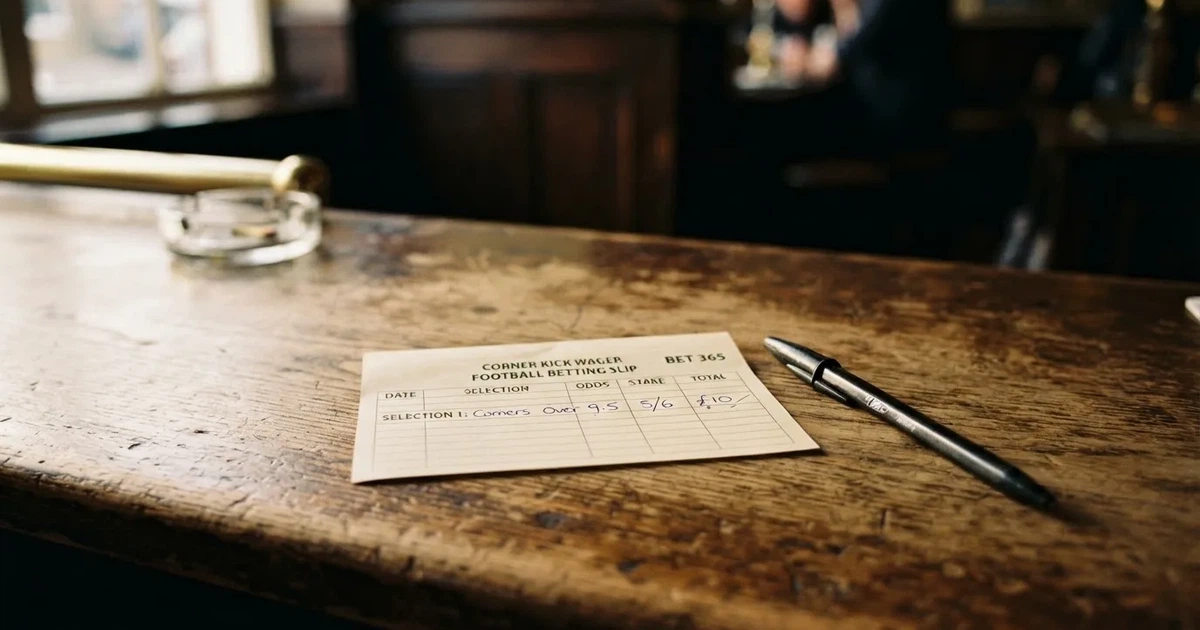
*Current as of 27 October 2026 · operator licences and offer terms checked against the UK Gambling Commission’s public register.*
What a corner market actually prices
A corner is awarded when the ball wholly crosses the goal line, outside the goal frame, after last touching a defending player. The touch does not have to be deliberate — a deflection off a defender’s boot, hip or chest is enough. The kick is taken from the corner of the field nearer to the point where the ball crossed the line, with the ball stationary inside a quarter-circle of one-yard radius at the corner flag. Opposing players must stay at least 9.15 metres (ten yards) from the ball until it is in play, and an attacker receiving the ball directly from a corner cannot be penalised for offside. A goal scored directly from a corner is allowed — the so-called *Olimpico* — and was explicitly legalised by the IFAB on 14 June 1924. An own goal scored directly from the corner is not.
That much is the law of the pitch. The betting market sits on top of it, and the market runs on its own rules. A corner-kick count is a settled counter from the moment the referee signals, regardless of whether the kick is taken cleanly, retaken for encroachment or wasted. In-play, a corner that is awarded and then overturned by VAR is removed from the running total once the final decision lands. These settlement quirks are why corners betting looks simple and feels, to a first-time punter, surprisingly fiddly.
The three market shapes every UK bookmaker runs
The shape most readers meet first is the match total: how many corners in the 90 minutes, with a line set at a number like 8.5, 9.5 or 10.5. The bet is over or under that line. The line matters more than the team. A match that ends 1–0 with 14 corners and a match that ends 4–4 with six corners settle entirely differently, and the bookmaker sets the line to push action to both sides. A second shape is the handicap: one team starts the count on, say, +2.5 or −1.5 corners, and the bet settles against the adjusted total. A third, older shape is the race: which team wins the first corner, which team wins the most corners, and the draw as a third outcome in a 1X2-style three-way market. That three-way shape is what most searchers mean when they ask what a “corners match bet” is: a winner, a loser, or a tie on the count.

The Asian corners line is the version that removes the push. Instead of 8.5, the line lands at 8.25 or 8.75; instead of the bet winning or losing outright, half the stake is settled at one neighbouring line and half at the other. The point is to cut the bookmaker’s margin while keeping a stake-by-stake payout. For a bettor who places singles, the Asian line trades a cleaner expectation for a slightly more complicated slip.
How in-play changes the maths
Live corners betting runs on a counter visible on the in-play screen, refreshed as each corner is awarded. The price moves with every flag kick — a corner at 0–0 in the 70th minute prices differently from a corner at 2–1 in the 88th, because the bookmaker’s remaining-volume calculation changes. A bettor using in-play is not pricing the match any more; they are pricing the next corner against the volume expected from the rest of the game. The bookmaker runs the same maths. That symmetry is what the in-play margin measures against.

What the bookmaker’s margin looks like in the odds
Every price carries an overround — the gap between what the bettor would win across all outcomes and what was staked. It is the bookmaker’s edge on a market. Take an illustrative two-way line priced at decimal odds 1.90 / 1.90 (fractional 9/10 on each side). The arithmetic is straightforward:
- payout share = 1 ÷ (1/1.90 + 1/1.90) = 1 ÷ (1.0526…) ≈ 95.00%
- margin = 1 − 0.9500 = 5.00%
That 5% is what the bookmaker keeps, on average, of every unit bet on this market. Across many bets at this margin, the bettor loses 5p of every £1 staked in expectation. The exact margin for a real corners line on a real fixture will land in a band around that figure — tight books run corners match totals at roughly 3–4% margin; wider books, or exotic corners markets, can climb above 8%. The point of the figure is not the precision but the structure: a margin of 5% means the same thing whether it is quoted as a decimal-odds overround, a “payout share” of 95%, or a “book percentage” of 105%.
The corollary is that picking winners is not the only edge a bettor can chase. The cheapest corner market on a fixture carries a different margin from the most exotic one, and the difference between them is, on average, what the bettor is paying for choosing the bigger-priced line. The spread on a single fixture across a single bookmaker is sometimes wider than the spread between two bookmakers on the same line — a fact worth holding when comparing sites.
The ten UK bookmakers worth a comparison in 2026
Ranking bookmakers is a fool’s errand: the same brand prices a Premier League total differently from a Championship handicap, and a small Welsh-focused operator may carry deeper rugby-league markets than a global giant. What follows is a shortlist of UK-licensed bookmakers that build corners markets into their core offering — sites that price 1X2, totals and handicaps on most televised fixtures, with in-play and a bet builder where it adds to the corners offering. Each review closes on its own judgement of where the brand fits, not on a generic verdict.
Bet Builder, Builders and Multi-Leg Corners Markets
A growing number of UK bookmakers offer same-game multi markets on corners. LiveScore Bet’s Bet Builder allows up to ten selections per slip and covers match result, both teams to score, corners, total goals, player scoring and card markets in one builder, so a corner-related selection can be combined with a goals-and-cards accumulator on the same fixture. Paddy Power’s Bet Builder+ and Popular Bet Builders markets run a similar shape, with the added feature called Super Sub: where a selected player is substituted, the bet rolls over to the replacement. Betfred’s Bet Builder covers the same ground, and 10bet runs Cash Out, Bet Builder and Live Streaming across its football, tennis and horse-racing sportsbooks. The same builder mechanics exist at DragonBet, where the focus is Welsh football and rugby but the in-play and builder markets are present.
For a bettor, the practical question is how a corner leg inside a builder settles when one leg of the same fixture is voided. The dominant pattern in 2026 is that the builder leg is settled on the corners counter as it stands at full-time, regardless of any other leg. That keeps corners a usable building block rather than a fragile one.
In-Play Corners Markets and Live Updates
In-play corners betting requires three things: an accurate live counter, prices that update fast enough to be useful, and a cash-out window that does not lock at a stale number. The first two are a function of the bookmaker’s data feed; the third is a function of how the bookmaker models risk on a moving market. The differences between the brands below are mostly in that third dimension.
The corner-market landscape at a glance
| Bookmaker | Gambling Commission licence (account, holder) | Corners-market depth |
|---|---|---|
| Betfred | 39544 — Petfre (Gibraltar) Limited | Full 1X2, totals, handicaps and builder legs |
| Coral | 54743 — LC International Limited | Full 1X2, totals, handicaps and builder legs |
| 10bet | 43173 — Blue Star Planet Limited | Full 1X2, totals, handicaps and builder legs |
| Paddy Power | 39439 — PPB Counterparty Services Limited | Full 1X2, totals, handicaps and builder legs |
| BetMGM UK | 39198 — LeoVegas Gaming p.l.c. | Full 1X2, totals, handicaps and builder legs |
| Unibet UK | 45322 — Platinum Gaming Limited | Full 1X2, totals, handicaps and builder legs |
| Bet Ahoy | 100094 — Bet Ahoy Ltd | Standard 1X2 and totals on televised fixtures |
| Dabble | 65677 — Dabble Sports UK Ltd | Standard 1X2 and totals |
| LiveScore Bet | 56859 — LiveScore Betting and Gaming (Gibraltar) Limited | Standard 1X2, totals and builder legs |
| BetTom | 64959 — Bet Tom Limited | Standard 1X2 and totals on televised fixtures |
| DragonBet | 64908 — DragonBet Ltd | Standard 1X2, totals and Welsh-market depth |
The columns are deliberately narrow. Every brand on the page is on the UK Gambling Commission’s public register against a remote general betting standard (real events) licence. The deeper question — which brand prices the tightest corners line on a specific match — is answered only by opening two screens side by side at kick-off. That comparison cannot be made in a static table.
The legal frame around every corners bet
A corners market in Great Britain is not a free-standing thing; it sits inside a licensing regime, a code of practice and a marketing rulebook that shape what an operator can offer, how it advertises it, and what happens when a customer runs into trouble. None of this affects the price of a single corner, but it shapes the cost across a betting career.
The Gambling Commission and what its licence actually authorises
The Commission is a non-departmental public body sponsored by the Department for Culture, Media and Sport. It licenses the whole commercial market under the Gambling Act 2005, which covers Great Britain — England, Scotland and Wales. Northern Ireland sits outside that Act under older legislation, so the correct phrase is “Great Britain licence” or “GB-licensed”, never a blanket “UK” claim. Since the Gambling (Licensing and Advertising) Act 2014, an operator whose remote facilities are used in Great Britain needs a Commission licence *wherever it is based*: a Curaçao, Maltese or Gibraltar licence is not a substitute. A GB-licensed operator may, of course, hold a remote licence in another jurisdiction as well — Unibet’s UK site, for example, runs under Platinum Gaming Limited in Gibraltar against a Commission account — but the Commission licence is the one that authorises taking bets from customers in Great Britain.
What may be bet on is not listed by statute. There is no Commission schedule of permitted markets. An operator holds a licence for a category — remote general betting standard (real events) being the relevant one for football — and offers markets under its own rules and the Licence Conditions and Codes of Practice (LCCP). That means a corners market exists because the operator decided to build it and price it, not because a regulator told it to.
Verification, age and the first deposit
Minimum age is 18. Identity is verified before a customer can deposit or gamble, a rule in force since 7 May 2019. That check covers name, address and date of birth; it covers every product the operator runs, including a free bet or a bonus. No licensed operator runs anonymous play. The Commission public register can be searched by business name, trading name, domain or account number, and is the whole test of whether a brand holds a licence.
The credit-card ban and what it costs
Credit cards have been banned for gambling in Great Britain since 14 April 2020 (LCCP condition 6.1.2). The ban covers credit-card-funded payments through an e-wallet, so topping up Skrill or Neteller from a credit card and then using the e-wallet at the bookmaker is not a workaround. Debit cards and bank-based payments are not covered. For a bettor, the practical consequence is that the only short-term credit line attached to betting is overdraft, and the bank decides whether to extend one.
The tax side of the equation
A punter in Great Britain pays no tax on betting winnings. General Betting Duty is the operator’s tax on gross profits — currently 15%, rising to a new remote betting rate of 25% from 1 April 2027 within the same duty, while remote bets on UK horse racing, pool betting and in-person betting stay at 15%. Until 1 April 2027 the remote rate stays at 15%; whether operators pass duty on through odds is not established, and it is wrong to say the player is charged duty. Spread betting has its own rates (3% on financial products, 10% on the rest). The Commission’s statutory levy is a separate charge and is not a tax on the punter.
Marketing rules and the bonus cap
Marketing is not licensed by the Commission. It runs through the CAP Code (non-broadcast) and BCAP Code (broadcast), enforced by the ASA, alongside the LCCP marketing conditions. CAP Code section 16 requires marketing to be socially responsible, to be of no strong appeal to under-18s, and to feature nobody who is or seems to be under 25 in a significant gambling role — that rule is about who appears in the ad, not about who may bet. The promotion rules in force since 19 January 2026 cap wagering requirements on bonuses at 10x: a £10 bonus that previously required £500 of bets at 50x is now capped at £100 of qualifying turnover, and mixed-product promotions — an offer that requires gambling on two or more product types such as betting and casino — are banned. Whether the cap applies to free bets with no wagering condition is not established.
What offshore means in practice
A bookmaker without a GB licence can still accept a bet from a customer in Great Britain, and the offence is the operator’s under section 33 of the Gambling Act 2005 — aimed at the operator, not the customer. The honest description of using such a site is not “legal to use” but a list of what is missing: no GAMSTOP coverage, no Commission complaints route, no approved dispute-resolution body, no British consumer redress if funds are withheld, and no obligation to honour the 10x bonus cap or the £150 financial vulnerability check. Enforcement is disruption rather than blocking: cease-and-desist notices, search-engine referrals, work with registrars, hosts and payment providers; the Commission has been given or is about to receive court-order DNS blocking powers, but that is not the same as ISP blocking in operation. Honest framing: a GB licence means verification, limits, GAMSTOP and a bonus cap, and an offshore site means none of those protections and the real risk of losing funds if the operator declines to pay.
Where the protections sit: responsible gambling in 2026
The protection regime around a GB-licensed corners bet is not optional for the operator and not free for the punter. Knowing what it is matters more than the marketing around it.
GAMSTOP and the self-exclusion register
GAMSTOP is the national multi-operator online self-exclusion scheme and a mandatory licence condition for online operators since 31 March 2020. Self-exclusion can be set for six months, one year, five years, or five years with auto-renewal; after the minimum period, the exclusion stays in place for a further seven years unless the customer asks GAMSTOP to remove it. GAMSTOP covers online sites and apps; betting shops use a separate offline service. Every GB-licensed online operator takes part, which is why the scheme matters at the operator level rather than the punter level.
The financial vulnerability check
A financial vulnerability check (LCCP condition 3.4.4, in force since 30 August 2024) applies to licensed remote betting when a customer’s deposits minus withdrawals exceed £150 in a rolling 30-day window — the threshold dropped from £500 to £150 on 28 February 2025. The check is a public-record search for markers such as bankruptcy or county-court judgments; it is not an income check and it is not a credit-reference check. The wider financial risk assessments — the “affordability checks” of the press — were announced in a staged plan in a Commission article of 7 July 2026 with no start date, so the correct framing is “announced, staged, no start date”, not “in force”.
Deposit limits and the customer’s own ceiling
Deposit limits (RTS 12) require operators to offer a gross deposit limit on a fixed time frame. The first changes have applied since 31 October 2025; a second phase was postponed to 30 September 2026 and whether it is now live is not established. There is no state-set deposit or loss ceiling for betting: limits are the customer’s own choice, and a customer who sets one is bound by it.
Help beyond the operator
GamCare runs the National Gambling Helpline. GambleAware funds treatment and education. The NHS runs gambling clinics. Gamblers Anonymous runs peer support. None of these is an alternative to self-exclusion; they sit alongside it.
Live corners betting and when cash out makes sense
Live corners betting is its own product and its own discipline. The bookmaker runs an in-play model of expected remaining corners; the bettor runs a mental model of the same fixture; the gap between the two is the bet. What follows is what the live corners market actually does.
How the in-play counter works
The counter is fed by the bookmaker’s data provider. A corner is added the moment the referee signals, and removed if VAR overturns the award before the kick is taken. The counter does not include corners awarded in stoppage time differently from those awarded in open play; the 90-minute total is settled as a single number. Bookmakers that price live corners badly tend to be the ones whose data feed lags a fraction of a second behind the actual award, because the price does not move until the counter does.
Cash out on a moving corners market
Cash out lets a bettor close a bet before the final whistle, at a price the bookmaker sets in real time. On a corners bet, the cash-out price is a function of the open position, the live counter and the time left. A cash-out offered at a fair price is one the bettor would, on average, take; a cash-out offered at a poor price is one the bookmaker would, on average, prefer the bettor to take. The spread between those two is the cash-out margin, and it tends to be wider on faster-moving markets — a corner awarded in the 88th minute moves a cash-out price faster than the same corner in the 12th.
The 10bet app lists Cash Out alongside Bet Builder and Live Streaming on its football, tennis and horse-racing sportsbooks. The same three features are common across the brands in this comparison; the question is how tight the cash-out spread is on a specific market at a specific moment, which is settled only at the moment of cash-out.
In-play strategy: what the live price is actually saying
The dominant pattern is that a corner at 0–0 in the 70th minute is priced as if the match will run to its expected total, weighted heavily toward the next flag kick. A corner at 2–1 in the 88th minute prices the next flag kick almost as a separate event, because the volume remaining is so small. The bookmaker’s job is to keep the market balanced across those two regimes; the bettor’s job is to spot when one side of the book is over- or under-exposed. That is the only honest way to describe the strategy, because describing it as “predicting” the next corner misses the point: the price already predicts the next corner, and the bettor is pricing the bookmaker’s exposure instead.
What live corners cannot do
Live corners cannot recover from a settled leg. A bet on over 10.5 corners that is sitting at 10 in the 80th minute does not get a re-priced version because the bettor wishes it did. A bet on the team race that is tied at 4–4 going into stoppage time does not get a “next corner wins” sub-market by default, although some bookmakers offer one. A bet that is cashed out early is closed, not paused.
Predictions and the limits of strategy
A page about corners betting cannot avoid the word “strategy”, because every searcher wants one. The honest answer is that strategy sits inside the margin, and the margin is the part of the price the bookmaker keeps.
What a “system” actually does
A corners system is a rule for sizing and selecting bets: how many fixtures to cover, what line to take, what the stop-loss is. A system cannot change the margin of the market it operates on; the only way to reduce the margin is to change market or change bookmaker. What a system can do is enforce discipline, which matters because the variance on corners is high. A bettor who runs the same selection rule over a 200-bet sample at a 4% margin will, on average, lose £8 for every 100 staked, and the actual result will be distributed around that mean with a standard deviation of several times the mean on small samples. The system makes the loss visible.
The anatomy of a corner-count forecast
Forecasting a corner count is a regression problem dressed as intuition. The inputs are shot counts, shots from wide areas, crosses completed, set-piece share and the match state; the output is a distribution over 0–20 corners. A model that says “expect 10.5 corners at this fixture” is not making a single prediction but a distribution, and the price of over 9.5 versus over 10.5 is the bookmaker’s take on that distribution. The bettor’s edge, if any, is a more accurate distribution than the bookmaker’s. That edge is small, on average, and is destroyed by paying too much margin.
Why “tips” rarely beat the margin
A tip — “over 9.5 corners at Manchester City” — is a single point on a distribution. It carries no sizing, no edge estimate and no information about the price at which it was placed. A bettor who follows tips without a price check is paying full margin on every bet and adding nothing. A bettor who follows tips with a price check is running a margin-reduction model, and the question becomes which tips clear the threshold. That question is answerable only with a track record.
What the bankroll is for
A bankroll is the total amount a bettor has set aside for betting, and a staking plan is the rule for what fraction of that bankroll goes on any one bet. The two together convert a stream of bets with negative expectation into a stream with a controlled variance, so that a run of bad luck does not exhaust the bank before a run of good luck arrives. On a corners market at a 5% margin, the bankroll buys time, not expectation.
The bet types and how each one settles
The bet types below cover most of what a UK bookmaker lists under “Corners” on a Premier League fixture. Each is settled at full-time unless the market states otherwise.
Match total (over / under)
The line is set at a half-number — 8.5, 9.5, 10.5 — so every bet wins or loses outright. The settlement counter is the number of corners awarded in the 90 minutes plus stoppage time; corners awarded after the final whistle do not count. This is the market most bettors start with and the one most price-tested across bookmakers.
Handicap
One team starts the count on a positive or negative number of corners; the bet settles against the adjusted total. A −1.5 handicap on the home team means the home side must win the corner count by two or more. This is the shape that flattens mismatched fixtures.
Three-way match bet
A 1X2-style three-way market: home team wins the corner count, away team wins the corner count, or a tie. The settlement rule is the same as for the match result: the 90-minute count decides. A three-way market is what most searchers mean when they ask about a “corners match bet”.
Asian corners
A line set at a quarter-number — 8.25, 8.75, 9.25, 9.75 — so half the stake settles at one neighbouring line and half at the other. The point is to remove the push and lower the margin. The trade-off is that the slip is harder to read.
Race markets
First corner of the match, last corner of the match, team to win the most corners in a half. These settle on the order of corners awarded, not the count. A first-corner bet on the away team loses if the first corner is awarded to the home side, regardless of the eventual count.
Player-specific corners markets
Whether a specific player takes a corner, or the team’s first corner is taken by a specific player. These are niche in 2026 — most major bookmakers price them but at thin markets.
Builder legs
A corner leg inside a bet builder settles independently of the other legs: the corner counter at full time decides the corner leg; the other legs settle on their own markets. LiveScore Bet’s Bet Builder allows up to ten selections across match result, both teams to score, corners, total goals, player scoring and card markets; Paddy Power’s Bet Builder+ runs a similar shape with the Super Sub feature rolling a substituted player onto the replacement.
Corners markets across sports and tournaments
Corners betting exists in football because football is the only sport that awards corners. Other sports award equivalents — a penalty corner in field hockey, a corner kick in futsal, a flag-kick in rugby variants — but the UK bookmaker’s “Corners” tab on a fixture is football-only. What varies is the depth of coverage across tournaments.
Domestic leagues
Premier League, Championship, League One and League Two are priced deeply at every UK bookmaker, with 1X2, totals, handicaps and Asian corners on most televised fixtures. The Scottish Premiership and the Welsh Premier League are priced at most, with the Welsh Premier covered in particular depth by DragonBet. The EFL Cup and the FA Cup carry the same markets as the league; the Community Shield and lower-round fixtures carry less.
European club football
The Champions League, Europa League and Conference League are priced deeply at every major UK bookmaker. The Europa League and Conference League tend to carry slightly wider margins than the Champions League, in part because the data feeds are less rich and the bookmaker’s models carry less information. The Europa League also tends to carry higher corner counts on average than the Champions League; the leagues from which Europa League clubs are drawn tend to play a higher-volume game.
International football
The World Cup and the European Championship are priced deeply. The 2026 World Cup — held in the United States, Canada and Mexico — carries a wide range of corners markets across the group stage and knockout rounds. The 2024 European Championship in Germany is the most recent reference point; the 2028 edition in the United Kingdom and Ireland is the next scheduled tournament. Friendlies and qualifying campaigns carry markets at most major bookmakers but at thinner prices.
Women’s football
The Women’s Super League and the major international tournaments (the Women’s World Cup and the Women’s Euros) are priced at the larger UK bookmakers. The depth is shallower than the men’s equivalent, the in-play markets are less developed, and the bookmaker’s data feeds lag. For a bettor who knows a league well, that lag is sometimes an edge.
Other sports
Field hockey and futsal carry corner-equivalent markets at a small number of UK bookmakers, usually under a “Set Pieces” tab rather than a “Corners” tab. MMA corner betting exists as a niche prop — a bet on which corner wins a round — but that is the corner of a fighter’s team, not a corner kick.
The ten operators: licensing and how each one handles corners
Every operator below is checked against the UK Gambling Commission’s public register against a remote general betting standard (real events) licence. The licence line is the floor, not the ceiling: a licence authorises the operator to take bets in Great Britain; it says nothing about how deep or how tight a corners market is.
Dabble — a newer name with a small sign-up and a full corners tab
Dabble’s sportsbook runs a corners 1X2 and a totals market on most televised football fixtures, with a Bet Builder that takes corners legs alongside goals and cards. The sign-up offer described by its own terms is “Bet £10, Get £10 in Free Bets” on a first deposit for new customers, with minimum odds applying, a seven-day free-bet expiry and the stake not returned with a win. The licence is Gambling Commission account 65677, held by Dabble Sports UK Ltd. Dabble is best suited as a supplemental account for televised football.
Coral — a long-established bookmaker with deep builder markets
Coral’s sportsbook is one of the deeper in the UK market, with a full corners 1X2, totals, handicaps and Asian corners on Premier League and EFL fixtures, plus a builder that takes corners legs. The sports welcome offer described by Coral’s own terms is “Get £40 in Free Bets when you bet £20”: a deposit and sports bet of £20 or more at minimum odds of 2.0 (1/1), with £40 in free bets issued within seven days and expiring seven days after issue, for new GB customers who opt in. The licence is Gambling Commission account 54743, held by LC International Limited. Coral remains a reliable choice for comprehensive coverage and builder markets.
10bet — a builder-led bookmaker with cash out and live streaming
10bet’s sportsbook covers football, tennis and horse racing, with Cash Out, Bet Builder and Live Streaming listed on the app. The licence is Gambling Commission account 43173, held by Blue Star Planet Limited. 10bet works well as a specialized account for those who value live streaming and integrated builder tools.
Geoff Banks — a smaller bookmaker with ante-post and in-play
The Geoff Banks app is published by GB Sports Advisors Limited and offers live in-play prices and ante-post prices on future events. The licence is Gambling Commission account 54095. Geoff Banks provides a niche option for smaller fixtures where competitive pricing is the priority.
Paddy Power — a high-volume bookmaker with a strong builder
Paddy Power’s app offers Bet Builder+, Popular Bet Builders, Super Sub (where a substituted player rolls onto the replacement), expanded Win More markets and player and ACCA stats. The licence is Gambling Commission account 39439, held by PPB Counterparty Services Limited. For a bettor who builds same-game multis on Premier League fixtures, Paddy Power is the brand that built the modern shape of that market.
Bet Ahoy — a small sign-up with a standard corners offering
Bet Ahoy’s sportsbook runs a standard corners offering on televised fixtures. The sign-up offer described by its own terms is “Bet £10 & Get £10 in Free Bets”, split into a £5 sports bet and a £5 acca. The licence is Gambling Commission account 100094, held by Bet Ahoy Ltd. Bet Ahoy caters to low-stakes players, despite the shallower corners offering compared to larger bookmakers.
LiveScore Bet — a builder that runs up to ten legs
LiveScore Bet’s Bet Builder allows up to ten selections and covers match result, both teams to score, corners, total goals, player scoring and card markets. The licence is Gambling Commission account 56859, held by LiveScore Betting and Gaming (Gibraltar) Limited. LiveScore Bet is an excellent platform for those seeking complex, long-leg same-game multis.
BetTom — a smaller bookmaker with a sports-casino sign-up
BetTom’s sportsbook runs a standard corners offering on televised fixtures. The sports welcome offer described by its own terms is 50% back as a free bet of up to £50, with a matching 50% back up to £50 as free slot funds for casino play. The licence is Gambling Commission account 64959, held by Bet Tom Limited. For a bettor who plays sports and casino from one account, BetTom is one of the brands that ties the two together.
Betfred — a long-established bookmaker with a full builder and extras
Betfred’s app features Bet Builder, Sub Switch, Racing Post data, Extra Places, live casino and bingo. The licence is Gambling Commission account 39544, held by Petfre (Gibraltar) Limited. Betfred provides a solid, full-service experience that combines racing data with a robust builder.
DragonBet — a Welsh-focused bookmaker with national-team depth
DragonBet’s app is published by DragonBet Ltd and features Welsh football and rugby markets, racing, American football, in-play betting and bet builder markets. The licence is Gambling Commission account 64908. For a bettor who follows Welsh football and rugby, DragonBet is one of the few brands that prices those markets at any depth; for Premier League corners, the offering is standard.
Calculating the margin: an illustrative worked example
Take an illustrative two-way corners market — the over/under line on a fixture priced at decimal odds 1.90 on each side. That is fractional 9/10, and the calculation runs as follows:
- payout share = 1 ÷ (1/1.90 + 1/1.90) = 1 ÷ (1.0526…) ≈ 95.00%
- margin = 1 − 0.9500 = 5.00%
That 5% is the bookmaker’s edge on this market. Stated as a band, real corners markets in 2026 land somewhere in the range of roughly 3% margin on the tightest Premier League totals to around 8% on more exotic corners lines, with most televised fixtures sitting between 4% and 6%. The exact figure for a real fixture on a real bookmaker is published only on that bookmaker’s page at that moment, and it moves as the bookmaker rebalances. The point of the calculation is not a number to remember but a way of reading the price: every price shown already carries a margin inside it, and the only way to compare bookmakers is to compare the margin they each carry on the same fixture.
A worked example does not predict a single bet; it averages across many. A bettor who places a hundred bets at a 5% margin loses, on average, £5 for every £100 staked. Some sessions win; some sessions lose more than the average. The arithmetic does not promise the session; it describes the long run.
Corner-match betting and a quick read: how the 1X2 settles
A “corner match bet” is the three-way market described earlier in this page — home wins the corner count, away wins the corner count, or a tie. The settlement is the 90-minute count plus stoppage time; corners awarded after the final whistle do not count. A bet on the home side wins if the home side takes more corners than the away side; loses if the away side takes more; ties if both sides take the same number. There is no handicap and no push. The Asian version of the same market replaces the tie with a half-line handicap, removing the tie outcome at the cost of a more complicated slip.
For a bettor, the corner match bet is the cleanest way to express a one-sided view on a fixture without taking a view on the total. The home side in a home fixture, on average, takes more corners; the bookmaker knows this and prices accordingly. The price on the home side tends to be shorter than the price on the away side for the same reason. A bettor who prices the gap accurately will sometimes find value on the home side at the bigger number; a bettor who prices it inaccurately will sometimes find the away side.
Frequently asked questions
How does a bet on corners work?
A corner bet settles on the number of corners awarded in a football match, or on the team that wins the corner count. The most common shape is the match total — over or under a line set at a half-number like 9.5. A corner-kick count is settled from the moment the referee signals, regardless of whether the kick is taken cleanly, retaken for encroachment, or wasted. A corner that is awarded and then overturned by VAR is removed from the running total once the final decision lands.
How does an Asian corners bet work?
An Asian corners line is set at a quarter-number — 8.25, 8.75, 9.25, 9.75 — so half the stake is settled at one neighbouring line and half at another. The trade is a cleaner expectation in exchange for a more complicated slip. The mechanism is the same as an Asian handicap on a goals market, with the corner count standing in for the goal count.
What is a corners match bet?
A corners match bet is the three-way market on which team wins the corner count — home, away, or tie. The 90-minute count plus stoppage time decides. There is no handicap and no push. The market is what most readers meet when they search for “corners match bet” or “corner match betting”.
How can a bookmaker’s Gambling Commission licence be checked?
The Commission’s public register can be searched by business name, trading name, domain or account number. It is the whole test of whether a brand holds a licence. Licensed operators use .com as well as .co.uk, so the domain proves nothing — a licence check on the register is the only check that proves anything.
How is the return on a bet worked out from the stake and the odds?
For a single bet, the return is the stake multiplied by the decimal odds. A £10 stake at decimal odds of 3.75 returns £37.50 — the original stake plus £27.50 of profit. For an accumulator, the odds of each leg multiply into one price, and the return is the stake multiplied by that combined price. The bookmaker’s margin sits inside every price, and the margin is the gap between the combined payout share and 100%.
What is the bookmaker’s margin and how can it be seen in the odds?
The margin is the share of every unit staked that the bookmaker keeps on average. On a two-way market priced at 1.90 / 1.90, the payout share is about 95% and the margin is about 5%. The lower the margin, the cheaper the market is for the bettor; the higher the margin, the more expensive. Margins move fixture by fixture and bookmaker by bookmaker, and the only honest comparison is to read the price on the screen.
Bet types & in-play – Boxing betting
Content created by the «Boxing betting» team
