
Cricket betting tips 2026: a punter's guide to value, margin and offers
 Available in US
27 October 2026 · verified against the Gambling Commission’s public register and each operator’s own terms
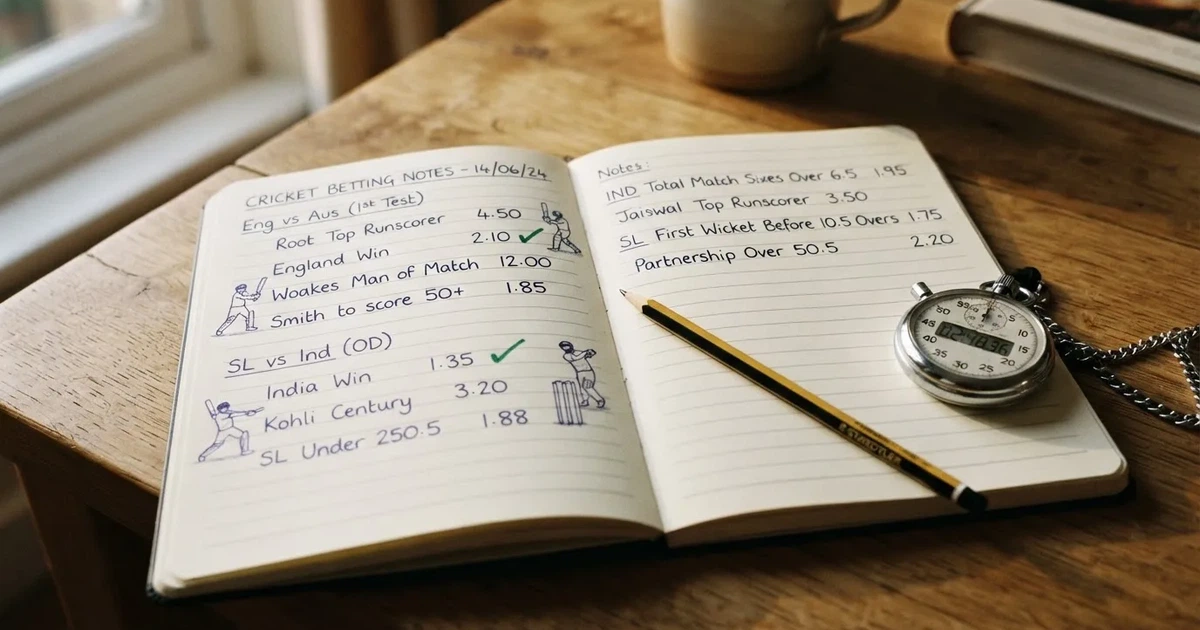
A tip is somebody’s forecast dressed up as advice. A market price is something else — the bookmaker’s view, set against the views of every other bookmaker, with a margin built in that the punter pays whether the bet wins or loses. The rest of this page works on that difference. It explains how a price is built around a cricket match, what value means once the margin is taken out, what a bonus really costs in turnover and minimum price, and where the legal frame sits for anyone betting from Great Britain. There are no picks and no predicted winners. A reader who finishes it should know what they are looking at when they look at a cricket market, and what an offer takes out of them before a ball is bowled.
In-play cricket and the cash-out question
Live betting on cricket is built around momentum. A side seven down for eighty in a Test match tells a different story than a side seven down for two hundred and forty; a chase at four an over in a rain-truncated ODI is a different bet than a chase at seven. The bookmaker’s screen tracks the same story the punter is watching, but it tracks it at a price that moves every over. That is the appeal of in-play, and it is also the risk: the price moves because the market thinks something has changed, and the punter who bets late has paid for that move.
Cash out is the second decision that sits next to an in-play bet. The bookmaker offers a figure that closes the bet before the over is finished. The figure is not a favour. It is the current price of the bet, less a margin of its own, and it changes as the match does. A punter who cashes out at the right moment beats the closing price. A punter who cashes out of habit hands back the edge to the bookmaker.
How momentum shows up in a price
Test match odds are the slowest-moving on the cricket board. A session can swing the price by a fraction when a wicket falls early in the day, and a partnership of fifty runs without loss barely moves it. ODI and T20 prices move faster: a powerplay without wickets tightens the favourite, a collapse at the end opens the underdog. The punter’s edge, when there is one, is to read the moment faster than the market does, and the margin the market carries is what makes that harder than it sounds.
The cash-out figure is a price, not a gift
The cash-out button does two things at once. It settles the bet at the current price, and it pockets the difference between that price and the original one. The punter’s profit on a successful cash-out is the rise in price times the original stake; the punter’s loss on a hedged cash-out is the fall. A bookmaker that pays out cash-outs on every market is paying out more often, but is not paying out more generously. The cash-out margin is invisible until the punter compares the cash-out figure against the live price of the same bet on the exchange or against another bookmaker’s live screen.
Predictions and the strategy behind a tip
A prediction is a probability dressed up as a forecast. A tip is a prediction with a price attached. The price is the bridge: it tells the punter what the bookmaker thinks, and a tip is only worth following when the punter’s own read of the match sits above the bookmaker’s.
Form, statistics and line-ups
The raw material of a tip is the same as the raw material of a price: recent form, head-to-head records, the pitch, the weather, the line-up. A side that has lost three ODIs on the bounce at a venue carries that into the next match; a key batsman out of the XI changes the trade in ways the market sometimes sees and sometimes does not. The punter’s job is to weigh these inputs against the price on offer. A team at 1.90 that the punter rates as a 60% favourite is a value bet; the same team at 1.50 is not, because the price already gives the bookmaker’s margin and a slice of edge.
Why no tip is ever certain
A cricket match has a result, and a price has a probability, and the two are not the same. A favourite at 1.50 is expected to win twice out of three. It does not, and exactly two-thirds of the time it does. The punter who treats a tip as a certainty loses on the third match and never sees the edge that made the first two worth taking. The arithmetic of betting is built on long runs of small advantages, not on a single call.
Bankroll and staking discipline
The punter who bets a fixed percentage of the bank on every tip survives the losing run; the punter who doubles up after a loss does not. Staking plans — flat, percentage, Kelly — are not magic. They are rules for keeping the punter in the game long enough for the edge to show. The bankroll is what the punter can afford to lose this season, and the stake is what one tip is worth.
Betting is not income
A punter with an edge, a staking plan and a long run may come out ahead. A punter without one of those three does not. Tips sold as income are sold as something they cannot be: a forecast is a probability, not a wage. The punter who reads a tip as a way to pay the rent is reading it wrong.
Bet types and how odds settle
A cricket bookmaker’s screen is wider than it looks. The match-result market — Test draw included, ODI tie included — is the headline. Around it sit innings runs, top batsman, top bowler, method of dismissal, fall of next wicket, total match sixes, and the bet-builder combinations that string several of these together. Each market has its own margin and its own way of settling.
Single, each-way and the accumulator
A single is one selection, one price, one result. An each-way bet is two singles of equal stake — one on the win, one on the place — and the stake doubles. An accumulator strings four or more selections into one ticket; the odds multiply, the stake is one unit, and the whole ticket loses if any leg loses. The accumulator is the market where the bookmaker’s margin compounds. A four-fold at 2.00, 2.00, 2.00, 2.00 looks like 16.00; the margin is taken out of each leg, so the true price of an accumulator is lower than the multiplication suggests.
The bet builder and the same-game multi
A bet builder lets the punter string selections from one match into one ticket — top batsman, total runs, method of first dismissal, number of sixes. The price the bookmaker offers is built from the same inputs as the individual markets, plus a margin of its own. The bet builder is convenient; it is not always cheaper than backing the same selections as singles.
Cash out, ante-post and the live ticket
Cash out closes an in-play bet at the current price. Ante-post bets are placed before the team is confirmed — on a Test series months ahead, on a T20 league winner before the auction — and the stake is lost if the selection does not run. Live tickets are accumulators that can be cashed out part-way through, with the same margin the cash-out button always carries.
How a price becomes a return
The arithmetic is short. A £10 single at decimal odds 2.50 returns £25 — the £10 stake plus £15 in winnings. A £5 each-way at fractional odds 5/1 returns £60 if the selection wins (£30 win, £30 place at one-fifth the odds, less the £5 place stake) and £20 if it only places (£10 place winnings, less the £5 place stake). An accumulator of four legs at 2.00, 3.00, 1.50, 4.00 has combined odds 36.00; a £1 stake returns £36 if all four win, nothing if any one loses. The margin the bookmaker built into each leg is taken out at the multiplication, and the punter pays it once per leg.
Cricket’s three formats and what each one asks of a price
Cricket has three international formats, and a price in one is not a price in another. The format decides the innings structure, the result options and the way a bookmaker builds the market.
Test cricket
A Test lasts up to five days, with up to four innings in total — two per side. Ninety overs is the scheduled minimum for a day’s play. The match can end in a win for either side, in a draw if neither finishes the job inside five days, or in a tie if both sides finish level on runs in the fourth innings. The draw sits inside the Test market at a price that reflects the surface, the forecast and the first-innings lead. A pitch that flattens on day three moves the draw in, a green seamer on day one keeps it out.
One Day Internationals
In an ODI each side bats a fixed 50 overs. The match can end in a win, a tie (level scores when the chasing side is bowled out or uses its overs) or a no result. Rain is part of the format. In rain-affected ODIs the Duckworth-Lewis-Stern method usually sets the target or result; if too few overs are bowled — the cut-off is usually 20 overs in a 50-over match — the contest is a no result and most markets settle as voids. A punter betting on an ODI in a wet forecast is betting on the forecast as much as the match.
Twenty20
In T20 each team bats a maximum of 20 overs (120 legal deliveries). A bowler may bowl at most four overs. A tied match is decided by a super over. T20 prices move fastest because the format does: a powerplay without wickets tightens the favourite, a batting collapse opens the underdog, and a single over can change the market.
Tournaments the markets track
The International Cricket Council governs the sport, with twelve full members holding Test status. The World Test Championship has run since 2019. India won the 2026 ICC Men’s T20 World Cup — co-hosted by India and Sri Lanka between 7 February and 8 March 2026, twenty teams — beating New Zealand by 96 runs in the final. The Hundred, the Big Bash, the Indian Premier League, the Caribbean Premier League and the domestic county season in England fill out the calendar and the in-play screen.
The ten UK bookmakers reviewed
The list is a shortlist of brands whose domains appear on the Gambling Commission’s public register against a licence holder holding a remote betting licence for Great Britain. The register is the whole test of who holds one. Every GB-licensed remote operator takes part in GAMSTOP. Several brands can run under one licensee, so two names on this list can sit behind the same parent.
| Brand | Licence | What the operator’s own terms state |
|---|---|---|
| Paddy Power | Gambling Commission remote licence 039439-R-319330-013 — PPB Counterparty Services Limited | Bet Builder+, Popular Bet Builders, Super Sub (a bet rolls over to the replacement if a selected player is substituted), expanded Win More markets, player and ACCA stats |
| Ladbrokes | Gambling Commission remote licence 054743-R-330863-014 — LC International Limited | Odds boosts on horse and greyhound bets, Best Odds Guaranteed on UK and Irish racing, in-play betting, Acca Boosts |
| Fitzdares | Gambling Commission remote licence 000400-R-103839-030 — Fitzdares Limited | Cash out, accumulators, Lucky 15s, specials and antepost markets on horse racing, football, tennis, rugby, cricket, golf and American football, in-play live odds |
| Lottoland | Gambling Commission remote licence 038991-R-319408-020 — EU Lotto Limited | Casino, lottery betting, sports betting and scratchcards in one app, licensed by the Gambling Commission for customers in Great Britain |
| Swifty Sports | Gambling Commission remote licence 058957-R-334734-006 — Swifty Global (UK) Ltd | Best Odds Guaranteed, Cash Out on horse racing and football, daily price boosts, live streaming, in-play betting; Bet Builder listed as coming soon |
| Hollywoodbets | Gambling Commission remote licence 053028-R-330019-013 — Hollywoodbets International UK Limited | Sports welcome offer for new players depositing £10 or more by card: stake returned as a free bet of up to £30 on the first qualifying losing accumulator (stake £10+, 3+ legs, odds 4/1 or greater, settled within 7 days); one free bet per customer |
| 888sport | Gambling Commission remote licence 039028-R-319297-014 — 888 UK Limited | Pre-match and in-play betting, Cash Out, Bet Builder, racing streams, BetFinder form tools, a live bet feed, daily boosted odds |
| BetTom | Gambling Commission remote licence 064959-R-339314-003 — Bet Tom Limited | Sports welcome offer: 50% back as a free bet of up to £50, with a matching 50% back up to £50 as free slot funds for casino play |
| Sky Bet | Gambling Commission remote licence 067370-R-341330-005 — SBG Sports Limited | Welcome offer for new customers: £30 in free bets, credited as three £10 free bet tokens after a deposit of at least £5 and a first single or each-way bet of at least 5p at odds of 1/1 or greater |
| BetGoodwin | Gambling Commission remote licence 002927-R-327985-008 — Goodwin Racing Limited | Best Odds Guaranteed on all UK and Irish horse and greyhound racing, up to £1,000 |
The columns are what the public register confirms and what each operator’s own terms state on the subject. A welcome offer is a marketing decision by the operator; the licence line is a regulatory fact. The two travel together because a licensed bookmaker in Great Britain is the only kind a reader in Great Britain is meant to bet with — the offshore alternative runs on its own house rules and offers none of the protections named in the section on legality.
Paddy Power
Paddy Power’s app carries the widest cricket in-play offering among the ten, and the Super Sub rule is a cricket-friendly touch that survives substitutions on the team sheet. The Bet Builder+ and Popular Bet Builders stack the same-game multi into a single ticket. The licence sits with PPB Counterparty Services Limited, and the Commission’s public register is the read-back for any reader who wants to confirm it.
Ladbrokes
Ladbrokes’ Best Odds Guaranteed covers UK and Irish horse racing, not cricket, so the cricket punter gets the odds boosts and the in-play product rather than the headline racing concession. The Acca Boosts compound across multi-leg tickets, which is exactly where the cricket accumulator punter feels the feature most. The licence sits with LC International Limited.
Fitzdares
Fitzdares lists cricket alongside horse racing, football, tennis, rugby, golf and American football in its specials and antepost lineup, with cash out and in-play live odds across the board. The Lucky 15 and the accumulator feature sits next to the cash-out button. The licence sits with Fitzdares Limited.
Lottoland
Lottoland is a different kind of name on the list: lottery betting, casino, scratchcards and a sportsbook share the app. The cricket punter buys a sportsbook alongside everything else; the brand is not a cricket-first shop. The licence sits with EU Lotto Limited.
Swifty Sports
Swifty Sports is the newest name on the list and the one whose cricket product is still being built: Bet Builder is listed as coming soon, and the live streaming and Best Odds Guaranteed cover horse racing and football rather than cricket. The punter who picks it for cricket is picking a name on the way up. The licence sits with Swifty Global (UK) Ltd.
Hollywoodbets
Hollywoodbets’ welcome offer is shaped around the losing accumulator: a stake returned as a free bet of up to £30 on a first qualifying acca that loses, with three or more legs at odds of 4/1 or greater and settlement inside seven days. The offer rewards the punter who backs a multi and gets it wrong by a hair. The licence sits with Hollywoodbets International UK Limited.
888sport
888sport carries the full pre-match and in-play product: Bet Builder, racing streams, BetFinder form tools, daily boosted odds and a live bet feed. The cricket punter gets the wide screen. The licence sits with 888 UK Limited.
BetTom
BetTom’s welcome offer splits the 50% back into a free bet and a free slot fund, and the headline cricket offer is sports-first. The punter whose betting and casino time splits evenly reads the dual offer as a fit; the punter who lives in cricket alone reads it as half a fit. The licence sits with Bet Tom Limited.
Sky Bet
Sky Bet’s welcome offer is the £30 in three £10 tokens after a £5 deposit and a first bet of 5p at 1/1 or greater — the smallest qualifying trigger on the list. The token structure means three separate free bets rather than one, and the punter uses them across three markets rather than one. The licence sits with SBG Sports Limited.
BetGoodwin
BetGoodwin’s headline concession is Best Odds Guaranteed on all UK and Irish horse and greyhound racing up to £1,000. Cricket is on the sportsbook but is not the brand’s centre of gravity, so the racing-led punter gets the best of it. The licence sits with Goodwin Racing Limited.
How cricket betting sits inside the wider market
Cricket sits inside a wider betting market that includes football, horse racing, tennis, rugby and a long tail of other sports. The punter who shops between bookmakers for cricket prices is doing the same thing as the punter who shops between bookmakers for football prices — looking for the best price after the margin is taken out. The cricket market is narrower than the football market: fewer operators carry an in-play cricket product at three in the morning, and fewer still run a cricket-specific price boost. The punter reads that as fewer chances to compare, and a wider spread between the best and the rest of the prices on offer.
Where the value sits in a small market
A small market is a market where the bookmaker’s screen carries fewer runners and the punter’s comparison set is shorter. Cricket is smaller than football in this sense. The value sits where one bookmaker’s price lags another’s after a wicket, an innings break or a rain delay. The punter with two screens open — one for the live match, one for the price — is doing what the market rewards.
The margin the punter pays
The margin is the slice of every pound wagered that the bookmaker keeps, on average, over the long run. It is built into every price on the screen. A two-way market priced at 1.90 and 1.90 in decimal (9/10 fractional each side) carries a margin of about 5% — the prices on the two outcomes sum to 1.05 when divided into 1, so the bookmaker keeps roughly 5p of every pound wagered across the long run. A market priced at 1.80 and 1.80 carries a margin of about 10%. The punter who sees a price lower than 1.90 on a two-way cricket market is paying the bookmaker more than 5% to take the bet.
A three-way Test market — home win, draw, away win — carries a wider margin because the draw sits inside the book. A typical Test market with prices 2.20 / 3.40 / 3.00 carries a margin in the 7% to 9% range, depending on how the bookmaker has balanced the draw against the two wins. The punter pays the margin on every bet, win or lose, and the only way to pay less of it is to find a bookmaker whose screen carries a tighter line.
The legal frame for betting on cricket in Great Britain
Cricket betting is legal in Great Britain for anyone aged 18 or over, and it is licensed through the Gambling Commission under the Gambling Act 2005. The Commission is a non-departmental public body sponsored by the Department for Culture, Media and Sport. Northern Ireland sits outside the 2005 Act under its own older law, so a Great Britain licence is exactly that — a GB licence, not a UK-wide one. A reader in Belfast should not assume a GB licence covers them in the same way a reader in Manchester can.
Who needs a licence
Since the Gambling (Licensing and Advertising) Act 2014 an operator whose remote facilities are used in Great Britain needs a Commission licence wherever it is based. A Curaçao, Maltese or Gibraltar licence is not a substitute. Sections 33 and 36 of the 2005 Act set the offence: providing gambling facilities in Great Britain without the licence the Act requires is an offence aimed at the operator, with up to 51 weeks’ imprisonment, a fine up to level 5, or both on summary conviction in England and Wales (six months in Scotland). No offence aimed at a customer who merely bets on an unlicensed site was found in the public record; the cost of an unlicensed site is the loss of protection, not a criminal record.
What the licence covers
The licence categories that matter to a cricket punter are remote general betting standard (real events), remote general betting standard (virtual events), remote general betting limited, remote pool betting and remote betting intermediary (the licence for a betting exchange). Virtual events — computer-simulated cricket, computer-simulated football — sit under their own category. The Commission’s public register can be searched by business name, trading name, domain or account number; it is the read-back for any licence claim on this page or anywhere else.
What may be bet on
There is no statutory list of permitted bets or markets. An operator holds a licence for a category and offers markets under its own rules and the Licence Conditions and Codes of Practice. In-play betting is offered by GB bookmakers under their own licence conditions; a statement that in-play is “unrestricted” as a legal conclusion would be wrong, because the controls sit inside the licence conditions rather than as a separate statute. Esports are treated like any other event. Bets on politics, TV shows and novelty markets are offered by GB bookmakers, and no statutory prohibition was found.
The bettor’s identity check
Name, address and date of birth are verified before a customer can deposit or gamble at a GB-licensed site — since 7 May 2019, and including with a free bet or a bonus. The cricket punter who opens a new account at a licensed bookmaker waits for the check before the first deposit. The check is not optional, and the licensed bookmaker does not offer anonymous play. The unlicensed bookmaker does, and that is one of the costs of going outside the GB frame.
Financial vulnerability check
A financial vulnerability check sits on top of the identity check for higher spend. The Commission’s LCCP condition 3.4.4, in force since 30 August 2024, applies to licensed remote betting when a customer’s deposits minus withdrawals exceed £150 in a rolling 30-day window — the £150 threshold has applied since 28 February 2025. The check is a public-record check — bankruptcy, county court judgments — not an income check and not a credit reference check. A punter whose rolling net deposits cross the £150 line should expect the question. Financial risk assessments — the affordability checks the press calls them — were announced in a staged plan by the Commission on 7 July 2026, with no start date. The current position is announced, staged, no start date.
Deposit limits
Operators must offer a gross deposit limit on a fixed time frame under Remote Technical Standards rule 12. The first changes applied from 31 October 2025, and a second phase was postponed to 30 September 2026; whether the second phase is live at the moment of reading is not established by a single dated source, so the punters’ actual experience may run ahead of or behind that date. There is no state-set deposit or loss ceiling for betting: limits are the customer’s choice, and the bookmaker’s screen carries the slider.
Help and self-exclusion
GAMSTOP is the national multi-operator online self-exclusion scheme and a mandatory licence condition for online operators since 31 March 2020. Periods are six months, one year, five years, or five years with auto-renewal; after the minimum period the exclusion stays in place for a further seven years unless the customer asks GAMSTOP to remove it. GAMSTOP covers online sites and apps; betting shops use a separate service. Help is also at GamCare (which runs the National Gambling Helpline), GambleAware, the NHS gambling clinics and Gamblers Anonymous.
Payments
Credit cards are banned for gambling in Great Britain since 14 April 2020 under LCCP condition 6.1.2, including credit-card-funded payments through an e-wallet. Debit cards and bank-based payments are not covered by the ban. The bettor who tries to deposit with a credit card at a licensed bookmaker is refused, and the bettor who funds an e-wallet with a credit card and then deposits from the e-wallet is refused at the second step. There is no state list of permitted payment methods, no British named-account rule, and no rule for or against cryptocurrency deposits at licensed operators; payments sit inside each operator’s terms.
Advertising and bonuses
Advertising is not licensed by the Commission. It runs through the CAP Code (non-broadcast) and the BCAP Code (broadcast), enforced by the ASA, alongside the LCCP marketing conditions. CAP Code section 16 says marketing must be socially responsible, must not be of strong appeal to under-18s, and no one who is or seems to be under 25 may be featured gambling or play a significant role — with an exception for marketing placed where a bet can be made directly. The rule is about who appears in the advertisement, not who may bet.
Promotion rules in force since 19 January 2026 cap wagering requirements on bonuses at 10x — a £10 bonus at 50x wagering needs £500 of qualifying bets; under the cap no more than £100 of qualifying bets is needed per £10 of bonus. Mixed-product promotions — an offer that requires gambling on two or more product types, such as betting plus casino — are banned. Whether the cap applies to free bets with no wagering condition, and any cap on the money value of a bonus, are not established by a single dated source. “Whistle-to-whistle” — no betting advertising on TV from five minutes before a live sporting event to five minutes after it, before the 9pm watershed — is an industry code that has run since 1 August 2019; horse and greyhound racing are excluded. The Premier League clubs’ withdrawal of gambling sponsorship from the front of matchday shirts from the 2026/27 season is voluntary, not law.
Tax
The punter pays no tax on betting winnings in Great Britain. General Betting Duty is the operator’s tax on gross profits, currently 15%; from 1 April 2027 a remote betting rate of 25% applies within it, while remote bets on UK horse racing, bets on self-service betting terminals in licensed premises, pool betting and in-person betting stay at 15%. Until 1 April 2027 the remote rate stays at 15%. The bettor’s return is the return on the ticket. Whether operators pass duty on through odds is not established, and no reader should read a price as one that includes duty.
Offshore, in plain terms
A GB licence is compulsory at the point of consumption. The unlicensed bookmaker offers none of the protections named above — no GAMSTOP coverage, no Commission complaints route, no approved dispute-resolution body, no British consumer redress if funds are withheld, no 10x bonus cap, no £150 vulnerability check. Enforcement is disruption rather than blocking: cease-and-desist notices, search-engine referrals, work with registrars, hosts and payment providers, and the Commission has been given, or is about to receive, court-order DNS blocking powers. ISP blocking is not in operation as a settled matter. The honest framing is that licensed means checks, limits, GAMSTOP, the bonus cap — and verification before the first bet — while unlicensed means none of those protections and possible loss of funds. Neither is “the safe choice” by default, because the licensed bookmaker’s checks are themselves a friction the punter feels.
Responsible gambling, in one paragraph
A punter who bets what they can afford to lose, who sets a deposit limit before the first deposit, who walks away after a loss and who reads a tip as a probability rather than a promise is gambling in the way the regulator intends. A punter who chases a loss, who bets the grocery money or who treats the bookmaker as an income is gambling outside it. The tools — deposit limits, time-outs, self-exclusion through GAMSTOP — sit on every licensed bookmaker’s safer-gambling page. The help — GamCare, the National Gambling Helpline, GambleAware, the NHS gambling clinics, Gamblers Anonymous — sits outside the bookmaker, and a punter who needs it does not need the bookmaker’s permission to use it. The line between a hobby and a problem is the line the punter cannot always see themselves, which is why the tools and the help exist as separate things.
What a cricket bonus really costs
The marketing word is “free”. The arithmetic is “turnover”. A free bet credited as £30 in three £10 tokens after a £5 deposit and a first qualifying bet of 5p at 1/1 or greater looks like a £30 gift; the requirement to deposit and bet first is the price. A welcome offer that returns the stake as a free bet of up to £30 on a first losing accumulator of three or more legs at 4/1 or greater looks like insurance; the requirement that the first acca loses is the price. A 50% back as a free bet up to £50 with a matching 50% back up to £50 as free slot funds looks like a double gift; the requirement that the qualifying bet loses is the price twice over.
The turnover the offer asks for
A bonus with a 10x wagering requirement on £10 of bonus asks the punter to place £100 of qualifying bets before the bonus balance withdraws. The qualifying bets must be at or above the minimum price — fractional odds of 1/2 (decimal 1.50) is a common floor — and each bet’s stake counts once. The punter who bets £10 a time at the minimum price needs ten bets to clear the requirement. The punter who bets £100 a time needs one, but carries the variance of a single bet.
The minimum price the offer insists on
The minimum price is the floor below which a qualifying bet does not count. It exists because a punter who backs Arsenal at 1.05 (decimal 1.05, fractional 1/20) ten times in a row would clear the bonus without risk, and the bookmaker is not offering a bonus to make that possible. The punter who backs Arsenal at 1.05 ten times in a row at a different bookmaker is not clearing a bonus, but is paying the margin ten times. Either way, the margin is what the bonus costs.
The deadline the offer sets
A bonus with a seven-day window from credit expires unclaimed if the punter does not clear it in time. A bonus with a thirty-day window is more generous on the calendar. The punter who picks a bonus with a short window is choosing to clear it inside a week; the punter who picks a longer window has the room to wait for the right tip. Either is fine. The offer’s deadline is the offer’s deadline, and it sits in the small print rather than the headline.
The cap on what the free bet wins
A free bet whose stake is not paid back with a win has a maximum value the punter should know before claiming. A £10 free bet at decimal odds 6.00 returns £50 — the £50 in winnings, not the £60 a £10 stake at the same price would return — because the stake is forfeit. The arithmetic is stake × (odds − 1), not stake × odds. The punter who treats the free bet as a £10 stake is treating it as something it is not.
A worked turnover on a £10 free bet
A £10 free bet on a single selection at decimal odds 3.00 returns £20 in winnings — the £10 stake is forfeit, so the punter collects £20 rather than £30. If the selection wins one time in three, the expected value of the free bet across many such bets is the average winnings times the win rate, which works out to £6.67 per £10 free bet on average at that price. The free bet is worth £6.67 in real money, not £10, and the gap is the stake the punter gave up by taking the offer. The marketing word is “free”. The arithmetic is what it is.
The cricket betting app, and the difference it makes
The cricket punter’s screen is a phone more often than it is a laptop. The mobile app is the place the in-play market lives, the place the cash-out button is tapped, the place the bet-builder ticket is built between overs. The browser is where the punter reads the longer form — the form guide, the head-to-head, the pitch report — and the app is where the punter acts on it.
What an app needs to do for cricket
A cricket app needs three things. It needs a deep in-play market with prices that update faster than the punter can blink. It needs a cash-out button that appears on the markets where the punter has a ticket, not just on football. It needs a bet builder that covers the cricket-specific markets — top batsman, top bowler, method of dismissal, fall of next wicket — rather than only the football ones. The punter who finds all three has found the cricket app; the punter who finds one or two has found an app with cricket on it.
App versus browser
The browser carries the long form — the form guide, the head-to-head, the news feed — and the app carries the action. A punter who reads on the browser and bets on the app is using both for what each does best. A punter who does everything on the app is using the app for what the browser does best, which is not what the browser does best. The trade-off is convenience against depth, and the punter picks the side that fits the day.
In-app offers versus the standard account
Some bookmakers run app-only price boosts and app-only free bets. The punter who bets on the app gets them; the punter who bets on the browser does not. The trade-off is the same one as before: a smaller screen and a faster button against a deeper screen and a longer form. The punter who wants the offer takes the smaller screen. The punter who wants the form takes the bigger one.
An illustrative margin, worked through
A two-way cricket market priced at 1.90 and 1.90 in decimal (9/10 each side in fractional) carries a margin of about 5%. The arithmetic is the inverse of the sum of the implied probabilities — 1 ÷ (1 ÷ 1.90 + 1 ÷ 1.90) gives a payout share of about 95.2%, so the margin is about 4.8%, in the 4% to 5% range. The punter who sees that price on both sides of a cricket market is paying roughly 5p of every pound wagered across the long run, win or lose.
A market priced at 1.80 and 1.80 — a tighter line on the favourite and the underdog — carries a margin closer to 10%, because 1 ÷ (1 ÷ 1.80 + 1 ÷ 1.80) gives a payout share of about 90.5%, so the margin is about 9.5%. The punter who sees 1.80 and 1.80 is paying roughly 10p per pound. The punter who sees 2.00 and 2.00 is paying roughly 0p per pound on a two-way market — which is the mathematical floor, and is not what a real bookmaker offers because the margin is the bookmaker’s wage.
A three-way Test market — home win, draw, away win — carries a wider margin than a two-way market because the draw sits inside the book. A typical line of 2.20 / 3.40 / 3.00 sums to an implied probability of 1 ÷ 2.20 + 1 ÷ 3.40 + 1 ÷ 3.00, which is about 105.6% — a margin of roughly 5.6% in the 5% to 6% range. The punter pays the margin on every bet, and the wider the book the more the punter pays.
The arithmetic is illustrative. A real market’s margin sits inside the price the bookmaker has set for that match, in that format, on that day, and the punter who wants the actual margin reads the actual prices from the actual screen at the moment of betting. The conclusion is a band — the 4% to 5% range for a tight two-way market, the 5% to 6% range for a typical Test market, with tighter markets costing the punter less and looser markets costing more — rather than one figure, because a margin that moves with the book is a margin that varies.
The cricket betting market in one read
Cricket betting is a smaller market than football betting in Britain — fewer bookmakers carry a deep in-play product, fewer still run cricket-specific price boosts, and the cricket screen at three in the morning is thinner than the football screen. The punter who wants cricket value shops a shorter list, compares fewer prices, and accepts that the best price on a cricket market may sit at a bookmaker whose football screen is second-rate. The licensed bookmakers on this list carry cricket in varying depth, and the comparison is the punter’s to make.
The bonuses are shaped around accumulators and losing tickets, because the bookmaker’s marketing goal is a first bet rather than a long relationship. The turnover is the price, the minimum price is the floor, the deadline is the window, and the cap on what the free bet wins is the gap between marketing and arithmetic. The legal frame is settled, the licensed bookmakers are named, the public register is the read-back. The tip is the punter’s own, because a price is the only tip the page can stand behind.
Frequently asked questions
How do you bet in cricket?
A bet in cricket starts with a market — match result, top batsman, total runs, method of dismissal — and a stake. The punter picks the selection, sets the stake, confirms the ticket. The price is set by the bookmaker and includes the margin; the punter pays the margin whether the bet wins or loses. The bookmaker settles the bet when the market settles, which can mean at the fall of the last wicket, at the end of the match, or after a rain delay if Duckworth-Lewis-Stern applies.
How do you bet on cricket from Great Britain?
Betting on cricket from Great Britain means opening an account at a bookmaker licensed by the Gambling Commission for remote betting. The Commission’s public register is the read-back; a brand without a licence on the register is not the kind a GB punter is meant to use. The account is verified before the first deposit — name, address, date of birth — and the punter must be 18 or over. The bet itself is placed on the bookmaker’s site or app, at the price on the screen at the moment of betting.
How does a punter win at cricket betting?
A punter wins at cricket betting by finding a price that is higher than the true probability of the outcome, after the bookmaker’s margin is taken out. That is the value bet. A punter who backs every favourite loses the margin every day; a punter who backs only the prices that sit above the true probability wins over the long run. There is no system that wins every bet, and a tip that promises one is selling something it does not have. The bankroll, the staking plan and the discipline to walk away are the other half of the arithmetic.
What is a value bet, and why is no tip ever certain?
A value bet is a price that is higher than the true probability of the outcome once the bookmaker’s margin is taken out. A tip is somebody’s forecast; a value bet is a forecast with a price attached that rewards the punter for being right. A tip is never certain because a cricket match has a result and a price has a probability, and the two are not the same. A favourite at decimal odds 1.50 is expected to win twice out of three; it does, twice out of three, over many matches. A punter who treats a tip as a certainty loses on the third match and never sees the edge that made the first two worth taking.
What is the bookmaker’s margin, and how does it show in the odds?
The margin is the slice of every pound wagered that the bookmaker keeps, on average, over the long run. It is built into every price on the screen. A two-way market priced at decimal odds 1.90 and 1.90 carries a margin of about 5%, because 1 ÷ (1 ÷ 1.90 + 1 ÷ 1.90) gives a payout share of about 95.2%. The punter can read the margin from the prices without knowing the true probabilities — a sum of implied probabilities below 100% would mean the bookmaker is offering more than the market, which does not happen. The punter who sees prices that imply a payout share of 90% is paying roughly 10% in margin.
How is the return on a bet worked out from the stake and the odds?
The return on a winning single is the stake multiplied by the decimal odds, with the stake included. A £10 single at decimal odds 2.50 returns £25 — the £10 stake plus £15 in winnings. The net profit is the stake multiplied by (odds − 1), which is £15 in the same example. An accumulator’s odds are the multiplication of the legs, so four legs at 2.00, 3.00, 1.50, 4.00 give combined odds of 36.00, and a £1 stake returns £36 if all four win. A free bet’s stake is not paid back with a win, which is why a £10 free bet at 3.00 returns £20 in winnings rather than £30.
Rugby, cricket & Gaelic – Boxing betting
Content created by the «Boxing betting» team
