
Where Gaelic Football Meets the Betting Slip in 2026
 Available in US
Bookmakers serving customers in Great Britain must hold a Gambling Commission licence, the public register is the whole test of who holds one, and every operator detail in this guide comes from each brand’s own terms. Gaelic football sits within that frame: a minority sport on most GB-facing sportsbooks, present on the bigger all-purpose brands and dedicated Irish-facing books, priced in the same decimals and fractions as every other market, and taxed at the operator’s end rather than yours. The page that follows works through what the offer looks like in 2026, what an in-play market and a cash-out are doing to the price you see, how the bookmaker’s margin sits inside those numbers, and which licensed brands the market puts in front of you. This page is a guide, not a tip sheet, and no outcome of any match is known in advance.

Data current as of 27 October 2026; Gambling Commission public register and operator terms verified against.
What Gaelic Football Brings to a Betting Site
Gaelic football is played between two teams of fifteen, with up to fifteen substitutes and a match-day allowance of six. Senior inter-county matches run seventy minutes, two thirty-five-minute halves; most adult club games are sixty. The pitch is grass, between 130 and 145 metres long and 80 to 90 wide. A goal, the ball driven under the crossbar into the net, scores three points. A point, ball over the crossbar, scores one. Since the 2025 rule change, shots from outside the new forty-metre arc are worth two points. The sport is governed by the Gaelic Athletic Association, the GAA, and the All-Ireland Senior Football Championship final has its home at Croke Park in Dublin. Kerry’s thirty-four lead men the all-time title list. The 2026 All-Ireland Senior Football Championship final was played on 26 July 2026 at Croke Park, with Mayo beating Kerry 1-20 to 1-17 for their fourth title.
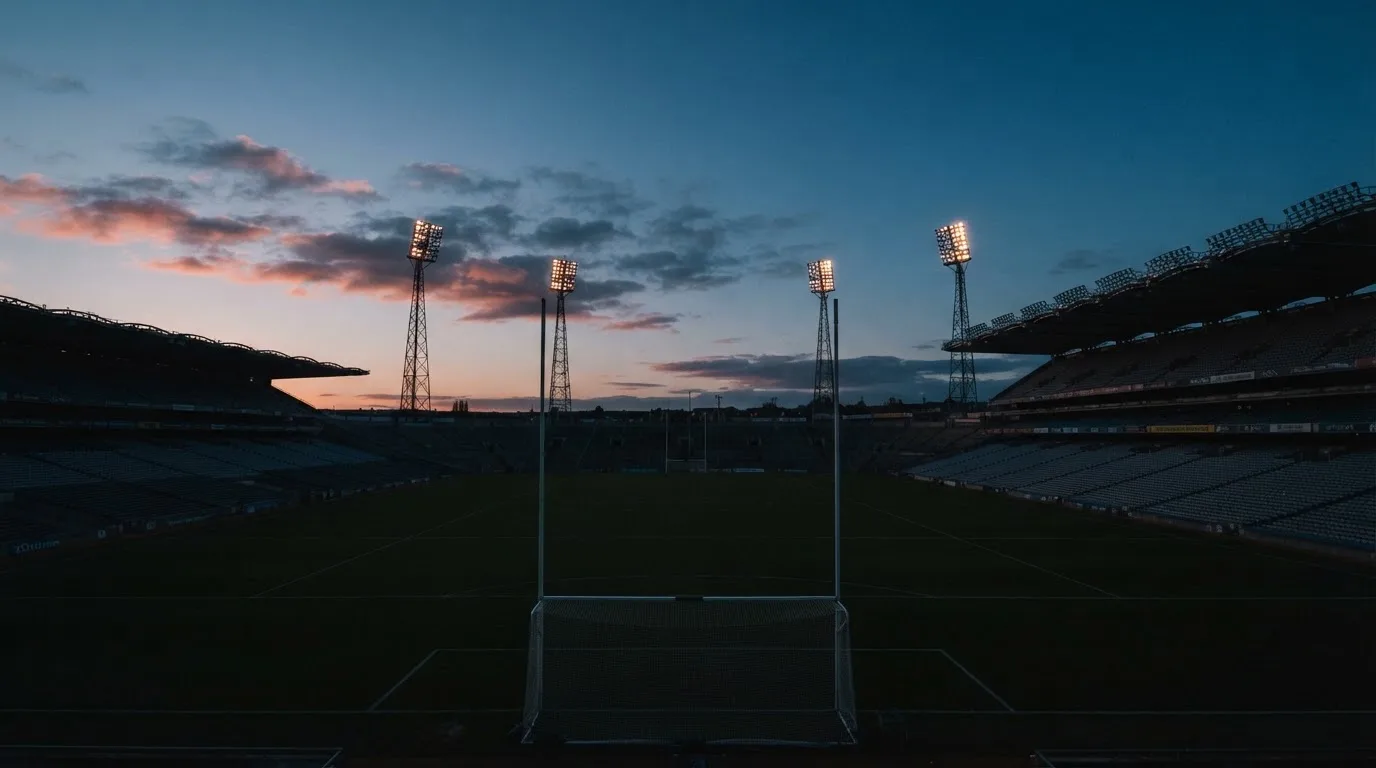
For a bettor, the sport lands inside a sportsbook as a season-long fixture list rather than a weekly league table. The Championship runs from January through to that July final, with provincial championships feeding into the All-Ireland series. League football, run by the GAA through the Allianz Leagues, runs from late winter into spring. Club championships fill the rest of the calendar. On a GB-facing sportsbook the markets are the same shapes you find in any other sport: match result, total points, handicap, goalscorer markets, and the football-specific novelty lines the more committed Irish-facing brands build around county rivalries and trophy progression.
How Live Betting and Cash Out Work on Gaelic Football
In-play, or “live”, betting lets you strike a wager once a match is underway. The price updates as the game progresses, with the bookmaker’s own model adjusting to goals, points, red cards and momentum. On Gaelic football, the score structure makes live markets feel unusual. A goal is worth three, a point is worth one, and a side can close a five-point gap on a single score. Live prices move accordingly: a three-point swing in a tight match can swing a match-result price several ticks in a few seconds. The market depth is also narrower than for Premier League football. Fewer bettors means more price gaps between bookmakers and a wider margin inside every book.

Cash out is the second live instrument. It settles your wager before the match ends, at the current live price, less the bookmaker’s take. If you backed Mayo at 2.50 and they lead by five with ten minutes left, cash out returns a portion of the full payout, locking in a profit at the cost of letting the bet ride. If the bet is going badly, cash out returns less than the stake, sometimes as little as a few pence on a pound. The feature is offered by the larger all-purpose brands and by some of the Irish-facing books; on Gaelic football specifically it is more common pre-match and at half-time than deep into the final quarter, when the bookmaker’s margin in the live price has grown.
What cash out costs is the question the marketing never answers. The bookmaker is paying you out at a price that already includes their margin, not at the true live probability of your original outcome. Cash out on a winning bet is a haircut on the full payout; cash out on a losing bet is a partial mitigation. Either way, it is the bookmaker’s price, not the market’s, and the difference is theirs.
Betting exchanges work differently. A peer-to-peer market, exchange customers back and lay against each other and the exchange takes a commission on net winnings. Matchbook is one such licensed betting intermediary on the GB register. On Gaelic football, exchange liquidity is thin: matches in the All-Ireland series attract enough liquidity to make prices competitive, provincial matches do not. In thin markets, the back price can sit several ticks below a traditional bookmaker and the lay price several ticks above, which is the exchange’s way of paying for the risk the platform carries.
Betting Tips, Forecasts and the Maths Underneath Them
Betting tips for Gaelic football fall into three camps: form and head-to-head records, market-implied probabilities, and the kind of long-form county knowledge a tipster who watches the league week in, week out brings. None of it predicts outcomes. A tip does not move the line in a thin market the way it does in English football, and it does not guarantee a result. What a tip does is frame a question: is this price shorter than the chance warrants, is this handicap generous, is the over/under in line with the scoring pattern of the two counties involved?
Form research starts with the Allianz League table and rolls forward into the Championship. Head-to-head records, particularly in fixtures between traditional rivals, carry weight: recent data suggests Dublin’s return shows in the record books. Championship form at Croke Park is its own line: certain counties’ performances on the bigger stage lift above their league form, and that shift shows up in the prices.
The market side is where the maths sits. A bookmaker’s margin is the difference between what they pay out across all outcomes of a market and one hundred per cent of every pound staked. Take an illustrative two-way market priced 1.90 against 1.90. The implied probabilities are one divided by 1.90 and one divided by 1.90, or about 52.63 per cent on each side. Added together, the book sees 105.26 per cent, and the gap to one hundred is the margin: about 5.26 per cent. That margin sits inside every price you see on Gaelic football, the same way it sits inside the price of any other market on the sportsbook. Lower-margin markets are tighter; higher-margin markets are where the book earns more of every pound staked. Markets priced close to evens, like a County Final in an evenly matched draw, hover near five per cent. Handicap and total-points markets on less popular fixtures move above eight. A wide band, in other words, and the only honest thing to do with the figure is state it as a band with its condition rather than as a single point.
Bankroll management is the part no one wants to hear about. A bankroll is the sum you have set aside for betting, separate from rent and food. Staking a fixed percentage, one to two per cent per bet, smooths the variance of a sport where a single goal swings a price by several ticks. Chasing losses by raising stakes is how small budgets end. A flat stake, a written ledger of bets, and a stop-loss for the session are the discipline behind any staking plan worth following.
Bet Types and How the Odds Settle
The Gaelic football bet types you find on a sportsbook mirror those of any other field sport. Match result, or moneyline, settles on the winner after regulation time. Draw no bet voids on a draw. Handicap, a points spread, settles on the margin. Total points, the over/under line, settles on the combined score. First goalscorer, first scorer, last scorer, and anytime scorer markets settle on the named player scoring during regulation. Each-way betting, the split between win and place, is less common on Gaelic football than on horse racing, and the place portion often pays a fraction of the win price.
Accumulator bets combine multiple selections into one wager. The odds multiply. A fourfold at 2.00, 3.00, 2.50 and 1.80 returns your stake multiplied by twenty-seven, the product of those four prices. The margin compounds, too, which is why an accumulator’s true cost is higher than the headline price suggests: each leg carries the bookmaker’s margin, and the final price carries all of them. Acca insurance refunds the stake, usually as a free bet rather than cash, if one leg loses. Enhanced odds and price boosts are marketing wraps around a price the book has decided to advertise, not a better-than-fair line.
Bet Builder lets you combine markets from one match into a single wager. Mayo to win, over 2.5 total goals, Conor Cansé to score first. Each leg carries its own margin, and the combined price is built by the sportsbook. Betfair’s Bet Builder, bet365’s Bet Builder+, and NetBet’s Bet Builder with instant dynamic odds all offer the same shape of product. The feature is more developed on the larger all-purpose brands than on the Irish-facing books.
Spread betting is a separate market run under Financial Conduct Authority rules on the financial side and Gambling Commission rules on sports spread betting. Sporting Index and Spreadex are the two spread-betting brands on the GB register. In spread betting, you buy or sell at a stated spread, and your win or loss is the difference between the spread and the actual outcome, multiplied by your unit stake. A spread of 28-30 on total match points, buying at 30, pays ten pounds per point over thirty, costs ten pounds per point under thirty. A total-points market in a sport where goals and points routinely produce double-digit totals can mean a stake of a few hundred pounds produces a four-figure win or loss. Spread betting losses can exceed deposits. That is the line every spread-betting terms page carries, and it is the line every bettor on a spread book should read before staking.
Fractional and decimal odds describe the same price in different forms. A fractional price of 5/1 returns five pounds for every pound staked, plus the pound back. The decimal price of the same wager is six point zero zero. To convert a fraction a/b to a decimal, divide a by b and add one. Five divided by one is five, plus one is six point zero zero. Eleven divided by four is two point seven five, plus one is three point seven five. The decimal price multiplied by the stake is the total return, stake plus profit. The fractional price multiplied by the stake is the profit, with the stake returned on top. British bookmakers publish fractional by default; the larger all-purpose brands publish both, and most betting apps let you switch.
Gaelic Games, Tournaments and Where the Fixtures Sit
The Gaelic games betting market is shaped by the GAA’s competition calendar. The Allianz Leagues run from January into spring, with Division One and Division Two football feeding promotion and relegation. The provincial championships, Leinster, Munster, Connacht and Ulster, run in May and June. The All-Ireland Senior Football Championship series begins in late June and runs to the July final at Croke Park. The Tailteann Cup and the Joe McDonagh Cup in hurling sit beneath the senior championship as second-tier competitions. The All-Ireland Club Championship runs the club calendar from county finals through to St Patrick’s Day.
On a GB-facing sportsbook, the All-Ireland series is the most consistently covered. Pre-match markets, match result, handicap, total points, first scorer, and player markets, are available a few days out. Provincial matches attract thinner coverage. League fixtures are covered on the bigger all-purpose brands and on dedicated Irish-facing books, often with reduced market depth. The Tailteann Cup and All-Ireland B fixtures sit on a smaller set of books.
Tournament outrights, the price on which county wins the All-Ireland, the price on which county reaches the final, and the price on top scorer markets, are offered through the Championship. Outright markets carry a longer settlement horizon and a higher margin than individual match markets, because the book is pricing every county’s path rather than a single fixture. Outrights also settle once, at the end of the Championship, which means a stake is committed for months.
Hurling is the GAA’s other field sport. The scoring is the same: three for a goal, one for a point. The hurling season mirrors football’s Allianz Leagues and All-Ireland Senior Hurling Championship, with the final played at Croke Park. The two sports sit together on most GAA-facing sportsbooks, with cross-county, like a Gaelic football and hurling combined price on a county’s double, offered as novelty markets during the Championships. Most GB-facing all-purpose books treat hurling as a minor sport, with limited market depth outside the All-Ireland final.
The Ten Licensed Bookmakers Carrying Gaelic Football
| Brand | Licence & Holder | Key Terms |
|---|---|---|
| Matchbook | 039504-R-319407-024 (Account 39504), Triplebet Limited | Betting exchange, back/lay, in-play, Bet Builder |
| 888sport | 039028-R-319297-014 (Account 39028), 888 UK Limited | Pre-match/in-play, Cash Out, Bet Builder, BetFinder |
| Betfair | 039439-R-319330-013 (Account 39439), PPB Counterparty Services Limited | Sportsbook and exchange, in-play, Bet Builder, streaming |
| Sporting Index | 027343-R-308898-011 (Account 27343), Sporting Index Limited | Fixed odds and spread betting, in-play, auto cash-out |
| NetBet | 039170-R-319343-032 (Account 39170), Netbet Enterprises Limited | Daily/Profit Boosts, Bet Builder with dynamic odds |
| Coral | 054743-R-330863-014 (Account 54743), LC International Limited | Pre-match/in-play, Cash Out, Bet Builder, racing streams |
| Betmaster | 065699-R-339929-002 (Account 65699), BM Solutions GB Ltd | App for football, cricket, racing, NFL, eSports |
| Tote | 054779-R-331321-008 (Account 54779), TDCO Limited | Pool betting, horse racing heritage, Best Odds Guaranteed |
| Kalooki Sportsbook | 057730-R-333396-005 (Account 57730), Kalooki Sportsbook Limited | GAMSTOP member, Ireland-facing brand, GAA-specific marketing |
| BetMGM | 039198-R-319450-029 (Account 39198), LeoVegas Gaming PLC | Pre-match/in-play, Bet Builder, football accumulators |
A bookmaker serving customers in Great Britain must hold a Gambling Commission licence; no other test, no other proxy. The Commission’s public register is searchable by business name, trading name, domain or account number, and it is the source of every licence reference on this page. Every brand below holds a current remote general betting standard licence. The list is not a ranking and is not a recommendation: a place in this comparison is not a licence to do more, it is a licence to be named and assessed on the criteria below. Several brands run under one licence holder, and the page never presents them as independent operators.
Matchbook
A betting exchange on a betting intermediary licence, account 39504, with the licence held by Triplebet Limited. Matchbook customers bet against each other rather than against a bookmaker’s price. Bet Builder, multiples, in-play and live streaming of horse racing and greyhounds are advertised. On Gaelic football, Matchbook’s liquidity is thinner than on Premier League football: the All-Ireland series attracts enough activity to make the exchange competitive, provincial fixtures less so. A backer or layer on the exchange faces a commission on net winnings, not a margin baked into the price. The trade-off is the lower take and the chance of being matched at a price closer to a fair line, at the cost of waiting for the price to appear.
Matchbook suits a bettor who wants to lay as well as back, and who is happy to wait for liquidity on Gaelic football rather than take a bookmaker’s price immediately.
888sport
This operator, 888 UK Limited, holds a remote general betting standard licence, account 39028. Pre-match and in-play markets, Cash Out, Bet Builder, racing streams, BetFinder form tools, a live bet feed and daily boosted odds are advertised. The all-purpose brand covers Gaelic football at championship level, with match result, handicap and total points available on All-Ireland fixtures.
The appeal is the marketing depth: daily price boosts, BetFinder, racing streams, all the boxes an all-purpose GB-facing book should tick. On Gaelic football specifically, 888sport’s market range stays closer to the head of the Championship than to the tail, and deep outright coverage is not advertised.
Betfair
A combined sportsbook and exchange on a remote general betting standard licence, account 39439, held by PPB Counterparty Services Limited. In-play, Bet Builder, free live streaming of UK and Irish horse racing and football within the app, and a 90 Minute Payout market, which refunds stakes on selected football markets if the match ends 0-0 after ninety minutes, are advertised. The exchange side carries the same liquidity profile as Matchbook, with the addition of a sportsbook for bettors who want a bookmaker’s price.
The dual structure is the point: a bettor can take a sportsbook price, take an exchange price, or lay the sportsbook’s selection on the exchange. On Gaelic football, Betfair Sportsbook’s coverage sits at championship level; the exchange’s depth depends on what other customers are doing that day.
Sporting Index
A spread-betting brand on a remote general betting standard licence, account 27343, held by Sporting Index Limited. Customers can switch between fixed odds and spread betting, with in-play, Bet Builder for football, auto cash-out and Multi-Markets advertised. The split-product setup means a bettor on Sporting Index can take a fixed-odds wager, a spread-bet on a stated spread, or a combination. The trade-off is the spread product’s variance: a total-points spread on Gaelic football, where match totals sit in the high teens to low twenties, can produce four-figure swings from a small unit stake.
Spread betting is for a bettor who has read the terms and understands that losses can exceed deposits. The fixed-odds side of Sporting Index behaves like a normal sportsbook, and the in-play and Cash Out features carry the usual sportsbook margin.
NetBet
Operating under account 39170, Netbet Enterprises Limited is licensed for remote general betting. Daily Boosts, Profit Boosts and free bet offers are advertised, with a Bet Builder offering instant dynamic odds and sports stats for major leagues. Gaelic football sits within the all-purpose product, with pre-match markets on Championship fixtures and a thinner offering on provincial and league matches.
NetBet’s edge is the boost-heavy marketing layer: Profit Boosts on accumulators, Daily Boosts on selected markets, free bet offers attached to specific events. A bettor chasing boosted prices will find more here than on a brand that does not advertise boosts.
Coral
LC International Limited manages this site under remote general betting standard licence, account 54743. The sports welcome offer for new GB customers is forty pounds in free bets for a twenty-pound sports bet at minimum odds of 2.0 (1/1), with the free bets issued within seven days and expiring seven days after issue. Pre-match and in-play markets, Cash Out, Bet Builder, racing streams and Best Odds Guaranteed on horse racing are advertised. The brand sits within the Ladbrokes-Coral group under LC International, and the two brands share promotional mechanics.
Coral is a fit for a bettor who wants the all-purpose bookmaker experience with a deep racing product. On Gaelic football, Coral covers the All-Ireland series at championship level with the standard pre-match and in-play market set.
Betmaster
A traditional sportsbook on a remote general betting standard licence, account 65699, held by BM Solutions GB Ltd. The mobile app covers football, cricket, horse racing, NFL and eSports, including League of Legends and Dota 2. Gaelic football is not advertised as a named vertical on the app listing. A bettor on Betmaster should check the football menu for Gaelic games specifically rather than assume the sport is covered.
The gap is the point: a brand whose mobile product is football, cricket, horse racing, NFL and eSports is unlikely to carry the depth on a minority field sport that a dedicated GAA-facing book would. Betmaster suits a bettor whose betting is mostly on the advertised sports and who treats Gaelic football as a one-off, checking the menu before staking.
Tote
A pool-betting brand on a remote general betting standard licence, account 54779, held by TDCO Limited. Tote’s heritage is horse racing, where the brand pools stakes across customers and pays out a dividend rather than taking a fixed margin. On horse racing, the brand advertises Best Odds Guaranteed. On Gaelic football, Tote’s sportsbook covers major events at a level consistent with a GB-facing pool brand’s racing-first heritage. A bettor whose primary interest is Gaelic football will find more on the all-purpose books; a bettor who already uses Tote for racing and wants a single-account setup for both will find the integrated product useful.
Kalooki Sportsbook
A traditional sportsbook on a remote general betting standard licence, account 57730, held by Kalooki Sportsbook Limited, with the company number 12938274. The brand is a GAMSTOP member, as every GB-licensed online operator must be. A smaller, Ireland-facing brand rather than an all-purpose GB sportsbook, with the marketing built around GAA fixtures specifically. A bettor looking for GAA-specific market depth, like county-level props and minor championship markets, will find more here than on an all-purpose book.
The brand is for a bettor who wants a dedicated GAA book rather than a GAA tab on a Premier-League-first sportsbook. Market depth and liquidity on a smaller brand are narrower than on the larger names, and prices may sit wider as a result.
BetMGM
A traditional sportsbook on a remote general betting standard licence, account 39198, held by LeoVegas Gaming PLC. The sports welcome offer for new UK customers depositing ten pounds or more and placing a sports bet within seven days is four ten-pound free bets: two football accumulators of four selections or more and two sports multiples of two or more, valid for seven days with minimum odds and opt-in required. Pre-match, in-play, Bet Builder, and the broader BetMGM product portfolio are advertised. Gaelic football is covered as part of the all-purpose sports menu, with depth at the Championship level.
BetMGM is for a bettor who wants the welcome offer structure of a larger brand with the LeoVegas-platform tech underneath. The sports welcome offer is more granular than Coral’s flat forty-pound free bet: the four free bets are split by bet type and carry their own qualifying conditions.
The Regulatory Frame Around Every Bet
The Gambling Commission is the regulator for the commercial gambling market in Great Britain. It is a non-departmental public body sponsored by the Department for Culture, Media and Sport, and it licenses operators under the Gambling Act 2005. Northern Ireland is outside the Act and runs under older law, so a GB licence is not a Northern Ireland licence. Since the Gambling (Licensing and Advertising) Act 2014, an operator whose remote facilities are used in Great Britain needs a Commission licence wherever it is based. A Curaçao, Maltese or Gibraltar licence is not a substitute for a GB licence at the point of consumption. There is no state monopoly, no statutory cap on the number of licences, and no statutory list of permitted sports or markets.
Betting licence types fall into five categories on the register: remote general betting standard (real events), remote general betting standard (virtual events), remote general betting limited, remote pool betting, and remote betting intermediary, the licence for betting exchanges. The Commission’s public register is searchable by business name, trading name, domain or account number, and it is the whole test of whether a brand holds a licence. Licensed operators use both .com and .co.uk domains; the domain proves nothing on its own. No single brand is the only licensed one.
Minimum age for gambling in Great Britain is eighteen. Identity verification, name, address and date of birth, has been mandatory before a customer can deposit or gamble since 7 May 2019, including with a free bet or a bonus. Credit cards have been banned for gambling in Great Britain since 14 April 2020, and that ban covers credit-card-funded payments through an e-wallet. Debit cards and bank-based payments are not covered by the credit-card ban. There is no statutory cap on stakes in sports betting: operators set their own maximum stakes and may restrict individual customers.
Betting winnings in Great Britain are not taxed at the player’s end. General Betting Duty is the operator’s tax on gross profits, currently fifteen per cent; from 1 April 2027 a new remote betting rate of twenty-five per cent applies within it, while remote bets on UK horse racing, self-service betting terminal bets, pool betting and in-person betting stay at fifteen per cent. Until 1 April 2027 the remote rate stays at fifteen per cent, and whether operators pass the duty through into odds is not established. A professional gambler should ask HMRC or a tax adviser.
The player-protection framework sits on top of the licensing frame. GAMSTOP is the national multi-operator online self-exclusion scheme and a mandatory licence condition for online operators since 31 March 2020. Exclusion periods are six months, one year, five years, or five years with auto-renewal, and after the minimum period the exclusion stays in place for a further seven years unless the customer asks GAMSTOP to remove it. The financial vulnerability check, a public-record check on bankruptcy or county court judgments, applies to licensed remote betting when a customer’s deposits minus withdrawals exceed £150 in a rolling 30 days, in force since 28 February 2025. Financial risk assessments, the affordability checks of the press coverage, are announced in a staged plan with no start date.
Deposit limits are mandatory under the Commission’s Remote Technical Standards, with the first changes applying since 31 October 2025 and a second phase postponed to 30 September 2026; whether that second phase is live is not established. There is no state-set deposit or loss ceiling for betting: limits are the customer’s choice within the framework the operator sets.
Offshore is a different frame. Providing gambling facilities in Great Britain without the licence the Act requires is an offence under section 33 of the Gambling Act 2005. The offence is aimed at the operator: on summary conviction, up to fifty-one weeks’ imprisonment, a fine up to level five, or both; six months in Scotland. No offence aimed at a customer who merely bets on an unlicensed site was found. What an unlicensed site lacks is the protection: no GAMSTOP coverage, no Commission complaints route, no approved dispute-resolution body, no British consumer redress if funds are withheld, and not bound by the 10x bonus cap or the £150 vulnerability check. Enforcement against unlicensed operators is disruption rather than blocking: cease-and-desist notices, search-engine referrals, work with registrars, hosts and payment providers. The Commission has been given, or is about to receive, court-order DNS blocking powers, but ISP blocking is not in operation as a standing policy.
Responsible Gambling: What a Licensed Operator Must Carry
Every GB-licensed online operator must offer GAMSTOP, deposit limits, time-outs, and self-exclusion at the customer level. The licensed operator carries the responsibility for the safer-gambling tools on its site; the customer decides whether to use them. The national support services are GamCare, which runs the National Gambling Helpline, GambleAware, the NHS gambling clinics network, and Gamblers Anonymous. Fitzwilliam Sports, for example, advertises instant deposits, fast withdrawals, timeouts and deposit limits alongside links to GambleAware, GamStop and Gamblers Anonymous, the kind of safer-gambling surface every GB-licensed operator should carry.
The financial vulnerability check is one piece of the framework: a public-record check rather than an income check, applied when deposits minus withdrawals exceed £150 in a rolling 30 days. The check is not a credit reference check; it looks at publicly available financial distress markers. A customer whose deposits stay below that threshold does not trigger the check. A customer whose deposits exceed it should expect a public-record check at the next deposit or at the rolling-thirty-day point, depending on the operator’s implementation. The financial risk assessments, sometimes called affordability checks, are a separate layer, announced in a staged plan with no start date, and will, when in force, look at spending patterns rather than public records.
A punter who finds the session has stopped being entertainment has the safer-gambling tools to walk away. GAMSTOP excludes from every GB-licensed online operator for the period chosen. Time-outs pause the account for a shorter window, twenty-four hours, a week, a month. Deposit limits cap how much can be staked in a day, a week or a month, and a punter can set the limit lower at any time, though raising it carries a cooling-off period. Self-exclusion at the operator level pauses the single account. The layers stack.
The terms on safer gambling on a GB-licensed operator are not optional. The licence conditions and codes of practice, the LCCP, set out the operator’s duties, and the Commission’s enforcement record on safer-gambling failures is published. An unlicensed site carries none of these protections, and the customer on an unlicensed site has no British consumer redress if funds are withheld, no approved dispute-resolution route, and no GAMSTOP coverage. The licensed-versus-unlicensed frame is a frame about protection rather than legality: a licensed site costs more in margin but offers the safer-gambling surface; an unlicensed site offers neither.
Crypto, Anonymity and the Limits of Pseudonymity
Great Britain has no statutory bar on cryptocurrency deposits at gambling operators, but no licensed GB operator is known to advertise cryptocurrency as a deposit method, and the credit-card ban does not cover crypto on its face. The licensed-operator reality is debit cards, bank transfers and a regulated set of e-wallets, with verification before the first deposit. There is no anonymous play at a licensed site: identity verification is mandatory before a customer can deposit or gamble, including with a free bet or a bonus, and source-of-funds questions at higher spend are normal under the money-laundering rules. A British named-account rule, a state list of permitted payment methods and any rule for or against cryptocurrency deposits at licensed operators are not established: payments are described qualitatively from each operator’s terms.
The unlicensed offshore market is a different frame. Some offshore operators do accept cryptocurrency and do not verify identity, running instead on a wallet-based model where the wallet is the account. The trade-off is the protection loss already described: no GAMSTOP, no Commission complaints route, no British consumer redress, no bonus cap, no vulnerability check. The bettor on an unlicensed crypto book has speed and pseudonymity; the bettor on a licensed book has the safer-gambling surface and the British consumer-protection backstop. Neither frame is “the safe choice” by default.
What crypto does to a price is a separate question. Crypto-funded bets on offshore books settle in the same decimal or fractional odds; the funding method does not change the price. The exchange rate between crypto and sterling is the bettor’s exposure on top of the wagering exposure, and that exposure is not hedged by the bookmaker. A bettor funding a sportsbook account in Bitcoin carries the position that the wagering outcome and the Bitcoin-Sterling rate both have to land in the same direction for the bet to be a net win in sterling terms.
Bonuses and Free Bets: What the Marketing Word Costs
A “free bet” is a marketing word, and the marketing word usually does not mean what it sounds like. A Coral-style offer of forty pounds in free bets for a twenty-pound sports bet at minimum odds of 2.0 issues the forty pounds in free bets after the qualifying bet settles. The free bets expire seven days after issue. The stake is usually not returned with a winning free bet: a ten-pound free bet at 3.0 returns thirty pounds, the profit only, with the ten-pound stake forfeited. A BetMGM-style offer of four ten-pound free bets, two on football accumulators of four selections or more and two on sports multiples of two or more, splits the offer by bet type, and each free bet carries its own qualifying conditions and minimum odds.
The promotion rules in force since 19 January 2026 cap wagering requirements on bonuses at ten times: a ten-pound bonus at 50x needs £500 of bets; under the cap, no more than £100. Mixed-product promotions, an offer that requires gambling on two or more product types such as betting, casino, bingo and lottery, are banned. Whether the cap applies to free bets with no wagering condition, and any cap on the money value of a bonus, are not established. The marketing word on a free bet is “free”; the cost is the forfeited stake, the expiry clock, and the qualifying bet.
A welcome offer is a marketing cost, and the operator’s marketing cost is the bettor’s time and discipline. The qualifying bet has to land for the free bets to issue, and the free bets have to be used inside the expiry window. A bettor who plans to bet on Gaelic football anyway can take the welcome offer on its merits; a bettor who places a qualifying bet specifically to unlock free bets is paying the qualifying stake to enter a marketing promotion. The free bet itself pays profit only, and the profit has to clear at minimum odds, often 2.0 or higher, which rules out the most popular Gaelic football markets, the short-priced favourites.
The arithmetic of a free bet is straightforward. A ten-pound free bet at odds of 4.0 returns thirty pounds, the profit of thirty on a stake of zero, because the stake is not returned. The expected value of that free bet is the profit multiplied by the payout share of the market, the inverse of one plus the margin. A market with a five per cent margin has a payout share of about 95.24 per cent; the expected value of a ten-pound free bet at 4.0 on that market is thirty pounds multiplied by 95.24 per cent, or about £28.57. The bookmaker’s free-bet offer is worth roughly the free-bet amount multiplied by the expected payout share, less the qualifying bet’s expected cost in margin. The marketing word is “free”; the cost is the qualifier, the expiry, the forfeited stake and the margin on the qualifying bet.
Accumulator insurance refunds the stake, usually as a free bet rather than cash, if one leg of an accumulator loses. The refund is capped at a stated amount, often £10 or £25, and the offer is on specific leagues, specific bet types, and specific minimum numbers of selections. A punter who takes acca insurance on every accumulator is paying the qualifying-bet margin for the insurance; a punter who takes it on one big-priced accumulator is hedging a tail outcome. The maths depends on the price and the length of the accumulator, and the underlying offer terms carry the calculation.
Price boosts and enhanced odds are the same marketing shape: a price the book has decided to advertise higher than the underlying line. The boost is real money if it lands, paid at the boosted price rather than the underlying price. The cost is the underlying line, which the book has set with the boost in mind, and the margin inside that underlying line. A bettor who always takes the boost rather than the underlying line is paying the bookmaker’s framing of the event.
Cashback offers return a percentage of net losses over a stated period as a free bet or as cash. The cost is the qualifying period’s losses, which the bookmaker has set the cashback against, and the cashback’s expiry if it is paid as a free bet. Cashback as cash, which is rarer, is the cleanest form of the offer: the bookmaker returns a slice of the losses without a further wagering requirement. Cashback as a free bet is a marketing wrap on the same offer.
Frequently Asked Questions
How do I bet on Gaelic football?
Find a GB-licensed bookmaker on the Gambling Commission’s public register, open an account, complete identity verification (name, address, date of birth) before depositing, fund the account by debit card or bank transfer, navigate to the Gaelic football menu, and select a market. Match result, handicap, total points and first scorer are the standard pre-match markets on the All-Ireland series; provincial and league fixtures carry thinner coverage.
How can I check that a bookmaker holds a Gambling Commission licence?
Search the Commission’s public register by business name, trading name, domain or account number. The register lists every licence holder, the licence categories, and the licence status. A brand named on this page can be checked by its account number on the register; a brand not on the register is not licensed for Great Britain.
How is the return on a bet worked out from the stake and the odds?
Multiply the stake by the decimal odds. The product is the total return, stake included. Subtract the stake from the return and the difference is the profit. A ten-pound stake at 3.0 returns thirty pounds, with a profit of twenty. A combination bet’s odds are the product of the legs’ odds; a fourfold at 2.00, 3.00, 2.50 and 1.80 returns the stake multiplied by 27.0.
What is the bookmaker’s margin and how does it show in the odds?
The margin is the difference between the sum of implied probabilities across all outcomes of a market and one hundred per cent. Take an illustrative two-way market priced 1.90 against 1.90: implied probabilities of about 52.63 per cent on each side, summing to 105.26 per cent, and a margin of about 5.26 per cent. The margin sits inside every price on the sportsbook; lower-margin markets are tighter, higher-margin markets are wider. State the figure as a band with its condition rather than as a single point.
How do fractional odds such as 5/1 convert to decimal odds such as 6.00?
Divide the numerator by the denominator and add one. Five divided by one is five, plus one is 6.00. Eleven divided by four is 2.75, plus one is 3.75. The decimal price multiplied by the stake is the total return; the fractional price multiplied by the stake is the profit, with the stake returned on top of the profit.
Which safer-gambling tools does a licensed bookmaker have to offer?
GAMSTOP self-exclusion at the multi-operator level, operator-level self-exclusion, time-outs, deposit limits, reality checks and access to the National Gambling Helpline via GamCare, to GambleAware, and to NHS gambling clinics. The licensed operator must offer these under the LCCP, and the licensed-versus-unlicensed frame is largely a frame about whether these tools are present.
Rugby, cricket & Gaelic – Boxing betting
Content created by the «Boxing betting» team
